December 27, 2008

Drink Ovaltine to Wake Up Gay


When I lived in Detroit, the attic of the house I lived in was full of old magazines. My mom took 3 of them, one of which was from the month that she was born. My brother-in-law's brother was over for Christmas and was thumbing through the magazine when he noticed an ad that promised to help him "Wake up Gay." Everyone got quite a kick out of it, so I scanned the page and thought I'd post the whole thing here.

December 4, 2008

Steve Jobs 2005 Stanford Commencement Address


Rogerio posted this, this morning (with Portuguese subtitles) and I thought it was excellent. (It's similar to "The Last Lecture".)

Ironically, it struck me that his 3 main points jived quite a bit with what we've been studying in our gals' Bible study. (We're reading through the book Peacemaking Women -- which isn't a traditional Bible study by any means, but it's still full of Scripture and is absolutely fantastic in terms of learning to love and forgive others.) I'm hoping, at some point, to tie Steve's thoughts to Tara and Judy's (perhaps on dandelion wine - now called Whispering Weeds) and if I do I'll post a link here.

November 24, 2008

My Martin Luther King Jr., Senior High School teacher days


I always got a kick out of the name of the school. Since MLK was a junior, but the school is a senior high school, they'd write out (and say) his whole entire name, but they'd add the senior bit in there lest anyone think we were a junior high school. ;-)

You can see the gold suit in all its glory, and more students pics, and another suit my grandmother sent (orange), in my Detroit photo album.

November 16, 2008

Easy No-Knead Whole Wheat Bread

Description:
This recipe is from the More-with-Less Cookbook (put out by the Mennonites). Rob has been using a Joy of Cooking recipe to make bread every once in awhile but he couldn't get it to rise properly. He tried this recipe yesterday and the bread rose wonderfully and tastes delicious!

Ingredients:
3 c. whole wheat flour
1/2 c. sugar
2 T. salt
3 pkg. dry yeast
2 c. milk
1/2 c. oil
2 eggs
5-6 c. more flour

Directions:
Combine the 3 cups of flour, sugar, salt and yeast. Heat 2 c. water along with milk and oil in a saucepan until warm. Combine dry ingredients, warmed liquids and 2 eggs. Beat at low speed until moistened. Beat for 3 minutes as medium speed. Stir in by hand 5 - 6 cups additional flour.

Use enough flour to form a stiff batter. Cover and let rise until double. Stir down and spoon into 2 greased 9x5" bread pans. Let rise 20-30 minutes. Bake at 375° F for 35 - 40 minutes.

Tastes great with butter and honey slathered on top.

Double Chocolate Snack Cake

Description:
This recipe is from Betty Crocker's 40th Anniversary Edition Cook Book. The problem with "upgrading" from one cook book to another is that the new version might not have all your favorite recipes from the old one. So this is one of those recipes that I can't find in the new BC cook book. (I think it's in there, but it's hidden within another cake recipe.) As I transfer cook books, I'm hoping to get all of my old favorites listed here so they're easy to find.

I like using this snack cake when I make a trifle (which Melanie got me hooked on. I'd never heard of a trifle before she posted a lavish photo spread of one she made.) The cake tends to be a bit dry on its own.

Ingredients:
1 2/3 cups flour
1 cup packed brown sugar
1/4 cup cocoa
1 teaspoon baking soda
1/2 teaspoon salt
1 cup water
1/3 cup vegetable oil
1 teaspoon vinegar
1/2 teaspoon vanilla
1/2 cup semisweet chocolate chips

Directions:
Heat oven to 350° F. Mix ingredients together and pour into an 8x8x2 in. pan. (The directions say to hold back the chips and sprinkle them on top, but I've also made it where I've just mixed them in. Bake 35 to 40 minutes or until wooden pick inserted in center comes out clean. Cool, sprinkle with powdered sugar or slather jam on top as I do.

I've also made this where I sprinkled chocolate and peanut butter chips on top. (As pictured.) The only problem with this is that the cake is really too dry without something custardy poured on. But once I put the peanut butter chips on it looks done and I tend to skip the custard.

September 21, 2008

House Kitty


One day Mr. Tibbs decided to check out my doll house. The kitchen seems to fit him nicely.

August 3, 2008

Robo-kitty


This is Mr. Tibbs in full battle gear (made by Nathan Inc.).

July 9, 2008

Half Indian / Half Mexican -- James Luna


I just saw this picture in the Denver Art Museum mag. I thought it was very cool. If you check out James Luna's website there's some other very cool stuff there as well.

(Sorry the pic is so grainy. It's much clearer in the Museum magazine.)

Here's a bit of the blurb from the mag: "The self-portrait was intended to confront people's expectations about ethnicity. It is Luna's response to the prejudices about his mixed American Indian and Mexican heritage, and questions about who is a 'true Indian'."

July 4, 2008

Blechkuchen

Description:
This is a recipe straight out of the More-with-Less Cookbook, a cookbook put out by the Mennonite Central Committee. This was the first cookbook that I ever sat down and read like a book. They have great sections for each chapter describing ways to stretch a dollar and still eat well and thoughts on global hunger issues.

The cookbook has this to say on Blechkucken: "Traditional among Prussian Memmonmites when guests come for Sunday afternoon coffee. "Blech" is a large baking pan."

For awhile Rob couldn't remember what this was called and termed it "Blawken snawken." He's been making it regularly lately. It's great with some rhubarb thrown in.

Ingredients:
(listed below)

Directions:
Scald and cool to lukewarm
3 c. milk
Stir together to dissolve:
2 pkg. dry yeast
1 c. warm water
Combine in large bowl:
lukewarm milk
1 1/2 c. soft shortening or lard (we just use butter)
1/2 c. sugar (we use sucanut)
4 t. salt
1 egg
6 c. flour
Beat well until dough is smooth and satiny.
Stir in:
1 c. raisins combined with
3/4 c. flour
(and some chopped up rhubarb or other dried fruit if you have something you want to get rid of)
Cover and let rise in a warm place until doubled. (Rob says he usually lets it rise 1 hour. But this morning the kids were so hungry that he cooked it without letting it rise and according to Nathan, "Wow, Papa! This is the best blechkucken you've made, ever!") With back of spoon spread dough thinly onto 2 greased 10x15" cookie sheets. Brush generously with melted butter and sprinkle with sugar (we use brown sugar here -- Rob mixes the butter and sugar together and dollops it on top, making pockets of super yumminess!)
Bake 20 minutes at 375ยบ.

(Recipe from Elsie Epp, Marion, S. D.)

June 4, 2008

Update on my dad -- Picks Disease: year 13 or so

This is an excerpt from a letter I wrote today:

My dad continues to get worse.  For a long time he seemed to stay about the same.  He was more active in the summer and a bit easier to deal with in the winter, but from year to year it seemed like he was stuck at a point where he could converse and do various activities, he just couldn’t remember very well and he occasionally did embarrassing things (like comment on how fat someone was within hearing distance).  But in the past two years there’s been a sharp decline to the point where now he hardly speaks.  He can read almost anything, but spontaneous speech is pretty much limited to a few lines.  (“Let’s go out the front door,” being the one that I hear the most often.)

My mom sends him to adult day-care twice a week.  They’re really good with him and it gives her a breather.  She really should have sent him more often when he was harder to deal with, but any break, even now, helps.

He walks A LOT.  You can walk in a circle at my mom’s house through the kitchen, the dining room, and the living room then back to the kitchen.  Pretty much my dad just walks in that circle from the time he gets up to the time he goes to sleep.  A couple years ago he went through a phase where he ate everything in site (including food in front of other people and dog or cat treats that were left around).  He gained a lot of weight and went up several pant sizes.  Well now he’s lost all of that weight and is even thinner than my mom ever remembers him being.  Something about the dementia makes him agitated and he just walks and walks and walks.  If he sits down, it’s only for a few seconds and then he pops right back up again to walk around some more.

If you ask him a question, he’ll look at you for a few seconds, and then continue doing whatever he was doing before (most likely walking).  As recently as 6 or 8 months ago he was able to answer a question such as “Who am I?”  but not any more.

It’s difficult getting him to eat anything.  If cookies or candy are sitting out, he’ll grab something to eat and munch while he’s walking.  Lollipops are particularly favored, although he’ll chew the stick when the candy is gone, so you have to watch and remove the stick when he’s reached the end.  But getting him to sit down at a table and eat is very hard to do.  Often you have to hand him a plate of food and he’ll take a bite while walking.  Then he sets the plate down and you have to get it and hand it to him again on his next pass through.

But while he’s clearly getting “worse,” he’s also getting better in the sense that he’s easier to deal with.  Whereas before he’d ask questions almost non-stop, now he hardly talks and when he does it’s quieter and not insistent at all in the way that it used to be.  He’s pretty gentle and complacent (other than needing to walk like crazy).

He’ll most likely eventually lose the ability to speak at all, even to read.  Sometimes he leans when he walks, so obviously something is taking place physically, but it’s hard to tell what’s going on when he can’t tell us anything.

The plan is to try to take care of him as long as we can on our own and only put him in a nursing home when it’s too hard to care for him.

The picture is of my dad after I picked him up from daycare where they had been celebrating Mardi Gras.

February 10, 2008

blue vinyl: the world's first toxic comedy

Rating:★★★★★
Category:Movies
Genre: Documentary

A few years back we somehow managed to get on the phone lists of several local window companies who wanted to give us a great deal on new vinyl windows. I hate telemarketers, especially telemarketers who want to sell me something I don't need and didn't ask for. But, being little Meg, meek and mild (stop laughing, Rob), I often listen to a telemarketers schpiel before politely declining. The vinyl window people put me over the edge, though. Not only hadn't I asked for them to call me, but when I politely said no, they started getting pushing. So that's when I pushed back. I would rant and rave about how bad PVC (Poly Vinyl Chloride) is for the environment. I'd blather on about how it's the worst form of plastic in the world today and that there's no way I'd put it on my house.

But the truth of the matter was that I really didn't know squat about PVC. I'd heard that it was a big baddy, but I didn't know why. So when I saw the documentary blue vinyl at the library, I jumped at the chance to find out more. (We're also going to have to order windows soon, so I figured this would help me decide just how much I really want to go through the drama of avoiding vinyl. Based on what the telemarketers said, vinyl appears to be fairly ubiquitous in new windows.)

Blue vinyl is the story of Judith Helfand and her parent's house. When the wood siding on the house started to rot, they decided to replace it with vinyl siding. Judith, a victim of DES related cancer whose ordeal led her to become hyper sensitive to the issue of toxins and their interaction with humanity, decided to do a little research on vinyl. The documentary covers about 5 years of research and explores not only the problems with PVC (including the number of PVC plant workers that have died from exposure to the product, but also the cover-ups by both European and American companies regarding the dangers), but also the search to find an alternative house siding that would be both affordable, and meet with Judith's mother's approval.

I felt like the documentary was very well done. As a viewer, I felt that I was being drawn into an exploration that wasn't already pre-determined. Though Judith started out with obvious concern about the product, she also started with ignorance as to the dangers, and she walks the viewer through her own thought process as well as through the information that she discovers in a clear and orderly way that helps the viewer feel like a partner in discovery rather than a voyeur in anger (a feeling Michael Moore's "documentaries" always leave me with). In the end, Judith's parents, who were very clear in the beginning that they thought she was being rather foolish to be concerned about the vinyl, decided to take the siding off their house and replace it with something less toxic.

I would definitely recommend this movie. It has it's funny moments, as well as it's tragically sad points. I feel like I have a much better sense of the problems with PVC after watching blue vinyl, and I have a renewed plan to research all-wood windows to install in our house.

September 18, 2007

Picks Disease - Aphasia and Leaning (to the left)

This past August marked the 6 year anniversary of our move to Colorado to help my mom cope with my dad who has Picks disease.  When we first moved, we assumed that we would be here two years, three at most.  We were told upon diagnosis that my father would most likely only live another 6 years from that point. (He was diagnosed in the spring of 2000. The disaster of Y2K came for us in the form of a disease rather than a coding glitch.)  But the 6th anniversary of his diagnosis has not only come and gone, but physically, my dad's health has remained quite strong.  He continues to be active, walking as much as 5 hours a day.

For several years, friends would ask how my dad was doing.  I'd shrug my shoulders and say, "He's about the same."  It was a disappointing answer to be sure -- disappointing on my end because, though things never got better, they never got worse either, meaning the end was still a long ways off; disappointing on my friends' end because I could tell by the tone of their voice that the lack of "events," tragic moments that I could cling to tearfully as signs of my dad's descent towards death, meant they were beginning to doubt if there really was anything wrong at all.  In fact, when my friends saw my dad, he looked not only fine, but quite healthy.  It wasn't until they talked to him that they might think him odd.  But it was only if they'd known him before the disease that they'd have a true sense of the change that had befallen him.  (For a taste of what it as like to spend a minute with him during that time, see my post, One Minute with Picks Disease.)

But this past year there has been a noticeable difference in my dad.  He does less (no more picking up coins in parking lots, moving pictures around on the walls, or doing dot-to-dots) and paces more (activity without productivity -- not that his previous actions were all that productive).  He nervously rubs his thumbnail across his pointer finger to the point where he's worn a groove in his finger.  He's confusing our names more often.  (He knows I'm Meg, but he doesn't seem to know what our relationship is.  And my mom has become his mom, even when his mother is in the room with them.) 

He's also, oddly enough, started to lean.  He doesn't always lean.  In fact, it only seems to happen a few times a week, most often when he's walking around my block.  But he'll round the bend and there it is, he's leaning to the left.  He doesn't seem to notice.  And after awhile he straightens back out.

And he's becoming increasingly silent, entering into the aphasia stage of the disease.  Some people with Picks hit this stage straight out, losing their ability to speak before they even begin to lose memory or ability to reason. But for my dad it's been gradual, sneaking upon us so stealthily, that when it finally dawned on us that he was losing language, he had already been reduced to about 500 words.  I don't know that he even understands most of what we say.  When asked a question, he will most often either ignore it, or nod his head and say "yes" before walking away.

Oddly enough, despite the fact that he's lost reason, memory and language, he has retained mechanical ability.  When I picked him up from day care yesterday, he was in the yard behind the building and the fence had a clip that kept the gate from opening.  There was another gate that wasn't locked, so I directed my dad toward it, but while I was busily gesturing and explaining, he walked right over to the closest gate and figured out how to undo the clip that was locking the latch.  He walked out without a word and headed straight to my car.  Before slipping into the passenger's side seat he muttered vaguely, "Let's go shopping, Meg," one of his few remaining phrases.

September 13, 2007

Redeeming Creation: The Biblical Basis for Environmental Stewardship

Rating:★★★★★
Category:Books
Genre: Nonfiction
Author:Van Dyke, Mahan, Sheldon and Brand

The creation, including the earth, is not to be well treated because it is sacred or because it should be worshiped, but because God made it and called it good (Genesis 1), and its goodness is independent of human utility.
-- Redeeming Creation


Caring for the environment is a moral issue. How we interact with the world around us, not just with other people but with the stuff of the earth, is not a matter of right, but of responsibility. That, at least, is the premise of the book Redeeming Creation, coauthored by Fred Van Dyke, David C. Mahan, Joseph K. Sheldon, and Raymond H. Brand. The authors believe that without a solid ethical foundation underpinning our behaviors, as well as the policies put in place to police these behaviors, we'll find that we're talking one way and walking another. The book explores various ethical foundations that have been proposed to support environmentalism, then proceeds to test those foundations as well as the logical end points that they lead to. They conclude that the only solid ethical construct is one which includes God as creator, sustainer, and redeemer.

Ethics -- do we Value ecology?

In order to treat the environment as though it has value, one must first believe that it does. What gives it value is at the heart of any environmental ethic.

To get to the root of this issue, the authors drive all the way back to creation. They explore several ancient creation stories, focusing primarily on those of the Near East. They tease out the distinctions between the stories of the Babylonians, Mesopotamians, Greeks, and Hebrews and distinguish the purposes presented in each story for the creation of both Earth and those that live upon her sphere. They also address the more modern creation story of evolution as well as touch upon other spiritual attributions of value (such as those arising from pantheism and pan-psychism).

In the end they determine that many modern day valuation systems put mankind as the determining instrument of measurement, to which they conclude, “The making of humanity into the measure of all use and value must, in the end, be accompanied by a blatant disregard for nonhuman life.” They flesh this out with examples of policy and practice in the National Parks of the United States, showing that what sounds like a reasonable environmental practice at the outset often ends up doing more harm than good.

Theology -- where's God on ecology?

Believing that a Biblical view of God is at the heart of a sound ethic regarding ecology, the authors proceed to flesh out the theology that underpins that ethic. Much of what they have to say carries a distinct flavor of Schaefferian thought (as outlined in Francis Schaeffer's book, Pollution and the Death of Man). The authors neatly and clearly flesh out several ideas that Schaeffer comparatively only glanced across: God is transcendent, God has called all creation "good" (thereby giving it value), humans are inseparably linked to creation, mankind is fallen (and this affects creation), and God has made a covenant of redemption not only with mankind but with all of creation.

Though many ancient creation stories tell of gods who fashioned the earth out of the stuff around them (or in some cases, out of the flesh of other gods), only the Hebrew God created the world out of nothing that had existed before. He remains separate from creation (transcendent), and creation gains value not because it is made of the flesh of god, but because God said it was "good." God ascribed value to creation. God said each part was good.

[As an aside, I'd like to point out that this is critically important theology in terms of getting Christians to think positively about the environment. Many Christians that poo poo environmentalists as a bunch of hippie tree-huggers have an underlying belief that caring for the environment means ascribing value to created things because they have inherent value. In other words, they fear that being an environmentalist means assenting to the belief that plants and animals (etc) have value because they contain spirits themselves (animism) or because they are a part of a greater being (pan-psychism - the Universe is sentient) or because they are spirits in their own right (pantheism). Many Christians refrain from addressing the issue of the environment entirely because they are fearful that these non-Christian belief systems are the only reasons one would care for the environment. Reminding them that God is distinct from creation, but has ascribed value to it, is an essential piece in helping Christians (especially older Christians who lived through the "hippie era") see that environmentalism is a God issue and not a domain reserved only for hippies and tree huggers.]

When God made people, he made them from the stuff of the earth, from the dust of the ground. Humans are inseparably linked to creation, not just because they are created beings along with the rest of creation, but because they were fashioned out of the very earth itself. [Again, notice that not even humans were made from the stuff of God, but the stuff of earth. Even humans don't have inherent value, but rather their value comes from God who said they were "good."]

But, according to the Biblical record, mankind fell; they sinned against God. Because of this, not only mankind has suffered, but all of creation as well. There's an interesting passage in Isaiah that reads, "The earth lies polluted under its inhabitants; for they have transgressed laws, violated the statutes, broken the everlasting covenant. Therefore a curse devours the earth, and its inhabitants suffer for their guilt." (Isaiah 24)

But God has brought about a new covenant, one that not only brings healing to humans, but to the earth as well. God is redemptive and though the Bible is very clear about the redemption brought to mankind, it is also clear that, "God was pleased to reconcile to himself all things, whether on earth or in heaven, by making peace through the blood of his cross." (Colossians 1) And, the authors point out, God has called his people, who he has redeemed, to be agents of redemption themselves, not only to other people but to all of creation. As stewards of God's creation, they are not to abuse the land and its inhabitants, but as Jesus washed the feet of his disciples, exemplifying for them a servant leadership, so too are God's people to be servants of God's creation, caring for it as stewards for its true owner.

Response -- individual and corporate responses to ecological problems

In order to recommend a response to the environmental ills of our age, the authors first described the problems at issue. They organized these into three main categories: 1) population, 2) consumption vs. sustainability and 3) pollution and waste -- the second two being aggravated by the growth of the first. They explore the Biblical record, the historic record, and the evidence we can see today, all of which point toward mankind being behind many of the ills under which the earth currently groans. And we also suffer, along with the rest of creation, as a result of these ills. The consequences are ecological, medical, economic, cultural, and aesthetic.

From there they address what they believe are appropriate Christian responses at an individual level as well as from the corporate levels of families and churches. They even address a national response, specifically in terms of public policy and private-property law.

As individuals, we need to seek information in order to keep abreast of the issues. We should be interacting with nature in order to keep a personal relationship with it. And we should be willing to take sacrificial steps to deal with environmental issues. As families we can make decisions regarding heating, vacations, and transportation, among other things, that can make a corporate difference. Within churches we can be teaching a Biblical view of creation as well as using our buildings and yard space in a way that is both environmentally sound and physically appealing to neighbors.

At a national level, the authors believe the Forest Service is an important outward expression of public environmental policy. They list several problems within the service in recent years, and challenge forest service workers to put the needs of nature before chances for advancement (in cases when the two are in conflict). And some private-property laws need to be re-addressed, they say, as unfair negative burdens are placed upon the masses while positive monetary rewards are reserved for the private land owners. (A quick example is the rewards to the property owner of a gold mine and the negative affects to all those downriver as dangerous chemicals are dumped into a city’s water supply as a result.)

Redeeming Creation

The authors are firm, clear, and concrete in their arguments. They're honest about some of the abject failures that the church has perpetrated upon the environment, but they are of great hope that only a sound Biblical ethic can address the environmental problems that humanity faces in this day and age.

I was impressed with both the breadth and depth of this book as well as by the rock solid belief these authors hold that a proper Christian ethic towards the environment is the only hope for true restorative change on earth. I've read several books now regarding Christianity and the environment and I’d say that a common theme among them is that the Bible does indeed have something to say on the issue of caring for the earth. But Redeeming Creation goes further. Not only does the Bible have something to say, but God’s plan, as laid forth in the Bible, has never been for mankind only, but has always included all of his creation, from “In the beginning,” to “It is finished.”

September 6, 2007

Worldmapper: The world as you've never seen it before

I love graphs. A well thought out graph that displays multiple pieces of information just knocks my socks off. (OK, so I'm barefoot. But you get the idea.)

In college I came across a book called Target Earth that turned each country into a rectangle and then sized that rectangle according to the data that was being addressed. For example, a graph regarding populations by country wouldn't show the size of the country's rectangle based on land mass, but on total population. So China and India ballooned out and the USSR (that tells you how old this book is) shrunk to a bitty strip.

I've never seen another book like it, until now. (Well, I suppose I'm using the term "book" lightly here.)

Worldmapper.org contains a marvelous series of maps that are very similar to the ones in Target Earth, except that the countries are allowed to retain at least a vestige of their proper shape (helping to more easily identify them on the map).

The picture to the upper right represents the population of the world in 1 AD Gregorian calendar (3761 Hebrew calendar, 7.17.18.13.3 Mayan calendar, 544 Buddhist calendar).

Other maps cover such data as: resources, housing, education, disease, communication, transportation, manufacturing, and so on.

August 25, 2007

Pollution and the Death of Man

Rating:★★★
Category:Books
Genre: Nonfiction
Author:Francis A. Schaeffer

Christians, of all people, should not be the destroyers.
We should treat nature with an overwhelming respect.
-- Francis Schaeffer


In 1967, two defining articles came out on our modern ecological crisis. The first one, by Lynn White, Jr., laid the blame squarely upon Christian attitudes of dominance over nature. The second, by Richard L. Means, came out 6 months later and not only reiterated White’s idea that Christianity was at fault, but took it a step further in advocating that because the root of the problem was moral, even religious, then the answer should likewise be moral and religious. Means believed that the hippies of the 60’s were on the right track in turning to Zen Buddhism because such a religious shift would lead also to a shift in cultural beliefs concerning the relationship between mankind and nature.

In 1970, Francis Schaeffer took on both White and Means in his book, Pollution and the Death of Man. He argued that though Christians had done a rather cruddy job of caring for the environment, he believed their actions reflected neither the Biblical mandate for mankind to care for the earth nor the Reformation theology that states that God’s redemption begins in the here and now. His book, therefore, not only responds to White and Means, but calls Christians to a more Biblical view of nature as well.

Schaefer's Response to White, Means, and Platonic Christianity

Schaeffer’s first two chapters are in direct response to the articles by White and Means. (Both articles are included in appendices at the end of the book. I’d recommend reading them first before starting in on Schaeffer’s response.) He walks through the articles, almost point by point, giving background on the sources that were used as well as agreeing that there is, indeed, an ecological crisis and religious beliefs do have bearing upon how we relate to nature. But he disagrees that Christianity is the root of the problem and that Buddhism (or Pantheism, as Schaeffer prefers to focus on) is the best solution.

Before getting into what Schaeffer believes is the proper Biblical response to nature in his last three chapters, he addresses the response of what he calls the wrong kind of Christianity. “Much evangelical Christianity,” he says, “is rooted in a Platonic concept,” and this Platonic concept, “does not have an answer to nature.” (This Platonic attitude can be seen in the documentary Jesus Camp when a homeschooling family poo poo's global warming. It is also a concept often maintained by many fundamentalist denominations.) Platonist Christianity spiritualizes nature; in other words, a tree has value in that it reflects God's creative nature, God's beauty or perhaps other things about God. The tree, however, doesn't have any value in it's own right, except to be used up for the benefit of mankind.

A Biblical View of Christianity and Ecology

So what is the "right" kind of Christianity? Schaeffer believes that it all begins with creation. Mankind was created in the image of God, which sets it apart from the rest of creation. But it was also created as a part of creation. Mankind is just as much created as animals and plants. We are, in his words, "equal in origin." We therefore share a unity with the rest of creation. Creation also has value, not because it contains a spirit of it's own (animism) or a bit of the spirit of God (pantheism), but because God made it and said, "this is good." God gave creation value and therefore it is valuable.

God has redeemed not only fallen sinners, but creation as well. This is not only Biblical, Schaeffer posits, but Reformed as well. As the reformers wrestled with concepts such as justification and sanctification, they came to believe that salvation wasn't only something that occurred in the afterlife, but that God's saving powers affected us immediately, sanctifying (purifying) us. Healing was not just a hoped for future, but a substantial part of the Christian's life today. In the same way, Schaeffer believes that a substantial healing of the earth today (not just in the future) is Biblical and reformed.

When mankind was given dominion over creation, it was not to abuse it as we please, but to care for it as one would care for something that is not their own, but entrusted to them by another. The dominion of mankind over nature should be a healing and productive process, not a scarring and destructive one. And of all the people who should be caring for God's creation, Christians should be leading the way. Non-Christians should see in Christians not only a reflection of God's redemptive power in their own lives and in their relationships with others, but in their relationship with the Earth as well.

By not getting our theology right in terms of nature, Schaeffer says, Christians have missed not only "the opportunity to help man save his earth," but we have lost "an evangelistic opportunity" as well "because when modern people have a real sensitivity to nature, many of them turn to the pantheistic mentality" (which was reflected in the recent movie, Evan Almighty, when Evan read that "God is in all things" and therefore he should protect the environment).

Schaeffer Then and Now

Though Schaeffer originally wrote this book in 1970 (under the title A Christian Manifesto: Pollution and the Death of Man), the book was republished in 1992 as the environment was finally picked up as an issue for discussion among wider circles of Christians. I can only imagine how cutting edge this book might have been for the 1970's Christian. Though there are several books on the topic of Biblical environmentalism today, I have yet to find anything else from this same time period on the topic. Schaeffer was clearly pushing the envelope given the state of the church at the time.

That said, I think the average reader today will find this book a bit thin compared to some of the other texts that are now available on the subject. Present day authors often quote Schaeffer, but it is clear that their thinking has grown from the seeds that Schaeffer planted into much fuller and richer concepts. I suppose Schaeffer could be considered, therefore, to be the grandfather of the Christian environmental movement. (Of course, that would make Adam, Noah, and Moses, among others, the great great (etc.) grandfathers of the movement.)

Book Recommendations for This Topic and Where Schaeffer Fits In

Of the books on Christianity and the environment that I have read so far, I would recommend saving God's green earth by tri robinson to any Christian who is new to the study of Christianity and the environment. Robinson's book is chock full of scripture that supports a pro-environment stance for Christians. Unfortunately, when I recommended the book to our church leadership for use in a Sunday school class, they immediately rejected it because of a mention of a "doe with this deep penetrating gaze" which Robinson mentions on page 40. As best I can determine, the reference to the deer struck the leadership as somehow animistic or pantheistic and, despite the fact that that wasn't at all the intention of the author, the book was tossed.

Another book that I'd recommend for those who enjoy deep, meaty theological discussions is Redeeming Creation: The Biblical Basis for Environmental Stewardship. This book is one in which Schaeffer's seeds grew furiously into well thought out, deeply theological bases for environmental stewardship. The authors also do a fantastic job of hitting specific environmental topics, especially land management, without pulling any punches. (In fact, I would urge even non-Christian environmentalists to read the book for this very reason.) But, and I cringe when saying this, I know not to even bother recommending this book to the church leadership, because within the very first chapter the authors mention global warming, and in a church where many people believe global warming is fiction, not fact, I know the book won't get very far.

So in the end, I come back to Francis Schaeffer with great hope. Schaeffer didn't hit specific environmental topics very hard and I don't believe he ever mentioned global warming. He did refer to the Reformation and even used it as a basis of his environmental thinking, firmly eschewing pantheism and animism. So though I think Schaeffer is a bit "thin," at the moment it is the only book I've come across that I think our church might be able to hear. The hope I have is that Schaeffer will provide the foot in the door into this issue for our church.

August 17, 2007

Zucchini Chocolate Cake

Description:
I've gotten to the point where the zucchini is starting to take over the kitchen. When you find wayward zucchini hidden inside your box of raisin bran, in the dog's food dish, and piled in mounds on every counter top, you know it's time to take action.

OK, so it hasn't really gotten that bad yet, but I could see where things were headed and I decided to take matters into my own hands. After zucchini bread, stuffed zucchini, ratatouille with zucchini and zucchini in my stir fry, I was completely sick of zucchini. I finally decided it was time for the ultimate in food disguise mechanisms. Sure, cheese covers over a multitude of wrongs, but even that was starting to wear on me. It was time for the big guns. It was time... for chocolate.

The following recipe was taken from Garden and Hearth and it's fantastic. I took some to the pool yesterday and offered it to a friend's kid. I said, "B, would you like some zucchini chocolate cake?" She looked at me funny, but nodded. I gave her a piece and she scarfed it right up. Her mom asked her later, "So did you notice the zucchini in the cake?" She turned and looked at me in awe and said, "I thought you were kidding!" Honestly, you don't notice the zucchini except that the cake is moister and there's an occasional green sliver of zuc. skin popping out.

Ingredients:
* 1 cup butter
* 2 1/2 cups sugar (I used sucanut.)
* 4 eggs
* 2 tsp. vanilla
* 2 tsp. baking powder
* 1 tsp. baking soda
* 3/4 tsp. salt
* 3 cups plain flour (I used ground hard red wheat.)
* 1/2 cup baking cocoa
* 1 cup milk
* 3 cups zucchini grated (any summer squash is fine)

Directions:
Mix the butter and sugar until creamed. Add the eggs and vanilla until blended. Add in the dry ingredients and milk. (You're supposed to alternate but I just toss it all in at once.)

I'm making my second cake already because the one I made two days ago is long gone.

August 12, 2007

Peanut Dipping Sauce

Description:
I got a hankering for some peanut dipping sauce, and thanks to the CSA I have a fridge full of veggies just waiting to be munched, so I thought I'd make some sauce and dip the veggies.

I took this to the pool where we met some friends. The sauce was definitely a hit. (I caught my friend dipping her finger in. As she then confessed to me, this is the kind of sauce that you just want to eat straight.) ;-)

I found the original recipe here but modified the ingredients to fit what I had on hand. (I'll post the original recipe here and explain my substitutions at the end.)

Ingredients:
1/3 cup smooth peanut butter
1 garlic clove
2 tablespoon fresh lime juice
2 tablespoon soy sauce
1 teaspoon sugar
1/8 teaspoon cayenne -- or to taste
1/3 cup water

Directions:
Blend the snot out of the above ingredients. [OK, so this part has been paraphrased a bit.]

The sauce may be made 2 days in advance and kept covered and chilled. Makes about 1 cup.

I didn't have lime juice, so I dumped in 1/3 cup limeade and 3 T lemon juice instead of the lime juice and water.

I recently threw my cayenne pepper out. (I had gotten a huge thing of the stuff at the warehouse where Rob used to live in SF. It was outdated then and had been nabbed by a dumpster along with several other cases of stuff. I figured that if it was outdated then, and that was 12 years ago, that it was probably time to toss the stuff.) So I substituted some ground black pepper. My friend said some sweet cayenne would have been good so I'm gonna check the co-op out and see if they have any. (I didn't know cayenne could be sweet!)

I don't like soy sauce because it's full of sugar and preservatives and non-soy crap. So I 2 T of Bragg's Liquid Aminos. We affectionately call it "The Spray" because we originally got it in a spray bottle, though now I buy the mega-sized version. The kids LOVE it.

July 21, 2007

Stuffed Zucchini

Description:
For those days when your garden runneth over....

Ingredients:
2 medium zucchini (6 to 7 inches each) - halved lengthwise
2 teaspoons olive oil or butter
2 jumbo garlic cloves - chopped fine, or grated teeny
1/3 cup dry bread crumbs or one slice whole wheat bread
2 tablespoons chopped fresh marjoram, tarragon, basil or thyme
salt and pepper to taste
1/2 grated or sliced mozzarella cheese

Directions:
Scoop out the insides of the zucchini leaving a 3/8 inch thick shell. Steam the shells, cut side down, for about 5 minutes. Coarsely chop the pulp.

Sautรฉ onions and garlic in butter/olive oil until translucent to slightly browned. Add chopped zucchini pulp and sautรฉ for another 5 minutes or so. Add bread crumbs, chopped herbs, salt and pepper. Scoop this mixture into the zucchini shells and place on a baking pan. Cover with shredded (or sliced) cheese and put under the broiler until the cheese is melted. (about 2 minutes)

Zucchini Cheddar Bread

Description:
I'm not a big fan of the usual, rather-too-sweet, form of zucchini bread. But I have too much zucchini lying around and decided to make some anyway (hoping that the friends we were meeting with today would eat most of it so I wouldn't have to).

So I pulled out the Joy of Cooking this morning only to find a lovely, savory recipe for zucchini bread. I didn't have any scallions so I used two enormous cloves of garlic (all mushed up) instead. It came out quite lovely.

Ingredients:
3 cups freshly ground whole grain flour (I used hard red wheat.)
4 teaspoons baking powder
1 teaspoon salt
1/2 teaspoon baking soda
-- -- -- -- --
1 cup coarsely shredded zucchini
3/4 cup shredded sharp Cheddar cheese
1/4 cup chopped scallions
3 tablespoons chopped fresh parsley
1 tablespoon snipped fresh dill, or, 2 teaspoon dried
-- -- -- -- --
2 large eggs
1 cup buttermilk (i used plain yogurt since i had no buttermilk in the house)
4 tablespoons (1/2 stick) warm melted butter

Directions:
Whisk the flour, bakking powder, salt and soda together. Add and toss to separate and coat with flour the zucchini, cheese, scallions, parsley and dill. Whisk the eggs, buttermilk and butter together in another bowl, then add to the flour mixture. Mix with a few light strokes just until the dry ingredients are moistened. Do not over mix; the batter should not be smooth. Bake until a toothpick inserted in the center comes out clean, 55 to 60 minutes. Let cool in the pan on a rack for 5 to 10 minutes before unmolding to cool completely ont he rack.

July 19, 2007

The Banana Lady: and other stories of curious behaviour and speech

Rating:★★★★★
Category:Books
Genre: Health, Mind & Body
Author:Andrew Kertesz


"To live with someone with FTD is a test of personal strength and character.... Spouses of FTD/Pick patients are often treated for clinical depression, and one I heard about committed suicide.”-- Andrew Kertesz


My dad has Picks disease. He was diagnosed about 7 years ago, but he’s had it for even longer. His personality started to slowly change. He would sing and dance at inappropriate times in inappropriate places. He would speak to people only in Ukrainian, even after they told him that they didn’t understand him. And it was difficult to have a conversation with him because he generally came back to one refrain (Ukraine) no matter what the actual topic of conversation was. And to top it all off, no one but my mom, my sister, and myself seemed to realize that anything was wrong. Everyone else apparently just assumed that he'd always had an eccentric personality.

Even after we'd finally gotten a diagnosis, people would still shrug their shoulders and say, "He looks fine to me," as if what they could see with their eyes was sufficient to deny what both an MRI and a doctor had confirmed. So when he would do something that was embarrassing (like insisting on greeting every Asian person with a Japanese greeting), or rude (like saying loudly that a woman nearby was fat) or unsettling (like looking through parking lots for coins--something many people took as an excuse to glance through cars looking for something to steal) we could explain that he had Pick’s disease, but because he didn’t look sick and because most people have no clue what Pick's disease is, they still got upset, uncomfortable, or called the police on him. Though my father didn’t mind--one of the symptoms of PIck’s disease is an apathetic response--it was withering to my mom, who day in and day out had to excuse his behavior and whisk him away home.

So it was utterly refreshing to read The Banana Lady: and other stories of curious behavior and speech, by Andrew Kertesz. Here was someone who deeply understood what we were going through. And he tells stories of many others who have stood in our place, who have walked the lonely and misunderstood path that we walk--who “get it.” It’s such a relief to know that you're not alone. And if The Banana Lady book were to accomplish nothing else, this would be enough, bringing some comfort to the caregivers who often suffer alone in silence and validating what we have been trying to explain to friends and family since the time the disease first started to take over.

But Kertesz goes beyond just the story telling. Along with giving depressing, scary, and sometimes even amusing portrayals of patients he has worked with, he also describes distinguishing features of the disease, variations of it (and how they’re related to each other), clinical features, and distinctives that help to distinguish Pick complex diagnoses from others such as bipolar disease, depression, Alzheimer's, obsessive-compulsive disorder, and several others with which Pick's could be confused. At times the descriptions and delineations become a bit clinical (They are obviously included in the book to help those in the medical profession better be able to recognize this disease.), but these sections are short and surrounded by stories and descriptions that are very accessible to the average reader.

Andrew Kertesz uses 19 case studies to describe the variations within a disease that he prefers to refer to as Pick Complex. (A list of the names attributed to various forms of this disease are given at the end of this review. One of the reasons that this disease is so little known, Kertesz suggests, is that rather than titling it with one umbrella term, doctors and researchers have given it many names to describe specific facets of the disease--often doing so without even realizing that one facet is related to another.) Though many of the symptoms described in the case studies overlap with those highlighted in other chapters, each chapter is intended to specifically highlight one characterization of the disease, how it might be manifested, and how it will differ from other diseases that have a few similar symptoms. Symptoms that are highlighted include: food fads (craving sweets and bananas, for example), gluttony (eating whatever is in front of them just because it’s there... even if it’s on a nearby stranger’s plate), compulsive behaviors, aphasia (loss of language), semantic memory loss (forgetting what a familiar word means), roaming and restlessness, having an “alien hand”, supranuclear palsy (motor difficulties), hypersexuality, senile squalor (failing to bathe, change clothes, wash dishes), social problems (like being in trouble with the law), inappropriate jocularity, punning and singing, constantly repeating words or phrases, stereotypic routines, inability to organize or finish tasks, lack of concern and insight, childishness, and change in personality.

This book also covers the history of the disease (first described in 1892 in a paper by Arnold Pick), its biology (Pick bodies, spongiform change in brain tissue, etc.), genetic counseling (Kertesz believes that "FTD/Pick's disease is more often dominantly inherited than AD [Alzheimer's Disease]."), and prevalence of the disease (which he believes is far higher than most estimates state). The author also addresses treatment options (There really isn't anything you can do but treat the symptoms.) and the directions that research is currently taking. And he gives 25 tips for caregivers to help them navigate the hellaciousness that Pick's will force upon them. (See the quote I included at the top if you have any doubt about the ridiculous amount of stress this disease can cause caregivers.)

If you have a friend or family member who has been diagnosed with Pick's disease (or any of the diseases listed at the bottom of this review), or if they have any of the symptoms listed above and you suspect Pick's, I highly recommend that you read this book. I also recommend this book to medical professionals, not just those who work in the field of geriatrics since Pick's disease can strike those in their 20's and 30's, but anyone who works with adults on a regular basis. Diagnosing the disease early may not make a difference to the patient (since there is no Aricept or similar drug that helps forestall the disease), but it can make all the difference in the world to the caregivers who can start to take financial and legal steps that will help them to prepare for what is to come.

You can find out more about this book on the publisher's website. It is also available for purchase through Amazon, Barnes & Noble, Booksamillion.com and other retailers.

- - - - - - - - - - -


Pick Complex
Though there is some argument over whether some of these diseases should be grouped with Picks, the author posits that "Pick complex" should cover them all (due to similarities in both symptoms and brain studies done upon autopsy).

Frontotemporal dementia (FTD)
Frontotemporal Degeneration (FTD)
Frontotemporal obar Degeneration (FTLD)
Pick's Disease (PiD)
Pick Complex (FTD/Pick)
Primary progressive aphasia (PPA)
Semantic dementia (SD)
Corticobasal Degeneration Syndrome (CBDS)
Corticobasal Degeneration (CBD)
Progressive Supranuclear Palsy (PSP)
FTD with Motor Neuron Disease (FTD/MND)
FTD-Motor Neuron Disease Inclusion type (FTD-MND)
FTLD-U
FTDP-17
Dementia Lacking Distinctive Histology
Argyrophillic Grain Disease
ALS-Parkinsonism-Dementia complex
"Lytico-Bodig" of Guam
Mesial Temporal Sclerosis
Neuronal Intermediate Neurofilament Disease (NIFID)
Progressive Subcortical Gliosis
Tangle only Dementia

July 12, 2007

Green Bean and Radish Salad

Description:
A few weeks back we had some friends over and I served Vichyssoise, Wild Rice Salad with Dried Sour Cherries, Green Bean and Radish Salad, and an array of sausages (chicken and apple, Polish, spinach and feta, and Italian). For dessert we had biscuits with sweetened strawberries and cream.

The recipes for everything except the sausages and dessert were out of various Saveur magazines. The Green Bean and Radish Salad is from the May 2006 issue.

Ingredients:
salt
1 lb. green beans, trimmed
1/4 cup extra-virgin olive oil
1/2 lb. radishes, trimmed and quartered
2 cloves garlic, chopped
1 tbsp. honey, preferably chilli (chile) honey
Freshly ground black pepper

Directions:
1. Bring a large pot of salted water to a boil over high heat. Blanch green beans until crisp-tender, 3-4 minutes. Drain and quickly plunge green beans into a bowl of ice water, to cool them. Drain.

2. Heat oil in a large skillet over medium heat. Add green beans, radishes, and garlic and cook until vegetables are soft, about 5 minutes. Add honey, season with salt and pepper to taste, and cook until vegetables are just beginning to caramelize, about 2-3 minutes more. Transfer salad to a large bowl; set aside to let cool slightly.

3. Season salad with salt and pepper to taste and divide between 4 small plates. Serve at room temperature.

Meg's Final Thoughts

This was pretty yummy. I think next time I'll add about 3 times as much garlic, though. I've never seen a cooked radish salad before, making this a great unique salad to bring out to "surprise and amaze your guests!"

Wild Rice Salad with Dried Sour Cherries

Description:
A few weeks back we had some friends over and I served Vichyssoise, Wild Rice Salad with Dried Sour Cherries, Green Bean and Radish Salad, and an array of sausages (chicken and apple, Polish, spinach and feta, and Italian). For dessert we had biscuits with sweetened strawberries and cream.

The recipes for everything except the sausages and dessert were out of various Saveur magazines. The Wild Rice Salad with Dried Sour Cherries is from the June/July 2004 issue.

Ingredients:
1/2 cup wild rice
5 cups chicken stock
4 sliced bacon, coarsely chopped
3/4 cup dried sour cherries
1 rib celery, diced
1 scallion, trimmed and chopped
leaves from 5 sprigs parsley, chopped
2 tbsp. red wine vinegar
salt and freshly ground black pepper

Directions:
1. Put rice into a medium pot, cover with water, and swish around with your hand. Drain; repeat process until water remains clear, 3-4 more times. Drain rice and return to pot. Add stock and bring to a boil over high heat. Stir rice once or twice and reduce heat to medium-low. Partially cover pot and cook rice until grains are swollen and tender but not blossomed, 50-60 minutes. Drain rice in a colander and let rest, undisturbed, for 10 minutes. (Disturbed rice can become very... disturbing!) Transfer rice to a large bowl to let cool.

2. Cook bacon in a medium skillet over medium heat until crisp, about 5 minutes. Transfer bacon and 2 tbsp. of the rendered bacon fat to bowl with rice. Add dried cherries, celery, scallions, parsley, and vinegar and toss well. Season to taste with salt and pepper. Garnish salad with a sprig of parsley, if you like, and serve at room temperature.

Meg's Final Thoughts

This was pretty darn yummy. I used dried cherried that I'd gotten last summer in Traverse City, MI. I'm not even sure they were sour, exactly, but they worked just fine. The only thing that went wrong while making this recipe is that I tried using a rice cooker and put the lid all the way on. The rice boiled an hour longer than it should have (and "blossomed") and much of the liquid was still there. I had to pour it off. *shrug* It was a waste of broth, but I don't think the salad suffered. I'll definitely be making this again.

Vichyssoise

Description:
A few weeks back we had some friends over and I served Vichyssoise, Wild Rice Salad with Dried Sour Cherries, Green Bean and Radish Salad, and an array of sausages (chicken and apple, Polish, spinach and feta, and Italian). For dessert we had biscuits with sweetened strawberries and cream.

The recipes for everything except the sausages and dessert were out of various Saveur magazines. The Vichyssoise is from the June/July 2006 issue.

Ingredients:
4 tbsp. butter
4 leeks, white and light green parts only, thinly sliced
1 medium onion, thinly sliced
5 medium white boiling potatoes (about 2 1/4 pounds), peeled and thinly sliced
salt
2 cups milk
2 cups light cream
1 cut heavy cream
2 tbsp. finely chopped chives

Directions:
1. Heat butter in a large pot over medium-low heat. Add leeks and onions and cook, stirring occasionally, until soft but not browned, about 20 minutes. Add potatoes, 4 cups water, and salt to taste and increase heat to high. Bring to a boil, reduce heat to medium-low, and simmer, stirring occasionally, until potatoes are soft, 50-60 minutes.

2. Strain soup through a mesh sieve into a bowl, pressing and scraping the solids with a spoon. Clean pot and return soup to it. Whisk in milk and light cream, bring to a boil over high heat, then remove from heat and let cool. Strain soup through a fine-mesh sieve (finer than the first), pressing and scraping it into a bowl with the spoon, leaving behind a thick paste of solids. Discard solids. Stir heavy cream into soup, cover with plastic wrap, and refrigerate until chilled. Season soup with salt to taste.

3. Divide soup between 8 soup bowls and garnish with chives. Serve cold.

Meg's Final Thoughts

Although this soup sounds very fancy, I found it not nearly as satisfying as a basic bowl of potato/leek soup. I think the outrageous amounts of cream were supposed to make this uber yummy, but I found that the cream also seemed to drown out the flavor of the potatoes and leeks. I also only sieved it once and I decided afterwards that that was one time too many. Soup should have substance, even if it's been bisqued. At some point I'll have to try making a Megyssoise version - no sieving, less cream, more flavor.

June 23, 2007

The Omnivore's Dilemma: A Natural History of Four Meals

Rating:★★★★★
Category:Books
Genre: Nonfiction
Author:Michael Pollan

One of the ironies of the era in which we live is that many Americans have pantries overflowing with food and yet are more detached from the origins of that food than ever before. We’re often quite ignorant of the many steps of production that our food endures as it travels from the fields to our kitchen. And as recent news stories involving pet food and toothpaste have shown, sometimes knowing where food has come from and what’s been done to it while it was there can be a matter of life and death: the ultimate dilemma.

Michael Pollan dives mouth first into issues of food in America in his book, The Omnivore’s Dilemma: A Natural History of Four Meals. He starts with a foray into the world of Industrial Agriculture, focusing specifically on a single crop: corn. He then moves on to the organic movement, exploring Big Organic as well as a sustainably run farm in Virginia, PolyFace Farm. The last third of the book explores the world of the present day hunter-gatherers and provides the author's favorite meal of the four he partakes in. Each third of the book ends with a meal, and each meal is representative of the type of food that Pollan has been discussing in that section. As faithfully as possible, Pollan has tried to trace the food from beginning to end, hitting upon relevant topics along the way, and ending with the meal itself -- his final thoughts on the process by which it came about, how it was eaten, and how it tasted.

(You may wonder, if there's three meals for three sections, why it's called a Natural History of Four Meals. Pollan does manage to fit an additional meal into the organic section of the book. But it doesn't get a chapter of it's own, nor complete a section of the book in the way that the other meals do. Still, it's a meal that helps to make a point, in this case a point about Big Organic.)

Industrial Agriculture: Corn

One of the hallmarks of Industrial Agriculture is monoculture, hence Pollan's decision to focus on only the one crop, corn. But through corn, he was able to delve into numerous related topics such as food subsidies, factory farmed animals, processed foods, food safety, obesity, and finally, how the meal (made predominantly with corn) tasted. Though I've read many articles about obesity in America and the problems of processed food, I've never understood farm subsidies very well. But Pollan not only explained how they worked, and why they were instituted, but he walks through the process step by step, describing the affects of subsidies upon the farmer, the purchasers (like Cargill or ADM), the food, and the consumers. It's an eye-opening read. In fact, even when Pollan hit upon topics that I was already familiar with, I found his his step-by-step, beginning-to-end descriptions of the how, what and why of things to be quite enlightening.

According to Pollan, the descendants of the Maya occasionally refer to themselves as "the corn people" or as "corn walking," not because they are trying to identify with the corn in some metaphysical way, but because they eat so much of the stuff that they're literally corn made flesh. Today, thanks to carbon 13, scientists can actually determine the percentage of corn that a person consumes. Pollan spoke with a Berkeley biologist, Todd Dawson, who said, “When you look at the isotope ratios, we North Americans look like corn chips with legs.” In fact, the average American eats more corn than the average Mexican. Granted, the standard Americano doesn’t wrap most of what he eats in corn tortillas, yet his food is still replete with corn. The meal that Pollan concludes the Industrial Agriculture section with includes McDonald’s chicken McNuggets. A chicken nugget, he says, "piles corn upon corn: what chicken it contains consists of corn, ... [since that is what the chicken was fed], but so do most of the nugget's other constituents, including the modified corn starch that glues the thing together, the corn flour in the batter that coats it, and the corn oil in which it gets fried. Much less obviously, the leavenings and lecithin, the mono-, di-, and triglycerides, the attractive golden coloring, even the citric acid that keeps the nugget 'fresh' can all be derived from corn."

Pastoral Agriculture: Grass

While corn provided an avenue through which to explore Industrial Agriculture, grass provides the means of exploring issues of sustainability, locality and the organic food movement. Factory farmed animals are stuffed full of corn (among other things that you really don't want to know about), but the movement in alternative farming circles is to allow animals to feed upon grass (which is actually the food stuff that works best in their system). So the central organizing theme of this section is grass - the pastoral.

This doesn't mean that meat with an organic label has been grass fed. And that, right there, is indicative of a widening crack that is growing along the veneer of the organic movement. Pollan takes a trip through Whole Foods exploring the world of organic food. As he does throughout the book, he then aims at getting to the heart of the matter by going to the farms where this food comes from. He meets "Rosie," the free-range chicken from Petaluma Poultry, and discovers that her world isn't that much different from her kosher and Asian cousins that reside on the same farm (except that she has a small grassy area that she can walk out onto (if she can find the doors, which might not be open), she gets cut up differently than her Asian cousin upon death, and there is no rabbi present when said death occurs. Other than that, Rosie's life is just as cramped and her food the same as all the other chickens.). He also visits Earthbound Farm (think packaged, pre-washed salads). He finds that large scale organic looks much different than the quaint, family-owned farm that often comes to mind when considering the organic movement. In the end, Big Organic leaves Pollan more than a little disappointed. Even the meal was a let down.

But in studying the world of organic agriculture, Pollan stumbles across Polyface Farm in Virginia. He visits Polyface for a week, helping out on the farm and seeing every part of this sustainable bit of agriculture. From grass to bugs to chicken and cows and pigs, Pollan records and explains the process of growth, of life, and of death. He describes a process that adds more to the earth than it takes away. And he describes animals that, though they're still eaten in the end, are allowed to live a happy, healthy life and are treated with respect from birth to death. And to wrap it all up, Pollan found that the meal he served from this world of local and sustainable farming was not only more nutritious than a comparable industrially raised meal, but it was far more flavorful as well.

Personal Agriculture: Forest

The last third of Pollan's book addresses the lifestyle and cuisine of modern day hunter gatherers. He went hunting for boar, picked morels that were shooting up after a forest fire, gathered wild yeast from the air and picked bing cherries from his sister's neighbor's cherry tree. He also harvested salt that turned out to be inedible due to it's toxic flavor. And he hunted for abilone, which he claimed was not only the hardest foraging he did, but the most dangerous as well. (And then he wasn't able to serve the abalone at his grand finale meal because he discovered that abalone had to be eaten fresh and the meal was still several weeks off at the time.)

This section of the book included a rather drawn out (in my opinion) meander through the morality of killing animals for their meat. If you look at the picture of Michael Pollan on the back cover, you'd think of him as the kind of guy that would swat at a fly and then feel guilty about it later. So before killing the boar, he spent a fair bit of time agonizing about it. Though this wasn't my favorite part of the book (get on with it already!), I have to admit that the guy did his best to be thorough by covering not only the hunt, but possible opposition to it as well.

In the end, Pollan admits that though hunting and gathering isn't the most practical way to put food on the table every day, it was definitely the means that he enjoyed most. He found that in hunting and foraging, there was quite a bit of fellowship, not only between humans and nature, but between people as well. In the end, not only did he find that his meal was excellent, but surrounding his table were also all of the people who helped to make that meal a reality. Of all the meals Pollan writes of in his book, this one seems the most to be a gift: a gift from nature and a gift from other people.

This is a well written book, and though the ethics of meat killing made me yawn a bit, the rest was definitely a real page turner. We've already made a few changes to where we get our food from, and we've absolutely forbidden my mother from taking the kids to Micky D's any more to partake of their chicken Mcnuggets (which we had previously assumed were one of their healthier kids meals. That's before we knew TBHQ (an antioxidant made from petroleum) was sprayed on them.).

I highly recommend reading The Omnivore's Dilemma. If you are interested in issues of nutrition, the environment, food politics, or food safety, then you'll appreciate this book. Heck, if you like eating, you might very well enjoy this book, since it is, after all, all about food.

June 10, 2007

Spinach and Ricotta Pasta


We've joined a CSA this year. It's Happy Heart Farm and it's just down the street from where my sister lives. She had joined last year and liked it, and the more we read of the Omnivore's Dilemma the more we felt we needed to go for it. We already eat mostly organic, whole-grain, less-processed foods. But ever since reading Gary Nabhan's book, Coming Home to Eat, I've felt like we should be focusing more on local foodstuffs. Though we'd done that a bit, Omnivore's Dilemma (review to come, I promise!) provided the kick in the butt that we needed.

When we lived in San Francisco we subscribed to "The Box" (now apparently called Organic Express). On a weekly basis we'd receive a box of veggies and fruits that were mostly local, all organic, and several items of which we'd never tried before (like chard). It was a wonderful chance to try out (and learn to cook) veggies that I'd never tried before. (Chard not only became one of my favorites, but Naomi has nicknamed it "Yummies in Tummies.")

I think that joining this CSA will be similarly gastronomically enlightening. I'm looking forward to trying new veggies, testing new recipes, and eating with the seasons.

After only two weeks of receiving shares from the farm, I found that I was already starting to drown in spinach. I had been adding it to the salads I was making with the radishes, beet leaves, and 2 kinds of lettuce I'd received from the farm, but I had only made a small dent in the spinach. So I decided not only to cook it all up tonight, but I also wanted to get rid of the ricotta that had been sitting in the fridge for too long (and which had a "sell by" date of today).

The following is what I came up with:

- - - - - - - - - - - - - - - - - - - -


butter
2 garlic chives
(This is a great example of something new I'm trying thanks to the CSA.)
fresh spinach (It was probably the equivalent of two boxes of frozen spinach. If I had tried to measure it before cooking, it probably would have been about 10 cups, but it cooked down to about 2 cups... maybe 3.)
15 oz. ricotta cheese
2 eggs (I buy these from a guy at church who has over 50 birds: chickens, ducks, geese, among other things. We're hoping to visit them sometimes this summer.)
1 teaspoon salt and pepper to taste
herbs (I used dried dill because I Love dill. But I also used some fresh oregano from the CSA.)
12 oz. pasta (I used fusilli, the kind that look like corkscrews, but shells would also work well.)
cheese (I used provolone but that's only because it's all I had. This dish would work well with mozzarella and a tad bit of parmesan.)
tomato sauce (I totally cheated and used Wild Oats parmesan pasta sauce

Put water on to boil. When boiling, add the pasta and cook until it's el dente.

Melt some butter in a large pan. (It should be big enough to hold the spinach.) Add chopped garlic chives. (Garlic chives look sorta like regular chives on steroids. They taste like green onions only magnified a few times and given a hint of a garlic punch.) Sautee garlic chives for about 2 minutes, then add cleaned spinach. (Remember, fresh spinach tends to be gritty. Wash it several times to be on the safe side.) Cook spinach until it is reduced to about half to a third of it's original size. Set aside.

In a medium sized bowl mix eggs, ricotta cheese, salt, pepper, and herbs. Add spinach and chives. Then add pasta and pour the entire mixture into a casserole dish.

Cook for about 10 - 15 minutes uncovered at 350 degrees. Add cheese to the top and cook until cheese is melted. While this is cooking, make pasta sauce (or heat up premade sauce, as I did).

Serve with a ladle (or two) of pasta sauce. Sprinkle some parmesan on top.

(Rob said several times, "I'm surprised at how good this is!")

May 12, 2007

Memories in the Making -- 2007


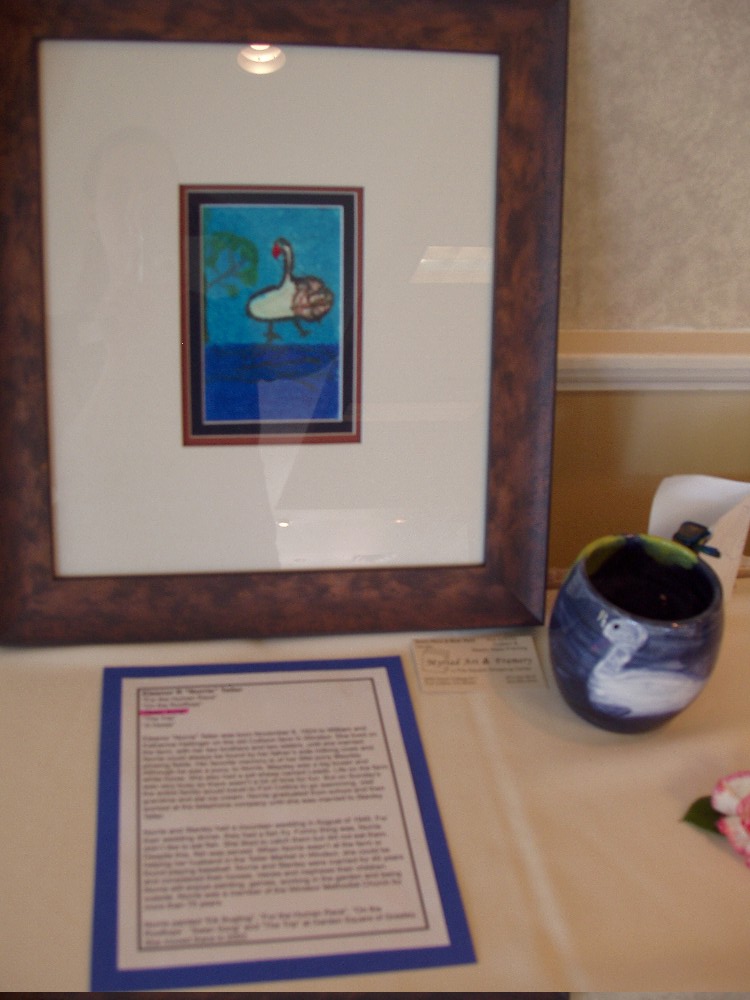
This is my dad's entry for this year.

For the fourth year in a row my dad's art entry has been accepted by the Northern Colorado Memories in the Making Auction. The auction is a fund-raising event by the local chapter of the Alzheimer Association.

Elder Care facilities from all over Northern Colorado have those in their care draw or paint pictures which are then submitted. The idea is that through art, these seniors can preserve some of the memories that are slipping away from them. (Since we live in an agricultural area, there are often farm scenes as well as farm animals.)

The auction is held in June, but as a thank you to all of the artist's whose works were accepted, there is a tea in early May. Artists and their families are welcomed and all of the art pieces are on display. This year there were also mugs pair with each piece. One of the sixth grades in the area was given color photocopies of each piece. The students were allowed to pick a piece that spoke to them and then make a mug to match. This gave the kids a chance to learn more about dementia and the mugs were then given to the artists as a thank you. They were very well done and it was a touching gift. Though the artists themselves, like my dad, may have no interest in or even recognition of the gift, it's a nice momento for the families.

To see pictures that my dad has done for previous auctions, click here.