January 18, 2010

Introvert or Extravert?

I'm reading a book called Introverts in the Church: Finding Our Place in an Extroverted Culture and the author, Adam McHugh, gives three categories of differences between Introverts and Extroverts. Apparently he took the description from another book called The Introvert Advantage by Marti Olsen Lancy.

First of all he points out that:
Introversion is one of a constellation of factors that fluidly work together to shape how we act. Introverts gather the information that feeds our inner worlds in different ways; some rely on the concrete experiences of the senses (an S on the Myers-Briggs), while some depend more on their intuition (an N), interpreting what lies below the surface. Some introverts make decisions more from their hearts (An F) and others more from their heads (a T). Some prefer to structure their lives carefully (a J), whereas others opt for more spontaneity and flexibility (a P).

We also fall somewhere along a spectrum between introversion and extroversion. With the three categories he describes, I find that some people immediately strike me as extroverted in one category, but it's a little more ambiguous in another category. And even within a specific category, we may lean toward one side or another, but it's possible that we show characteristics of the opposite side of the spectrum at times.

The three categories of introversion/extroversion are: 1) energy source, 2) internal vs. external processing, and 3) depth vs. breadth.
Introverts are energized by solitude.  We are recharged from the inside out, from the forces of our internal world of ideas and feelings.

We generally fill our energy tanks in private or in the presence of one or two close friends, or else in a public place without interacting with those around us.

Long periods without quiet refueling leave introverts feeling physically exhausted and emotionally hollow.

Extroverts, on the other hand, derive their energy from outside of themselves. They need other people, interaction and various kinds of stimulation in order to replenish their energy. Too much time alone, silence or inactivity leaves extroverts feeling drained.

I've often heard people explain the energy category (and I've done this myself) specifically in terms of spending time with people, but over time I've grown to see that it's not just a people thing. As he points out above, activity and variety are also keys to the energy equation.  I've noticed before that on days when I have one large project to work on (like making year end school movies or pumping out year end giving statements) I have more energy at the end of the day than when I've spent the day clawing my way through a to-do list 20 items long (even when the items on the list were all small things like making a phone call or tackling some burnt out light bulbs). There's something about the transitioning from one task to the other that wears me out. If I can find a way to make the tasks all seem congruent, I do better than when they strike me as disparate tasks.

In our culture we are continuously bombarded by stimuli, in the forms of information, images, conversation, and a multitude of other data and experiences.  In order for introverts' lives not to degenerate into disassociated states of confusion, we need to process these stimuli and integrate them into our lives.  Another way that this integration process might be described is filtering.  We need to filter information and experiences, allowing the good to take root in us and transform us, discarding the bad or irrelevant.

Extroverts have flexible and porous filters that allow much to pass without getting clogged.  They can usually take a much higher amount of stimuli before they become inundated.  They mostly process externally, through conversation and interaction with others. Taking is an integral part of their processing, and they often speak in order to understand. Their speaking and thinking occur simultaneously. Though they are capable internal filtering and reflection, they are most alive when engaged in the world of people and activity.

...extroverts may be more physically expressive than introverts.
The introverted filter, on the other hand, is much finer and more rigid, only able to allow small amounts of stimuli to pass before it backs up. Introverts process internally, in the workings of our own minds.  We integrate and think silently. Ideally, we like to be removed from external stimuli and people in order to process.

Though we are capable of engaging in the world, we are most alive in the reflections of our minds, mulling over concepts and experiences.  Our learning style centers around observation and contemplation, and we are not as dependent on external feedback for growth.

Many introverts do not do well with interruptions, either when we are speaking or reflecting.

When the finer filters of introverts become clogged in the presence of people, we often go silent.

When this filtration process is impeded, the result can be disorientation and confusion -- or for me, temporary depression....

My first thought upon reading about this second category was, "but I'm so good with Dad!" Part of having Picks disease includes perseveration, which means saying the same thing over and over and over again until everyone around you goes insane. My dad's perseveration drove my mom nuts, and my sister, but somehow I put up with it easily.  But I suspect that's because, after having 3 kids under the age of 2, I learned to filter beyond my filter. I could "turn off" my dad in a way that they couldn't and sometimes people would complain about my dad's repetitions and I'd be surprised that he'd been speaking that whole time and I hadn't even noticed.  (My kids hate when I've turned them off -- they keep asking me a question and I don't hear them at all. There are definitely times when it's not an asset.)

But as I finished reading this section, especially the last bits about shutting down and getting depressed, a light bulb went off.  There have been so many times when I've been in the midst of a stressful conversation and between my trying to convey my thoughts to people who obviously weren't understanding me, and trying to make sense of and sort through their responses to me, I would just get to the point where I couldn't even function any more. I'd have to leave the room. Or I'd break down in tears. Or I would just get very, very quiet.

Introverts tend toward high degrees of intimacy in our relationship, which we usually have fewer of than extroverts.  Introverts are rarely content with surface-level relationship and do not generally consider our acquaintances to be friends.  We may find small talk to be disagreeable and tiring.

Introverts also prefer to have depth in fewer interests.  This trait is connected to our style of processing. The breadth of information about a wealth of topics often results in introverted-filter overload.  Instead, introverts prefer to invest our energy resources into a a smaller number of topics or activities. We desire to mine them for all their richness, to explore all their nuances and complexities. This commitment to specialization of expertise, along with our love of ideas and our powers of concentration, explains why many introverts thrive in lives of scholarship.

Although this third category introduces a new idea regarding introverted vs. extroverted behavior, I think it overlaps a lot with the other two categories. Switching between topics is harder on our filters than sticking with one topic and digging deep. The same holds true with switching between activities or even with the number of people we hang out with.

The way I think of it sometimes is sticking on the main road vs. taking detours, especially detours that I wasn't expecting. If I *feel* like I'm sticking to one general task all day, I do a lot better than when I feel like I'm headed in one direction, and then a friend of mine calls up to ask if I'd like to go for a walk and suddenly I'm like a deer caught in the headlights. "What! Throw a variable into what had started off as a straight forward day?! You've got to be kidding!" I go silent and I'm sure she's on the other end of the line wondering what happened to me. And when I relent and go on the walk (because she IS my friend and I DO like going on walks once in awhile, though I usually prefer being alone) I come home and the rest of the day is gone. No matter how much work I still had to do, I'm physically and emotionally unable to deal with anything else that day.

McHugh, in this chapter on the differences between Introverts and Extroverts, gives a list of "common attributes of introverts." If you're still not sure on which side of the spectrum you fall, perhaps this will help:
  • Prefer to relax alone or with a few close friends.
  • Consider only deep relationships as friends.
  • Need rest after outside activities, even ones we enjoy.
  • Often listen but talk a lot about topics of importance to us.
  • Appear calm, self-contained and like to observe
  • Tend to think before we speak or act
  • May prefer a quiet atmostphere
  • Experience our minds going blank in groups or under pressure
  • Don't like feeling rushed
  • Have great powers of concentration
  • Dislike small talk
  • Are territorial -- desire private space and time
  • May treat their homes as their sanctuaries
  • Prefer to work on own rather than with a group
  • May prefer written communication
  • Do not share private thoughts with many people
I've also posted some interesting quotes from McHugh's book regarding physiological differences between extroverts and introverts in the INTJ Group: Dopamine vs. Acetylcholine and Blood Flow

January 16, 2010

Caring for Your Introvert - The Atlantic (March 2003)

Caring for Your Introvert  < -- Click here to read the Atlantic Monthly article.

This is a classic article about introverts. If you are an introvert, it might come as a relief to read this and find that a lot of the things that have always drained you or annoyed you or stressed you out are normal. Every time I read this article I think, "Yes! That's it exactly!" over and over again. If you are an extrovert, this article will hopefully help you to better understand the introverts in your life. Unfortunately, after sending this article out to several extroverted friends, the standard response I got from them was, "That's funny. What a hilarious joke!" In other words, they didn't get it. They thought it was a spoof on the differences between introverts and extroverts, but not at all based in reality. *sigh*

Here's a few quotes from the article to whet your appetite: 

Introverts may be common, but they are also among the most misunderstood and aggrieved groups in America, possibly the world.
Introverts are not necessarily shy. Shy people are anxious or frightened or self-excoriating in social settings; introverts generally are not. Introverts are also not misanthropic, though some of us do go along with Sartre as far as to say "Hell is other people at breakfast." Rather, introverts are people who find other people tiring.
Extroverts are easy for introverts to understand, because extroverts spend so much of their time working out who they are in voluble, and frequently inescapable, interaction with other people. They are as inscrutable as puppy dogs. But the street does not run both ways. Extroverts have little or no grasp of introversion.

Enjoy!


(I thought I had posted this long ago, but I can't find it anywhere so I thought I'd repost the link.)

Dopamine vs. Acetylcholine and Blood Flow - Introversion vs. Extraversion

I am reposting this from the INTJ  group on Multiply.com (which is ending its social networking services in December). I won't be saving all of the posts that I wrote in the group, but this is one that I'd like to keep around to refer back to if needed.  I have back dated this post according to its original posting date.

- - - - - - - - - - - - - - - - - - - - - - - - - - - - - - - - - - - - - - - - 


I'm reading a book called Introverts in the Church: Finding our place in an extroverted culture (by Adam S. McHugh) and the author spends a fair bit of time essentially explaining introverts: how they're different than extroverts, why they're different, and what that means in terms of what's reasonable to expect and what's not. As I'm reading it I keep thinking, "So that's why I do that!" and "No wonder I often feel guilty I'm not doing that." (The guilt is because the extroverted culture tells us that we should be doing XYZ and for extroverts, that XYZ is something that energizes them so they really don't understand our reticence. But for us, it just wipes us out.)

I just hit a section on dopamine and brain function differences that I think is particularly interesting. I thought I'd include a few excerpts here.

Studies of the human brain have revealed three significant physiological differences between introverts and extroverts.  First, introverts have naturally busier, more active brains than extroverts.  Though introverts look calm on the surface, our brains are bubbling with activity, and thus we require less external stimulation than extroverts.  Too much external stimulation, in fact, leads to a feeling of overwhelm.  Second, blood flows in different paths in introverted and extroverted brains. Introverts have more blood flow, but it flows in a longer, slower path than in extroverted brains.  The blood in introverted brains flows to sections that are focused on internal things like remembering, solving problems and planning.  ON the other hand, the blood in extroverted brains goes to those parts that are used for the processing of sensory experienced, what's happening externally.

Third, introverted and extroverted brains have different chemical balances.  The activities of our brains are catalyzed by neurotransmitters, which are chemical substances that transmit nerve impulses.  Extroverts require greater amounts of dopamine, a central neurotransmitter in the sympathetic nervous system. It is produced when people are active and in motion. As psychologist and author Marti Olsen Laney writes, "extroverts feel good when they have places to go and people to see," probably because they are flush with dopamine.  Dopamine takes a short path through the brain and, in stressful situations, produces an "act and react" response.  It can be credited for extroverts' ability to think and speak quickly and to thrive under pressure.  It also helps them access their short-term memory more rapidly, so their data-processing circuit is shorter and faster. 
Introverts, on the other hand, require less dopamine, and when our brains have too much, we can feel anxious or overwhelmed.  Our brains rely more on another neurotransmitter, acetylcholine, a neurotransmitter of the parasympathetic nervous system, which conserves and restores energy, producing a "rest and repose" posture.  It produces a pleasurable sensation in introverts when we are thinking and reflecting. Acetylcholine, however, cuts a longer path through the brain, which explains why introverts may have difficulty accessing words or memories quickly and why we may be slow to react in stressful situation.  Introverts often prefer writing to speaking, because writing uses a different neurological pathway in the brain than speaking does. Additionally, the slower acetylcholine tributary may produces a posture of calmness in introverts and cause us to move more slowly than extroverts, which may explain why we are often less expressive with our bodies."

Wow, that explains a lot. I've always known that I don't interview well, but I thought only the nervousness could be attributed to being introverted. Now I know that the words on the tip of my tongue and the ideas not coalescing on demand (when they all came together so well just the day before as I was planning on the talk) are all a result of stuff going on in my brain. It's kind of a relief to know it's not that I'm just a moron.

December 23, 2009

One of my favorite Christmas gifts as a kid

To be honest, there aren't a lot of toys that I look back upon with longing or nostalgia.  I never cared for dolls (much to my mother's chagrin). I did enjoy Legos, but I wouldn't say that I felt any loss when my mom passed them on. (And we have more than enough Legos in the house now to make up for any loss then, thanks to Nathan.)

But there's one toy that I remember hoping and praying I would get for Christmas. And when I got it, I adored it! It was a magnetic driving car. It would drive in circles around a track and you could steer it right and left as it drove. You could even make it go faster or slower with the accelerator.  Sooooooooo cool!

What was one of your favorite Christmas gifts as a kid?


--------------

Here's a couple pictures of two toys similar to the U-Drive-It.


I think this version came out in the UK.
Instead of a steering wheel, you used a joystick to move the car around.


This is the steer-n-go. The mountains in this version are cool.

December 19, 2009

November 28, 2009

Thanksgiving Dinner - 2009


Potatoes, sweet potatoes, beets and carrots. I also threw in an acorn squash, but I didn't peel it first. I think next time perhaps I'll try butternut instead. It's easier to peel. I sprinkled fresh rosemary from the back yard over the whole pile.

We had a stunningly delicious Thanksgiving meal this year.

November 22, 2009

Albuquerque, Flagstaff, and the Grand Canyon


As we were leaving the EconoLodge in Albuquerque I looked up to see two hot air balloons passing overhead. Everyone else was already in the car ready to go but I made them all get out and look at the balloons.

Then we headed into Old Town and ate at the Church Street Cafe which I'd highly recommend. The breakfast was delicious (skip the pancakes and go for something that comes with one of their yummy chili sauces). We headed out for Flagstaff and enjoyed the variations in the rock formations along the way. In Colorado most of the rock has been mangled to some degree (lots of folding, mostly) but here the rock was fairly level and the layers were so clear and well defined. It's really beautiful.

In Flagstaff, we ate at the Flagstaff Brewing Company which had good food, reasonable prices, the beer was crisp and fresh and they had live music (that was slightly too loud).

We got to the Grand Canyon just in time to watch the sun set across the rock face. Then we went to El Tovar for dessert which was mediocre at best (and also probably the most we'd spent on a "meal" so far in the trip).

We then drove on to Kingman for the night and plan to hit the Mojave Dessert today.

September 1, 2009

Under a Blood Red Moon - taken from Moby Arena after Greg Mortenson's talk


Outside the Moby Arena at CSU.

The kids and I joined several school friends and their families in going to hear Greg Mortenson ("author" of the Three Cups of Tea book). The Moby arena was packed. We had to wait an hour before they got started (We got there early because there was open seating.) and the kids got a bit antsy, but once Greg started to speak they were able to settle down and listen fairly well. Nathan's school is going to be reading the children's version of Three Cups of Tea this year. (Each grade will be reading through it at the same time.)

After the talk we walked out of the south side of the arena and saw the moon, red as can be. It was rather eery. I'm assuming it's red because of the fires in California. It was overcast/hazy yesterday and it is again today. And the sun is definitely a bit redder looking than usual.

If it's this bad here, I can only imagine what the skies in Southern Cal are like right now. (I asked Rob if it was hazy in San Francisco as well, but he said it was too foggy to tell.)

August 20, 2009

I destroyed my laptop screen today (or... how dulce de leche led me down the path of destruction)


*sniffle*

(If you look closely you might notice that some of the letters on the keys are worn off. That happened on my last laptop too. It couldn't be that I type too much, could it?)

I doubt this is visible but the plastic casing to either side of the mouse was cracking. I've wondered if that's why they switched to the solid body style of laptop. The plastic didn't hold up so well.

Last week the gals went to a dude ranch with my sister. The place is called Latigo ranch and I'll post pics soon. But that detail is relevant to this story because two 10-year olds were gone for a week and therefore weren't drinking milk here. And Nathan has had bumps on his arm for ages now and we finally decided to try cutting out (or at least cutting back on) dairy to see if that made a difference. So he's been drinking less milk.

We usually go through 6 gallons a week and sometimes I even have to run out and buy an additional gallon to see us through till the milk man arrives next. But not this week. This week we have more milk than we can shake a stick at. So I decided to shake a wooden spoon at it instead just to see what happened. I boiled the milk, added some sugar, cooked it and stirred for aaaages. (In other words, I used a gallon of milk to make about 4 or 5 cups of dulce de leche.) While stirring I read through the New York Times and the Denver Post and I still had to stir longer but had nothing left to read. So I decided to try to get some work done. I grabbed my laptop (the Macbook that I won from me.dium (now OneRiot)) and set it near me and sorta... on top of something that was sturdy at the time. So here I am stirring and entering data, stirring, stirring, entering data. You get the picture. It was all going somewhat OK until... that sturdy thing that I had set the computer on got hit by one of the breakfast dishes shifting in the sink. It didn't shift far. It really wouldn't have been a problem at all if I hadn't set a thousand dollar computer on top of it. But I did. And the computer fell. Down. to the Ground.

The screen doesn't work so well now, though the rest still seems to be functional. So I suppose if I can find a cheap screen around somewhere we can still use the thing.

Yeah, so that's what happened.

Fortunately I just backed the thing up yesterday. It had problems overheating this summer (which I found particularly odd since it never overheated last summer and last summer was quite a bit hotter than this summer) and shut itself down a few times. It's never acted quite the same since so I was already thinking of doing a laptop switch. The dulce de leche sorta spurred me on toward shifting sooner rather than later.

What am I using now? A Macbook Pro that's somewhere around 6 months older (I think) than the Macbook that did that "kiss the ground" thing. It's a cast-off that Rob bought from his work place. Thank God for start ups that do mini-layoffs and end up with a few extra computers laying around. ;-) (Hey, look at that! A silver lining to the unemployment debacle.)

July 15, 2009

Talkin' Trash

On average, I/we set out _____ of trash to be picked up each week.

2 kitchen trash sized bags (13 gallon) or less
 13

1 small trash can full (about 3 bags)
 5

2 trash cans full (or one of those larger gizmos the trash companies give you)
 7

I don't use a trash service. I use only public trash cans for all household waste.
 0

None. Period. I don't do trash. I'm 100% compostable. Here, pat me on the back.
 0

I have a dumpster. And I fill it up. HooRah!
 1

Trash was always a big deal in our family when I was growing up. There were rules and carefully outlined procedures that one must follow when dealing with trash. I wrote a paper about it in college. When I showed the A+ paper to my mom, I expected her to protest that I'd overstated how things were in our family. Instead she read it, laughed, nodded and was quite pleased with the extreme type A behavior that I had described.

One of the house rules was: Always get rid of trash at the first opportunity that presents itself. A follow up rule was: If no opportunity presents itself, make an opportunity. My grandma actually got in trouble with the law because she was following rule number 2. She was caught putting a bag of trash in another person's dumpster. I'm the only person I know who's grandma started her police record at the spry young age of 70, and for getting rid of a bag of trash at that.

As far as procedures go, the main rule of thumb was to always put trash into the trash bag the instant it could conceivably be considered trash. In fact, many times items were added to the trash bag long before any of us thought they were really at that "this is trash" level. (My dad had a favorite pair of shoes that became trash in my mom's eyes probably a year before they would have become trash in my dad's eyes.) BUT, and this is critically important, IF IT IS TRASH DAY, then trash is not to be put into the trash bag because that would have already been set out on the curb the night before. No, at this point, you have two options. You can either walk the trash out to the end of the driveway and deposit it there yourself.  Or you could add it to the temporary mini-bag that was set up for this purpose and which would be run out to the trash men at the moment of their arrival. Perhaps a specific example would help make this procedure a little more clear. (This is the example I used in my A+ paper, by the way.) Suppose you have a cold and you need to blow your nose. After blowing, one would usually deposit the tissue into the nearest trash bin. That was the usual procedure. But on trash day, that would be the exact wrong thing to do. Instead you would walk out to the end of the drive-way, no matter how ill you might be, and make sure that tissue was safely deposited where the trash men would get it.

I've diverged from the family path a short ways when it comes to trash. I'm not nearly as type A as my mom or grandma. But there is one way in which I've carried on the family tradition. Despite my family's love of getting rid of trash, we've never been very big on making trash. 

When Rob and I were first married (14 years ago next week), we had two housemates.  Soon after, we picked up a third and not long after that we added three kids to the mix. During that whole time, we never had more than one normal sized trash can. (It was a trash can that we found along the side of the highway once on our way back from a weekend retreat in Grass Valley.) When we moved to Colorado we reduced our number by 3 (since we no longer had the housemates) and the kids grew out of the diaper stage, so our trash accumulation plummeted.  Though I've been able to fill a trash can during a deep cleaning week, in general we seem to average about a bag and a half of trash a week (and the bags aren't packed down at all).

So I was struck recently, when reading the blog of an old youth group friend, that some people produce more trash than that in a week. Joanne (the Simple Wife) is trying to become more frugal and one of the by-products of that has been that their family has greatly reduced the amount of trash that they generate each week.  She wrote, "Since we've cut WAY back on being consumers and stepped up our recycling, I'm astounded at how little trash we have on trash day. This morning, there was only one trash can--and it was only half full. Used to be two full cans every week!" That comment really piqued my curiosity. Two full cans?!!!  What would you be throwing away that you'd have that much trash?  I asked that question in a reply on her post, but I suspect that I might have come across as a bit of a snot (not that that was my intention at all.  I am a bit of a snot at times. And generally I intend to be a snot when I'm being snotty. But this is one of those cases where I was asking a question because I was honestly curious, and the snot must have leaked out without my permission.  All I know is, she never responded to me.)

So, believe it or not, the whole point of this long and convoluted post hasn't been to tell you about my Type A family, nor to introduce you to Joanne. What I want to know is, how much trash does your family produce and what goes into it? Inquiring minds want to know.  ... Well, my mind wants to know.

And if you'd like a twist on what to do with trash, check out Cat's post on her garbage experiment in which, for a short time, she got creative about getting rid of the goods.

May 9, 2009

A few lines on Dementia


Some versions of Picks disease are inherited.  (There is a family in Italy that can trace the path of the disease down their family line for 500 years.) And sometimes Picks hits one person in a family but everyone else remains untouched (except for the changes that come about due to the caring for the one).  My mom thinks that my dad's situation falls into the latter category. 

My dad's dad lived well into his 80s and was knocking out crosswords like they were child's-play up until the day he was taken to the hospital. My dad's mom is starting to slip a little mentally, but once you pass 85, I think that's often to be expected. And she's still the social butterfly she always was. None of my dad's cousins or aunts or uncles or grandparents have or had any form of dementia. (And he has no siblings.  So we can't make comparisons there.) So it's quite likely that my mom is right. Perhaps this is an isolated event within our family. Perhaps my sister, and myself, and my children won't get it. ... But then again, it's hard not to consider the possibility that we will.

I've written two poems recently. One is about taking a walk with my dad and how special that was to me, even though he wasn't really there. And the other is about losing several things at once and wondering if this marked the beginning of my end.

Relations

I hold his hand as we walk.
I am walking not with who he was,
    all of that is gone,
not with who he is,
    who is he when he cannot speak?
    cannot make a decision?
    cannot respond to his body's needs.
I walk with who we are.

I cherish who we are.
He is my dad.  I am his daughter.
In all our frailties
    our relationship gives meaning to our walk.


Children of Dementia

When you misplace things
    do you fear
not that you will never find it again
    but that you have entered upon that road?
Do you see
    in a missing note,
    a misplaced camera,
    a forgotten meeting
signs of greater loss coming,
no longer crouching in wait
    but now stalking
    wrenching a memory away here
    a modicum of your personality there?

Which is worse, that you can't find your keys?
or that this might be the key to how your end will come?

April 13, 2009

Mom's Molasses Cookies

Description:
Mom made these all the time when we were growing up. My Gramps loves them so she makes them any time he's coming to town.

(I've had this recipe in here for ages waiting for a photo. I'm going to post it and add a photo next time I make them (which hasn't been very often lately. *sigh*).

Ingredients:
3/4 c. butter
1 c. sugar
1/2 c. molasses
1 egg
1 t salt
2 c. flour
2 t soda
1/2 t. ginger
1/2 t. cloves
1 t. cinnamon

Directions:
Beat the butter and sugar together. Once well blended, add the molasses and egg. Stir until completely mixed together then add the dry ingredients. Roll into balls and place on cookie sheet. If you want, mush the center of each cookie down with a finger and toss a dollop of jam in there. Yummers!

April 3, 2009

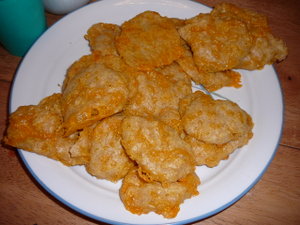
Cheddar Cheese Puffs

Description:
From the 25 March 2009 New York Times, which took it from "Party Appetizers," by Tori Ritchie (Chronicle Books, 2004)

I made these with medium cheddar rather than sharp and they could have used some salt and pepper.

Ingredients:
1 stick (8 tablespoons) unsalted butter, cut into pieces
1/2 teaspoon salt
1 cup all-purpose flour (i used freshly ground hard red wheat)
4 large eggs, at room temperature (who thinks that far ahead?!!)
1 1/2 teaspoons dry mustard
1/4 teaspoon cayenne pepper
1 1/2 cups (about 6 ounces) shredded sharp cheddar cheese

Directions:
1. preheat oven to 375 derees. line two baking sheets with parchment paper or nonstick baking mats. in a medium-size heavy saucepan, combine 1 cup water, the butter and salt, and bring to a boil. turn off heat adn add flour. mix with a wooden spoon until dough starts to pull away from sides of pan and form a lump. set aside, without stirring, 5 minutes. (lumps of this stuff taste so yummy!!! esp. if you used good flour.)

2. add eggs 1 at a time, mixing well after each addition. with each addition, dough will look glossy and slick at first; let it come together before adding next egg. mix in mustard, cayenne and cheese. dough will be quite loose and sticky.

3. scoop up a heaping teaspoon of dough and use another spoon to scrape it onto lined pan; it should form a mound about an inch in diamter. alternatively, use a pastry bag or thick plastic bag with one corner cut off, to pipe small mounds onto pan. repeat with remaining dough, leaving 1/2 inhc between puffs.

4. bake until pffy and golden, about 25 minutes, rotating pans halfway through. remove from oven adn serve immediately, or turn oven off and open door slightly to keep puffs warm up to 1 hour.

yield: about 36 puffs

March 12, 2009

Rob's Oat Cakes

Description:
When we first moved from San Francisco to Fort Collins, there were many foods that we missed -- freshly made tortillas, papusas, thai fish cakes (ok, so i was the only one that missed those), and oat cakes.

My search for tortillas and oat cakes particularly brought puzzled looks from people. Believe it or not, the only corn tortillas some of the supermarkets here had back in 2001, were the fried, taco shaped kinds. Now most supermarkets carry soft tortillas, but they're so full of preservatives that you're lucky if you can taste any corn. But at least when I asked for a tortilla, people in general seemed to know what I was getting at -- a flat thing made of corn.

When I'd ask about oat cakes on the other hand, people hadn't a clue. "You mean oatmeal cake?" they'd ask? "No, little round puck shaped things made with oats." "Oooooh." And that was that. They obviously thought I was a nutcase for even thinking such a thing existed and that anyone would want to eat one if they did.

So finally Rob, in exasperation, decided there's got to be a recipe out there somewhere so we could learn to make our own oatcakes. He did find a few online and modified them until he finally settled on the following recipe.

(In the meantime, I've finally seen oatcakes for sale in Fort Collins. They're over-packaged and marketed as heart-healthy food (instead of just being marketed as plain old yummy oat cakes). I haven't tried one yet, but that's largely because Rob's oat cakes are so good, I don't feel the need to even try the others now.)

Ingredients:
3 c. rolled oats (we used the thick rolled kind)
2 c. whole wheat flour
2 t. salt
1/2 t. baking powder
1 to 2 eggs
1/2 c. coconut oil (melted)
1/4 c. olive oil
3/4 c. cane syrup (we use steen's)
1/2 c. sucanut (wikipedia says i was spelling this wrong. it's sucanat.)
3 T. flax seeds (optional)
1 c. dried cherries (optional)

Directions:
Mix everything together and pack into muffin tins. (We don't use any cups of any kind and we don't grease the tins either.) Cook for 22 minutes at 325 degrees. Let cool before removing from tin. Eat within a week or store in the fridge to preserve freshness.

January 19, 2009

Pok-e-Kitty


This pic was not part of Naomi's email series of pics, but it was done on Photo Booth just like the other shots.

Behold, Poke-Kitty!

(Poor tibbies.)

December 27, 2008

Drink Ovaltine to Wake Up Gay


When I lived in Detroit, the attic of the house I lived in was full of old magazines. My mom took 3 of them, one of which was from the month that she was born. My brother-in-law's brother was over for Christmas and was thumbing through the magazine when he noticed an ad that promised to help him "Wake up Gay." Everyone got quite a kick out of it, so I scanned the page and thought I'd post the whole thing here.

December 4, 2008

Steve Jobs 2005 Stanford Commencement Address


Rogerio posted this, this morning (with Portuguese subtitles) and I thought it was excellent. (It's similar to "The Last Lecture".)

Ironically, it struck me that his 3 main points jived quite a bit with what we've been studying in our gals' Bible study. (We're reading through the book Peacemaking Women -- which isn't a traditional Bible study by any means, but it's still full of Scripture and is absolutely fantastic in terms of learning to love and forgive others.) I'm hoping, at some point, to tie Steve's thoughts to Tara and Judy's (perhaps on dandelion wine - now called Whispering Weeds) and if I do I'll post a link here.

November 24, 2008

My Martin Luther King Jr., Senior High School teacher days


I always got a kick out of the name of the school. Since MLK was a junior, but the school is a senior high school, they'd write out (and say) his whole entire name, but they'd add the senior bit in there lest anyone think we were a junior high school. ;-)

You can see the gold suit in all its glory, and more students pics, and another suit my grandmother sent (orange), in my Detroit photo album.

November 16, 2008

Easy No-Knead Whole Wheat Bread

Description:
This recipe is from the More-with-Less Cookbook (put out by the Mennonites). Rob has been using a Joy of Cooking recipe to make bread every once in awhile but he couldn't get it to rise properly. He tried this recipe yesterday and the bread rose wonderfully and tastes delicious!

Ingredients:
3 c. whole wheat flour
1/2 c. sugar
2 T. salt
3 pkg. dry yeast
2 c. milk
1/2 c. oil
2 eggs
5-6 c. more flour

Directions:
Combine the 3 cups of flour, sugar, salt and yeast. Heat 2 c. water along with milk and oil in a saucepan until warm. Combine dry ingredients, warmed liquids and 2 eggs. Beat at low speed until moistened. Beat for 3 minutes as medium speed. Stir in by hand 5 - 6 cups additional flour.

Use enough flour to form a stiff batter. Cover and let rise until double. Stir down and spoon into 2 greased 9x5" bread pans. Let rise 20-30 minutes. Bake at 375° F for 35 - 40 minutes.

Tastes great with butter and honey slathered on top.

Double Chocolate Snack Cake

Description:
This recipe is from Betty Crocker's 40th Anniversary Edition Cook Book. The problem with "upgrading" from one cook book to another is that the new version might not have all your favorite recipes from the old one. So this is one of those recipes that I can't find in the new BC cook book. (I think it's in there, but it's hidden within another cake recipe.) As I transfer cook books, I'm hoping to get all of my old favorites listed here so they're easy to find.

I like using this snack cake when I make a trifle (which Melanie got me hooked on. I'd never heard of a trifle before she posted a lavish photo spread of one she made.) The cake tends to be a bit dry on its own.

Ingredients:
1 2/3 cups flour
1 cup packed brown sugar
1/4 cup cocoa
1 teaspoon baking soda
1/2 teaspoon salt
1 cup water
1/3 cup vegetable oil
1 teaspoon vinegar
1/2 teaspoon vanilla
1/2 cup semisweet chocolate chips

Directions:
Heat oven to 350° F. Mix ingredients together and pour into an 8x8x2 in. pan. (The directions say to hold back the chips and sprinkle them on top, but I've also made it where I've just mixed them in. Bake 35 to 40 minutes or until wooden pick inserted in center comes out clean. Cool, sprinkle with powdered sugar or slather jam on top as I do.

I've also made this where I sprinkled chocolate and peanut butter chips on top. (As pictured.) The only problem with this is that the cake is really too dry without something custardy poured on. But once I put the peanut butter chips on it looks done and I tend to skip the custard.

September 21, 2008

House Kitty


One day Mr. Tibbs decided to check out my doll house. The kitchen seems to fit him nicely.

August 3, 2008

Robo-kitty


This is Mr. Tibbs in full battle gear (made by Nathan Inc.).

July 9, 2008

Half Indian / Half Mexican -- James Luna


I just saw this picture in the Denver Art Museum mag. I thought it was very cool. If you check out James Luna's website there's some other very cool stuff there as well.

(Sorry the pic is so grainy. It's much clearer in the Museum magazine.)

Here's a bit of the blurb from the mag: "The self-portrait was intended to confront people's expectations about ethnicity. It is Luna's response to the prejudices about his mixed American Indian and Mexican heritage, and questions about who is a 'true Indian'."

July 4, 2008

Blechkuchen

Description:
This is a recipe straight out of the More-with-Less Cookbook, a cookbook put out by the Mennonite Central Committee. This was the first cookbook that I ever sat down and read like a book. They have great sections for each chapter describing ways to stretch a dollar and still eat well and thoughts on global hunger issues.

The cookbook has this to say on Blechkucken: "Traditional among Prussian Memmonmites when guests come for Sunday afternoon coffee. "Blech" is a large baking pan."

For awhile Rob couldn't remember what this was called and termed it "Blawken snawken." He's been making it regularly lately. It's great with some rhubarb thrown in.

Ingredients:
(listed below)

Directions:
Scald and cool to lukewarm
3 c. milk
Stir together to dissolve:
2 pkg. dry yeast
1 c. warm water
Combine in large bowl:
lukewarm milk
1 1/2 c. soft shortening or lard (we just use butter)
1/2 c. sugar (we use sucanut)
4 t. salt
1 egg
6 c. flour
Beat well until dough is smooth and satiny.
Stir in:
1 c. raisins combined with
3/4 c. flour
(and some chopped up rhubarb or other dried fruit if you have something you want to get rid of)
Cover and let rise in a warm place until doubled. (Rob says he usually lets it rise 1 hour. But this morning the kids were so hungry that he cooked it without letting it rise and according to Nathan, "Wow, Papa! This is the best blechkucken you've made, ever!") With back of spoon spread dough thinly onto 2 greased 10x15" cookie sheets. Brush generously with melted butter and sprinkle with sugar (we use brown sugar here -- Rob mixes the butter and sugar together and dollops it on top, making pockets of super yumminess!)
Bake 20 minutes at 375º.

(Recipe from Elsie Epp, Marion, S. D.)

June 4, 2008

Update on my dad -- Picks Disease: year 13 or so

This is an excerpt from a letter I wrote today:

My dad continues to get worse.  For a long time he seemed to stay about the same.  He was more active in the summer and a bit easier to deal with in the winter, but from year to year it seemed like he was stuck at a point where he could converse and do various activities, he just couldn’t remember very well and he occasionally did embarrassing things (like comment on how fat someone was within hearing distance).  But in the past two years there’s been a sharp decline to the point where now he hardly speaks.  He can read almost anything, but spontaneous speech is pretty much limited to a few lines.  (“Let’s go out the front door,” being the one that I hear the most often.)

My mom sends him to adult day-care twice a week.  They’re really good with him and it gives her a breather.  She really should have sent him more often when he was harder to deal with, but any break, even now, helps.

He walks A LOT.  You can walk in a circle at my mom’s house through the kitchen, the dining room, and the living room then back to the kitchen.  Pretty much my dad just walks in that circle from the time he gets up to the time he goes to sleep.  A couple years ago he went through a phase where he ate everything in site (including food in front of other people and dog or cat treats that were left around).  He gained a lot of weight and went up several pant sizes.  Well now he’s lost all of that weight and is even thinner than my mom ever remembers him being.  Something about the dementia makes him agitated and he just walks and walks and walks.  If he sits down, it’s only for a few seconds and then he pops right back up again to walk around some more.

If you ask him a question, he’ll look at you for a few seconds, and then continue doing whatever he was doing before (most likely walking).  As recently as 6 or 8 months ago he was able to answer a question such as “Who am I?”  but not any more.

It’s difficult getting him to eat anything.  If cookies or candy are sitting out, he’ll grab something to eat and munch while he’s walking.  Lollipops are particularly favored, although he’ll chew the stick when the candy is gone, so you have to watch and remove the stick when he’s reached the end.  But getting him to sit down at a table and eat is very hard to do.  Often you have to hand him a plate of food and he’ll take a bite while walking.  Then he sets the plate down and you have to get it and hand it to him again on his next pass through.

But while he’s clearly getting “worse,” he’s also getting better in the sense that he’s easier to deal with.  Whereas before he’d ask questions almost non-stop, now he hardly talks and when he does it’s quieter and not insistent at all in the way that it used to be.  He’s pretty gentle and complacent (other than needing to walk like crazy).

He’ll most likely eventually lose the ability to speak at all, even to read.  Sometimes he leans when he walks, so obviously something is taking place physically, but it’s hard to tell what’s going on when he can’t tell us anything.

The plan is to try to take care of him as long as we can on our own and only put him in a nursing home when it’s too hard to care for him.

The picture is of my dad after I picked him up from daycare where they had been celebrating Mardi Gras.

February 10, 2008

blue vinyl: the world's first toxic comedy

Rating:★★★★★
Category:Movies
Genre: Documentary

A few years back we somehow managed to get on the phone lists of several local window companies who wanted to give us a great deal on new vinyl windows. I hate telemarketers, especially telemarketers who want to sell me something I don't need and didn't ask for. But, being little Meg, meek and mild (stop laughing, Rob), I often listen to a telemarketers schpiel before politely declining. The vinyl window people put me over the edge, though. Not only hadn't I asked for them to call me, but when I politely said no, they started getting pushing. So that's when I pushed back. I would rant and rave about how bad PVC (Poly Vinyl Chloride) is for the environment. I'd blather on about how it's the worst form of plastic in the world today and that there's no way I'd put it on my house.

But the truth of the matter was that I really didn't know squat about PVC. I'd heard that it was a big baddy, but I didn't know why. So when I saw the documentary blue vinyl at the library, I jumped at the chance to find out more. (We're also going to have to order windows soon, so I figured this would help me decide just how much I really want to go through the drama of avoiding vinyl. Based on what the telemarketers said, vinyl appears to be fairly ubiquitous in new windows.)

Blue vinyl is the story of Judith Helfand and her parent's house. When the wood siding on the house started to rot, they decided to replace it with vinyl siding. Judith, a victim of DES related cancer whose ordeal led her to become hyper sensitive to the issue of toxins and their interaction with humanity, decided to do a little research on vinyl. The documentary covers about 5 years of research and explores not only the problems with PVC (including the number of PVC plant workers that have died from exposure to the product, but also the cover-ups by both European and American companies regarding the dangers), but also the search to find an alternative house siding that would be both affordable, and meet with Judith's mother's approval.

I felt like the documentary was very well done. As a viewer, I felt that I was being drawn into an exploration that wasn't already pre-determined. Though Judith started out with obvious concern about the product, she also started with ignorance as to the dangers, and she walks the viewer through her own thought process as well as through the information that she discovers in a clear and orderly way that helps the viewer feel like a partner in discovery rather than a voyeur in anger (a feeling Michael Moore's "documentaries" always leave me with). In the end, Judith's parents, who were very clear in the beginning that they thought she was being rather foolish to be concerned about the vinyl, decided to take the siding off their house and replace it with something less toxic.

I would definitely recommend this movie. It has it's funny moments, as well as it's tragically sad points. I feel like I have a much better sense of the problems with PVC after watching blue vinyl, and I have a renewed plan to research all-wood windows to install in our house.

September 18, 2007

Picks Disease - Aphasia and Leaning (to the left)

This past August marked the 6 year anniversary of our move to Colorado to help my mom cope with my dad who has Picks disease.  When we first moved, we assumed that we would be here two years, three at most.  We were told upon diagnosis that my father would most likely only live another 6 years from that point. (He was diagnosed in the spring of 2000. The disaster of Y2K came for us in the form of a disease rather than a coding glitch.)  But the 6th anniversary of his diagnosis has not only come and gone, but physically, my dad's health has remained quite strong.  He continues to be active, walking as much as 5 hours a day.

For several years, friends would ask how my dad was doing.  I'd shrug my shoulders and say, "He's about the same."  It was a disappointing answer to be sure -- disappointing on my end because, though things never got better, they never got worse either, meaning the end was still a long ways off; disappointing on my friends' end because I could tell by the tone of their voice that the lack of "events," tragic moments that I could cling to tearfully as signs of my dad's descent towards death, meant they were beginning to doubt if there really was anything wrong at all.  In fact, when my friends saw my dad, he looked not only fine, but quite healthy.  It wasn't until they talked to him that they might think him odd.  But it was only if they'd known him before the disease that they'd have a true sense of the change that had befallen him.  (For a taste of what it as like to spend a minute with him during that time, see my post, One Minute with Picks Disease.)

But this past year there has been a noticeable difference in my dad.  He does less (no more picking up coins in parking lots, moving pictures around on the walls, or doing dot-to-dots) and paces more (activity without productivity -- not that his previous actions were all that productive).  He nervously rubs his thumbnail across his pointer finger to the point where he's worn a groove in his finger.  He's confusing our names more often.  (He knows I'm Meg, but he doesn't seem to know what our relationship is.  And my mom has become his mom, even when his mother is in the room with them.) 

He's also, oddly enough, started to lean.  He doesn't always lean.  In fact, it only seems to happen a few times a week, most often when he's walking around my block.  But he'll round the bend and there it is, he's leaning to the left.  He doesn't seem to notice.  And after awhile he straightens back out.

And he's becoming increasingly silent, entering into the aphasia stage of the disease.  Some people with Picks hit this stage straight out, losing their ability to speak before they even begin to lose memory or ability to reason. But for my dad it's been gradual, sneaking upon us so stealthily, that when it finally dawned on us that he was losing language, he had already been reduced to about 500 words.  I don't know that he even understands most of what we say.  When asked a question, he will most often either ignore it, or nod his head and say "yes" before walking away.

Oddly enough, despite the fact that he's lost reason, memory and language, he has retained mechanical ability.  When I picked him up from day care yesterday, he was in the yard behind the building and the fence had a clip that kept the gate from opening.  There was another gate that wasn't locked, so I directed my dad toward it, but while I was busily gesturing and explaining, he walked right over to the closest gate and figured out how to undo the clip that was locking the latch.  He walked out without a word and headed straight to my car.  Before slipping into the passenger's side seat he muttered vaguely, "Let's go shopping, Meg," one of his few remaining phrases.

September 13, 2007

Redeeming Creation: The Biblical Basis for Environmental Stewardship

Rating:★★★★★
Category:Books
Genre: Nonfiction
Author:Van Dyke, Mahan, Sheldon and Brand

The creation, including the earth, is not to be well treated because it is sacred or because it should be worshiped, but because God made it and called it good (Genesis 1), and its goodness is independent of human utility.
-- Redeeming Creation


Caring for the environment is a moral issue. How we interact with the world around us, not just with other people but with the stuff of the earth, is not a matter of right, but of responsibility. That, at least, is the premise of the book Redeeming Creation, coauthored by Fred Van Dyke, David C. Mahan, Joseph K. Sheldon, and Raymond H. Brand. The authors believe that without a solid ethical foundation underpinning our behaviors, as well as the policies put in place to police these behaviors, we'll find that we're talking one way and walking another. The book explores various ethical foundations that have been proposed to support environmentalism, then proceeds to test those foundations as well as the logical end points that they lead to. They conclude that the only solid ethical construct is one which includes God as creator, sustainer, and redeemer.

Ethics -- do we Value ecology?

In order to treat the environment as though it has value, one must first believe that it does. What gives it value is at the heart of any environmental ethic.

To get to the root of this issue, the authors drive all the way back to creation. They explore several ancient creation stories, focusing primarily on those of the Near East. They tease out the distinctions between the stories of the Babylonians, Mesopotamians, Greeks, and Hebrews and distinguish the purposes presented in each story for the creation of both Earth and those that live upon her sphere. They also address the more modern creation story of evolution as well as touch upon other spiritual attributions of value (such as those arising from pantheism and pan-psychism).

In the end they determine that many modern day valuation systems put mankind as the determining instrument of measurement, to which they conclude, “The making of humanity into the measure of all use and value must, in the end, be accompanied by a blatant disregard for nonhuman life.” They flesh this out with examples of policy and practice in the National Parks of the United States, showing that what sounds like a reasonable environmental practice at the outset often ends up doing more harm than good.

Theology -- where's God on ecology?

Believing that a Biblical view of God is at the heart of a sound ethic regarding ecology, the authors proceed to flesh out the theology that underpins that ethic. Much of what they have to say carries a distinct flavor of Schaefferian thought (as outlined in Francis Schaeffer's book, Pollution and the Death of Man). The authors neatly and clearly flesh out several ideas that Schaeffer comparatively only glanced across: God is transcendent, God has called all creation "good" (thereby giving it value), humans are inseparably linked to creation, mankind is fallen (and this affects creation), and God has made a covenant of redemption not only with mankind but with all of creation.

Though many ancient creation stories tell of gods who fashioned the earth out of the stuff around them (or in some cases, out of the flesh of other gods), only the Hebrew God created the world out of nothing that had existed before. He remains separate from creation (transcendent), and creation gains value not because it is made of the flesh of god, but because God said it was "good." God ascribed value to creation. God said each part was good.

[As an aside, I'd like to point out that this is critically important theology in terms of getting Christians to think positively about the environment. Many Christians that poo poo environmentalists as a bunch of hippie tree-huggers have an underlying belief that caring for the environment means ascribing value to created things because they have inherent value. In other words, they fear that being an environmentalist means assenting to the belief that plants and animals (etc) have value because they contain spirits themselves (animism) or because they are a part of a greater being (pan-psychism - the Universe is sentient) or because they are spirits in their own right (pantheism). Many Christians refrain from addressing the issue of the environment entirely because they are fearful that these non-Christian belief systems are the only reasons one would care for the environment. Reminding them that God is distinct from creation, but has ascribed value to it, is an essential piece in helping Christians (especially older Christians who lived through the "hippie era") see that environmentalism is a God issue and not a domain reserved only for hippies and tree huggers.]

When God made people, he made them from the stuff of the earth, from the dust of the ground. Humans are inseparably linked to creation, not just because they are created beings along with the rest of creation, but because they were fashioned out of the very earth itself. [Again, notice that not even humans were made from the stuff of God, but the stuff of earth. Even humans don't have inherent value, but rather their value comes from God who said they were "good."]

But, according to the Biblical record, mankind fell; they sinned against God. Because of this, not only mankind has suffered, but all of creation as well. There's an interesting passage in Isaiah that reads, "The earth lies polluted under its inhabitants; for they have transgressed laws, violated the statutes, broken the everlasting covenant. Therefore a curse devours the earth, and its inhabitants suffer for their guilt." (Isaiah 24)

But God has brought about a new covenant, one that not only brings healing to humans, but to the earth as well. God is redemptive and though the Bible is very clear about the redemption brought to mankind, it is also clear that, "God was pleased to reconcile to himself all things, whether on earth or in heaven, by making peace through the blood of his cross." (Colossians 1) And, the authors point out, God has called his people, who he has redeemed, to be agents of redemption themselves, not only to other people but to all of creation. As stewards of God's creation, they are not to abuse the land and its inhabitants, but as Jesus washed the feet of his disciples, exemplifying for them a servant leadership, so too are God's people to be servants of God's creation, caring for it as stewards for its true owner.

Response -- individual and corporate responses to ecological problems

In order to recommend a response to the environmental ills of our age, the authors first described the problems at issue. They organized these into three main categories: 1) population, 2) consumption vs. sustainability and 3) pollution and waste -- the second two being aggravated by the growth of the first. They explore the Biblical record, the historic record, and the evidence we can see today, all of which point toward mankind being behind many of the ills under which the earth currently groans. And we also suffer, along with the rest of creation, as a result of these ills. The consequences are ecological, medical, economic, cultural, and aesthetic.

From there they address what they believe are appropriate Christian responses at an individual level as well as from the corporate levels of families and churches. They even address a national response, specifically in terms of public policy and private-property law.

As individuals, we need to seek information in order to keep abreast of the issues. We should be interacting with nature in order to keep a personal relationship with it. And we should be willing to take sacrificial steps to deal with environmental issues. As families we can make decisions regarding heating, vacations, and transportation, among other things, that can make a corporate difference. Within churches we can be teaching a Biblical view of creation as well as using our buildings and yard space in a way that is both environmentally sound and physically appealing to neighbors.

At a national level, the authors believe the Forest Service is an important outward expression of public environmental policy. They list several problems within the service in recent years, and challenge forest service workers to put the needs of nature before chances for advancement (in cases when the two are in conflict). And some private-property laws need to be re-addressed, they say, as unfair negative burdens are placed upon the masses while positive monetary rewards are reserved for the private land owners. (A quick example is the rewards to the property owner of a gold mine and the negative affects to all those downriver as dangerous chemicals are dumped into a city’s water supply as a result.)

Redeeming Creation

The authors are firm, clear, and concrete in their arguments. They're honest about some of the abject failures that the church has perpetrated upon the environment, but they are of great hope that only a sound Biblical ethic can address the environmental problems that humanity faces in this day and age.

I was impressed with both the breadth and depth of this book as well as by the rock solid belief these authors hold that a proper Christian ethic towards the environment is the only hope for true restorative change on earth. I've read several books now regarding Christianity and the environment and I’d say that a common theme among them is that the Bible does indeed have something to say on the issue of caring for the earth. But Redeeming Creation goes further. Not only does the Bible have something to say, but God’s plan, as laid forth in the Bible, has never been for mankind only, but has always included all of his creation, from “In the beginning,” to “It is finished.”

September 6, 2007

Worldmapper: The world as you've never seen it before

I love graphs. A well thought out graph that displays multiple pieces of information just knocks my socks off. (OK, so I'm barefoot. But you get the idea.)

In college I came across a book called Target Earth that turned each country into a rectangle and then sized that rectangle according to the data that was being addressed. For example, a graph regarding populations by country wouldn't show the size of the country's rectangle based on land mass, but on total population. So China and India ballooned out and the USSR (that tells you how old this book is) shrunk to a bitty strip.

I've never seen another book like it, until now. (Well, I suppose I'm using the term "book" lightly here.)

Worldmapper.org contains a marvelous series of maps that are very similar to the ones in Target Earth, except that the countries are allowed to retain at least a vestige of their proper shape (helping to more easily identify them on the map).

The picture to the upper right represents the population of the world in 1 AD Gregorian calendar (3761 Hebrew calendar, 7.17.18.13.3 Mayan calendar, 544 Buddhist calendar).

Other maps cover such data as: resources, housing, education, disease, communication, transportation, manufacturing, and so on.

August 25, 2007

Pollution and the Death of Man

Rating:★★★
Category:Books
Genre: Nonfiction
Author:Francis A. Schaeffer

Christians, of all people, should not be the destroyers.
We should treat nature with an overwhelming respect.
-- Francis Schaeffer


In 1967, two defining articles came out on our modern ecological crisis. The first one, by Lynn White, Jr., laid the blame squarely upon Christian attitudes of dominance over nature. The second, by Richard L. Means, came out 6 months later and not only reiterated White’s idea that Christianity was at fault, but took it a step further in advocating that because the root of the problem was moral, even religious, then the answer should likewise be moral and religious. Means believed that the hippies of the 60’s were on the right track in turning to Zen Buddhism because such a religious shift would lead also to a shift in cultural beliefs concerning the relationship between mankind and nature.

In 1970, Francis Schaeffer took on both White and Means in his book, Pollution and the Death of Man. He argued that though Christians had done a rather cruddy job of caring for the environment, he believed their actions reflected neither the Biblical mandate for mankind to care for the earth nor the Reformation theology that states that God’s redemption begins in the here and now. His book, therefore, not only responds to White and Means, but calls Christians to a more Biblical view of nature as well.

Schaefer's Response to White, Means, and Platonic Christianity

Schaeffer’s first two chapters are in direct response to the articles by White and Means. (Both articles are included in appendices at the end of the book. I’d recommend reading them first before starting in on Schaeffer’s response.) He walks through the articles, almost point by point, giving background on the sources that were used as well as agreeing that there is, indeed, an ecological crisis and religious beliefs do have bearing upon how we relate to nature. But he disagrees that Christianity is the root of the problem and that Buddhism (or Pantheism, as Schaeffer prefers to focus on) is the best solution.

Before getting into what Schaeffer believes is the proper Biblical response to nature in his last three chapters, he addresses the response of what he calls the wrong kind of Christianity. “Much evangelical Christianity,” he says, “is rooted in a Platonic concept,” and this Platonic concept, “does not have an answer to nature.” (This Platonic attitude can be seen in the documentary Jesus Camp when a homeschooling family poo poo's global warming. It is also a concept often maintained by many fundamentalist denominations.) Platonist Christianity spiritualizes nature; in other words, a tree has value in that it reflects God's creative nature, God's beauty or perhaps other things about God. The tree, however, doesn't have any value in it's own right, except to be used up for the benefit of mankind.

A Biblical View of Christianity and Ecology

So what is the "right" kind of Christianity? Schaeffer believes that it all begins with creation. Mankind was created in the image of God, which sets it apart from the rest of creation. But it was also created as a part of creation. Mankind is just as much created as animals and plants. We are, in his words, "equal in origin." We therefore share a unity with the rest of creation. Creation also has value, not because it contains a spirit of it's own (animism) or a bit of the spirit of God (pantheism), but because God made it and said, "this is good." God gave creation value and therefore it is valuable.

God has redeemed not only fallen sinners, but creation as well. This is not only Biblical, Schaeffer posits, but Reformed as well. As the reformers wrestled with concepts such as justification and sanctification, they came to believe that salvation wasn't only something that occurred in the afterlife, but that God's saving powers affected us immediately, sanctifying (purifying) us. Healing was not just a hoped for future, but a substantial part of the Christian's life today. In the same way, Schaeffer believes that a substantial healing of the earth today (not just in the future) is Biblical and reformed.

When mankind was given dominion over creation, it was not to abuse it as we please, but to care for it as one would care for something that is not their own, but entrusted to them by another. The dominion of mankind over nature should be a healing and productive process, not a scarring and destructive one. And of all the people who should be caring for God's creation, Christians should be leading the way. Non-Christians should see in Christians not only a reflection of God's redemptive power in their own lives and in their relationships with others, but in their relationship with the Earth as well.

By not getting our theology right in terms of nature, Schaeffer says, Christians have missed not only "the opportunity to help man save his earth," but we have lost "an evangelistic opportunity" as well "because when modern people have a real sensitivity to nature, many of them turn to the pantheistic mentality" (which was reflected in the recent movie, Evan Almighty, when Evan read that "God is in all things" and therefore he should protect the environment).

Schaeffer Then and Now

Though Schaeffer originally wrote this book in 1970 (under the title A Christian Manifesto: Pollution and the Death of Man), the book was republished in 1992 as the environment was finally picked up as an issue for discussion among wider circles of Christians. I can only imagine how cutting edge this book might have been for the 1970's Christian. Though there are several books on the topic of Biblical environmentalism today, I have yet to find anything else from this same time period on the topic. Schaeffer was clearly pushing the envelope given the state of the church at the time.

That said, I think the average reader today will find this book a bit thin compared to some of the other texts that are now available on the subject. Present day authors often quote Schaeffer, but it is clear that their thinking has grown from the seeds that Schaeffer planted into much fuller and richer concepts. I suppose Schaeffer could be considered, therefore, to be the grandfather of the Christian environmental movement. (Of course, that would make Adam, Noah, and Moses, among others, the great great (etc.) grandfathers of the movement.)

Book Recommendations for This Topic and Where Schaeffer Fits In

Of the books on Christianity and the environment that I have read so far, I would recommend saving God's green earth by tri robinson to any Christian who is new to the study of Christianity and the environment. Robinson's book is chock full of scripture that supports a pro-environment stance for Christians. Unfortunately, when I recommended the book to our church leadership for use in a Sunday school class, they immediately rejected it because of a mention of a "doe with this deep penetrating gaze" which Robinson mentions on page 40. As best I can determine, the reference to the deer struck the leadership as somehow animistic or pantheistic and, despite the fact that that wasn't at all the intention of the author, the book was tossed.

Another book that I'd recommend for those who enjoy deep, meaty theological discussions is Redeeming Creation: The Biblical Basis for Environmental Stewardship. This book is one in which Schaeffer's seeds grew furiously into well thought out, deeply theological bases for environmental stewardship. The authors also do a fantastic job of hitting specific environmental topics, especially land management, without pulling any punches. (In fact, I would urge even non-Christian environmentalists to read the book for this very reason.) But, and I cringe when saying this, I know not to even bother recommending this book to the church leadership, because within the very first chapter the authors mention global warming, and in a church where many people believe global warming is fiction, not fact, I know the book won't get very far.

So in the end, I come back to Francis Schaeffer with great hope. Schaeffer didn't hit specific environmental topics very hard and I don't believe he ever mentioned global warming. He did refer to the Reformation and even used it as a basis of his environmental thinking, firmly eschewing pantheism and animism. So though I think Schaeffer is a bit "thin," at the moment it is the only book I've come across that I think our church might be able to hear. The hope I have is that Schaeffer will provide the foot in the door into this issue for our church.

August 17, 2007

Zucchini Chocolate Cake

Description:
I've gotten to the point where the zucchini is starting to take over the kitchen. When you find wayward zucchini hidden inside your box of raisin bran, in the dog's food dish, and piled in mounds on every counter top, you know it's time to take action.

OK, so it hasn't really gotten that bad yet, but I could see where things were headed and I decided to take matters into my own hands. After zucchini bread, stuffed zucchini, ratatouille with zucchini and zucchini in my stir fry, I was completely sick of zucchini. I finally decided it was time for the ultimate in food disguise mechanisms. Sure, cheese covers over a multitude of wrongs, but even that was starting to wear on me. It was time for the big guns. It was time... for chocolate.

The following recipe was taken from Garden and Hearth and it's fantastic. I took some to the pool yesterday and offered it to a friend's kid. I said, "B, would you like some zucchini chocolate cake?" She looked at me funny, but nodded. I gave her a piece and she scarfed it right up. Her mom asked her later, "So did you notice the zucchini in the cake?" She turned and looked at me in awe and said, "I thought you were kidding!" Honestly, you don't notice the zucchini except that the cake is moister and there's an occasional green sliver of zuc. skin popping out.

Ingredients:
* 1 cup butter
* 2 1/2 cups sugar (I used sucanut.)
* 4 eggs
* 2 tsp. vanilla
* 2 tsp. baking powder
* 1 tsp. baking soda
* 3/4 tsp. salt
* 3 cups plain flour (I used ground hard red wheat.)
* 1/2 cup baking cocoa
* 1 cup milk
* 3 cups zucchini grated (any summer squash is fine)

Directions:
Mix the butter and sugar until creamed. Add the eggs and vanilla until blended. Add in the dry ingredients and milk. (You're supposed to alternate but I just toss it all in at once.)

I'm making my second cake already because the one I made two days ago is long gone.

August 12, 2007

Peanut Dipping Sauce

Description:
I got a hankering for some peanut dipping sauce, and thanks to the CSA I have a fridge full of veggies just waiting to be munched, so I thought I'd make some sauce and dip the veggies.

I took this to the pool where we met some friends. The sauce was definitely a hit. (I caught my friend dipping her finger in. As she then confessed to me, this is the kind of sauce that you just want to eat straight.) ;-)

I found the original recipe here but modified the ingredients to fit what I had on hand. (I'll post the original recipe here and explain my substitutions at the end.)

Ingredients:
1/3 cup smooth peanut butter
1 garlic clove
2 tablespoon fresh lime juice
2 tablespoon soy sauce
1 teaspoon sugar
1/8 teaspoon cayenne -- or to taste
1/3 cup water

Directions:
Blend the snot out of the above ingredients. [OK, so this part has been paraphrased a bit.]

The sauce may be made 2 days in advance and kept covered and chilled. Makes about 1 cup.

I didn't have lime juice, so I dumped in 1/3 cup limeade and 3 T lemon juice instead of the lime juice and water.

I recently threw my cayenne pepper out. (I had gotten a huge thing of the stuff at the warehouse where Rob used to live in SF. It was outdated then and had been nabbed by a dumpster along with several other cases of stuff. I figured that if it was outdated then, and that was 12 years ago, that it was probably time to toss the stuff.) So I substituted some ground black pepper. My friend said some sweet cayenne would have been good so I'm gonna check the co-op out and see if they have any. (I didn't know cayenne could be sweet!)

I don't like soy sauce because it's full of sugar and preservatives and non-soy crap. So I 2 T of Bragg's Liquid Aminos. We affectionately call it "The Spray" because we originally got it in a spray bottle, though now I buy the mega-sized version. The kids LOVE it.

July 21, 2007

Stuffed Zucchini

Description:
For those days when your garden runneth over....

Ingredients:
2 medium zucchini (6 to 7 inches each) - halved lengthwise
2 teaspoons olive oil or butter
2 jumbo garlic cloves - chopped fine, or grated teeny
1/3 cup dry bread crumbs or one slice whole wheat bread
2 tablespoons chopped fresh marjoram, tarragon, basil or thyme
salt and pepper to taste
1/2 grated or sliced mozzarella cheese

Directions:
Scoop out the insides of the zucchini leaving a 3/8 inch thick shell. Steam the shells, cut side down, for about 5 minutes. Coarsely chop the pulp.

Sauté onions and garlic in butter/olive oil until translucent to slightly browned. Add chopped zucchini pulp and sauté for another 5 minutes or so. Add bread crumbs, chopped herbs, salt and pepper. Scoop this mixture into the zucchini shells and place on a baking pan. Cover with shredded (or sliced) cheese and put under the broiler until the cheese is melted. (about 2 minutes)

Zucchini Cheddar Bread

Description:
I'm not a big fan of the usual, rather-too-sweet, form of zucchini bread. But I have too much zucchini lying around and decided to make some anyway (hoping that the friends we were meeting with today would eat most of it so I wouldn't have to).

So I pulled out the Joy of Cooking this morning only to find a lovely, savory recipe for zucchini bread. I didn't have any scallions so I used two enormous cloves of garlic (all mushed up) instead. It came out quite lovely.

Ingredients:
3 cups freshly ground whole grain flour (I used hard red wheat.)
4 teaspoons baking powder
1 teaspoon salt
1/2 teaspoon baking soda
-- -- -- -- --
1 cup coarsely shredded zucchini
3/4 cup shredded sharp Cheddar cheese
1/4 cup chopped scallions
3 tablespoons chopped fresh parsley
1 tablespoon snipped fresh dill, or, 2 teaspoon dried
-- -- -- -- --
2 large eggs
1 cup buttermilk (i used plain yogurt since i had no buttermilk in the house)
4 tablespoons (1/2 stick) warm melted butter

Directions:
Whisk the flour, bakking powder, salt and soda together. Add and toss to separate and coat with flour the zucchini, cheese, scallions, parsley and dill. Whisk the eggs, buttermilk and butter together in another bowl, then add to the flour mixture. Mix with a few light strokes just until the dry ingredients are moistened. Do not over mix; the batter should not be smooth. Bake until a toothpick inserted in the center comes out clean, 55 to 60 minutes. Let cool in the pan on a rack for 5 to 10 minutes before unmolding to cool completely ont he rack.