May 16, 2010

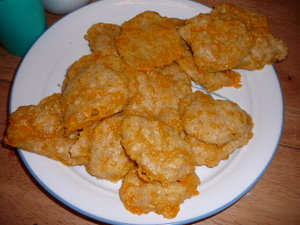
Chive Biscuits

Description:
This is mostly the Joy of Cooking recipe for whole wheat biscuits with a bit of changing up to make it chive-worthy.

Ingredients:
1 3/4 c flour (I used mostly hard red wheat with a smidgen of white flour thrown in. The recipe called for more but we didn't have it and it still came out just fine.)
2 t. baking powder
1/2 t. baking soda
3/4 t. salt
1/3 c. (5 1/3 tablespoons) butter
1 c. buttermilk (or sour cream)
chives to taste (I cut in about 2 tablespoons of chives)

Directions:
Blend all ingredients except buttermilk in mixer until pebbly. Don't let it get to a solid mass. Add buttermilk and chives and mix.

I used a cookie scoop to make mini-biscuits cooking them for 10 minutes at 400F degrees. I love my cookie scoop and it makes dishing things out so much easier. The biscuits come out looking like bite-sized puffs.

April 28, 2010

Meg's Chocolate Brownie Cakes

Description:
Nathan asked me today if he could try making some Molten Chocolate Baby Cakes. I was just about to start staining some shelves on the back porch and wanted to get it done before the sun went down, so I popped open the recipe, helped him find a few key ingredients and left him to it. ... Only to realize, as I glanced at the recipe to give him some pointers, that what I have written there isn't really how I make the baby cakes. So leaving him to go it alone meant he "did it all wrong" (mainly by not stirring the chocolate and letting it burn... but I think if he'd had the butter in there it would have gone a little better for him). So I decided to rewrite that recipe according to the way that *I* make these mini-cakes. Hopefully next time Nathan will be able to follow these directions step-by-step and get it right the first time. (We managed to pour out the not-burned chocolate and finish up the recipe ending up with a pretty respectable mini-cake.)

Ingredients:
4 tablespoons butter (1/2 a stick)
12 ounces bittersweet or semisweet chocolate (I aim for 8 cubes semi-sweet and 4 cubes bittersweet Baker's chocolate.)
4 large eggs
Pinch of salt
¾ cup sucanat
1/3 cup flour (I usually use ground hard red wheat.)

Directions:
1. Preheat oven to 400 F degrees.

2. Put the chocolate and butter into a small sauce pan and melt over low heat stirring very often. Once melted, remove from heat and let it sit while you mix together the next set of ingredients.

3. In a medium sized bowl, mix the eggs, salt, and sucanat until well blended. Add the flour and stir until combined.

4. Pour the chocolate mixture into the egg mixture and stir until combined, scraping the edges of the bowl to mix well.

5. Pour the batter into silicone cupcake holders. (I set these into a cupcake pan, but you can set them right on a cookie sheet as well.)

6. Cook the brownie cakes for 11 minutes. When you pull them out of the oven they might still be wiggly.

If I serve these immediately, then I give people a spoon to eat them with and we slurp up the goopy brownie cake like it's a thick chocolate pudding. If you let the brownie cakes cool until they are room temperature, they will be more like a soft brownie.

April 24, 2010

Introverts in the Church: Finding our place in an extroverted culture

Rating:★★★★
Category:Books
Genre: Religion & Spirituality
Author:Adam S. McHugh

Applying the Meiers-Briggs Type indicator (MBTi) to issues of spirituality and church life appears to be a trend of late. Phil Douglass sorted churches into various personality types in his book What Is Your Church's Personality? and Sandra Krebs Hirsh and Jane Kise addressed preferred worship, prayer and spiritual interaction styles for each of the 16 MBTi categories in their book Soul Types. Adam McHugh’s book, Introverts in the Church, is the latest in this "personality types and spirituality" trend to arrive on the scene. McHugh takes on the difficulties introverts face in an extroverted evangelical culture. He describes several innate differences between introverts and extroverts and encourages introverts in the church that they are not less spiritual just because extroverts are placing expectations of extroversion upon them. And he addresses strengths that introverts have and how these strengths can be helpful and balancing for the church as a whole.

I suspect there are areas in each of our lives where we act or think a certain way and think, "well, that's just me." A good example of this in my own life is my reticence to make phone calls. There is a call I was asked to make 4 weeks ago that I have yet to make. If I had been given an email address, I would have already made the connection and passed on the info that I was asked to convey. But because all I have is a phone number, it just hasn't happened yet. It's not like I deliberately avoid making the call. It's more like the phone and I are oppositely polarized magnets that just can't seem to get together. It dawned on me a few years ago that perhaps it wasn't just me. Maybe there were others out there that had a similar struggle. I asked several INTJ's about this in an online community I was a part of and was delighted to discover that they weren't fans of the phone either. It was liberating to realize that there was a reason I struggled with phones. I wasn't just being contrary or rude or lazy. I could point to a reason, my introverted tendencies, to explain my aversion. This feeling of liberation is something that I think most introverts will feel as they read the first few chapters of McHugh's book. (The fact that I can pinpoint a reason for my phone reticence doesn't mean that I shouldn't still push myself outside of my comfort zone at times, of course.)

The evangelical church in the United States applauds activity and overt (even "loud") Christianity. A "good" Christian is one who is out evangelizing complete strangers, who is demonstratively excited about being a follower of Jesus, and who jumps feet first into church projects without necessarily spending time in planning or prayer beforehand. Introverts, by their very nature, are more likely to take things slowly and with aforethought. They are more contemplative, often more academic or bookish, and they prefer relating to people one on one or in small groups. McHugh points out that both extroverted and introverted means of interactions are important and helpful (rather than only valuing extroverted modes of operation as is common in Evangelical churches today and making introverts feel bad, or even less spiritual, if they don't fall in step).

McHugh spent a chapter explaining not only the differences in personality traits between introverts and extroverts, but he also delved into the physiological differences, which I found incredibly fascinating. (I posted about it in the INTJ group here if you'd like to read more.) He spent a couple of chapters exploring the types of spirituality and community interactions that introverts prefer. (I would recommend the Soul Types book if you're interested in hearing even more on this. McHugh not only skims the surface on these issues, but he also doesn't take into consideration how Thinking vs. Feeling, Judging vs. Perceiving, or Intuitive vs. Sensing personality differences affect personal worship preferences. His focus is introversion in a more general sense, which he covers admirably.) McHugh spends the second half of his book focusing on the strengths introverts bring specifically to the areas of church leadership and evangelism. (More on introverted evangelism here.) Rather than being "movers and shakers," introverts are more likely to be contemplative leaders who help to lead their congregation toward the bigger picture. (It was at points like this that I felt like McHugh was attributing to introverts traits that fit better with other parts of the Meiers-Briggs Personality typing. In this case he seemed to be describing intuitive leaders as opposed to sensing leaders.)

Though I didn't agree with all of McHugh's conclusions, I definitely agree with the idea that both extroverted and introverted strengths are helpful and necessarily in a healthy church. (In fact, in my mind, the ideal church is one in which all personality types of the MBTi are integrated in such a way that strengths of each type are equally valued rather than only valuing the strengths of one personality type and downplaying or even criticizing the strengths of other personality types.) Introverts shouldn't feel like "lesser Christians" simply because their personality traits don't fit in with the accepted "norms" of American Christianity in today's day and age.

Though I've been familiar with the concepts of Introversion and Extroversion for a couple decades now and I've studied them specifically in the context of church and spirituality for the past few years, I still found Introverts in the Church to be an excellent summary of Introversion (a summary that even non-Christians might find interesting and helpful) and an encouraging look at how the strengths of introverts can be a pillar of strength for the American church (right alongside the already accepted pillar forged from extroversion).

April 2, 2010

The Future of Food

Just watched the movie, The Future of Food. It's crazy scary. At one point I turned to Rob and said, "This is a horror film!"

The first half of the film gives a scathing review of Monsanto's actions for the past few decades. The film pretty much agrees with what was said about Monsanto in the movie, Food Inc., but it includes damning documentation from Monsanto itself.

Within the discussion of Monsanto, several overarching issues are also addressed, most especially the patenting of life and the loss of property rights (of farmers). Even when a farmer and his predecessors have been growing and modifying a crop for generations, if even a little bit of Monsanto's patented gene gets cross-pollinated into it, Monsanto can take you to court for patent infringement. In such a case the farmer is required to destroy the seed that his family has been growing and modifying for generations because Monsanto didn't keep its patented seed from intermingling with his family's seed (and Monsanto is not required to keep its seed out either).

The movie then rolls right into the problem of genetically modified foods -- especially as they proliferate outside of the lands where they've been planted. Food allergies are a problem because genetically modified foods are not labeled in the U.S. and therefore can be unknowingly consumed. And there's the problem of a genetically modified organism containing the terminator gene (a gene that renders the next generation of that seed useless for planting) spreading into the world at large. (This is where it started to sound like a horror movie. Can you imagine what would happen if a large percentage of the world's crops got inadvertently crossed with the terminator gene? That would be our last year of those crops. The following year would be one of mass famine.)

Anyone who's concerned with the property rights of the individual, the health of yourself and your children, or the health of the environment, should watch this movie. ... Actually, if you eat, you should watch this movie.

March 31, 2010

Super Recycle Girl


One day about 2 years ago, I loaded up all our recycling materials and pedaled out to the recycle center about 4 miles away. I felt very self-righteous about not driving out there and I felt even more so when I saw an SUV (the second picture, though it's only half in the shot) drive up by me. So I snapped some photos.

I haven't done it since. So much for my self-righteous self.

These are pictures that have been sitting around in my media locker. While I was working on the movies this past month, I went through the media locker and pulled out a bunch of shots that were in storage that I had lost off my hard drive when our computer crashed (during the move). While I was digging around in there I came across these and thought I'd post them.

March 27, 2010

A generation of "environmentalists" who rarely walk (or play) outdoors

"...our young people are more aware of threats to the global environment than they are of the natural world in their own backyards." - David Elkind, in his New York Times article, "Playtime Is Over"

March 21, 2010

Yam Sandwiches

Description:
The cafe around the corner from our house in San Francisco makes some yummy sandwiches. One of my favorites has always been the yam sandwich, which I really missed when we moved. So I grabbed a to-go menu one year when we were back in SF and used their description of the sandwich to recreate a version of my own.

I wanted to check the recipe today and though I knew I had posted it here somewhere once (I think it was in the vegetarian group.) I couldn't find it. I finally turned it up on T's site, but I figured it was high time I had a copy of the recipe on my own site. So here it is. (ps: I used T's picture. It rocks and way outdoes any pics I've taken of the sandwich myself.)

Ingredients:
* 1 or 2 large yams (depending on how many sandwiches you'll be making)
* toasted baguette (or any other kind of bread. I often use regular slices of whole wheat bread)
* feta cheese (crumbled)
* cilantro (just the leaves)
* tomato (I leave the tomatoes out if they're not in season.)
* red onion
* garlic olive oil (or a garlic oil spread = butter and olive oil in equal measures, a couple of cloves of raw garlic and a sprinkle of salt, blended till smooth)

Directions:
Lightly oil a cookie sheet with olive oil. Slice the yams (or sweet potatoes). Lengthwise is best in terms of keeping the slices on the sandwich, but medallions are probably easier to cut. As I put them on the cookie sheet I rub one side in the oil, then flip the piece of yam over. That way both sides get oiled. Each piece should be only about a quarter of an inch thick. Put these in the oven for 10 minutes on each side at 350 degrees or until soft enough to run a fork through easily.

You can set the roasted yams aside for later, or put them directly into a sandwich. They don't have to be warm to make a really tasty sandwich, though. So don't be afraid to roast them in advance and add them to a sandwich later, even if they're cold.

To make the sandwich spread the garlic oil on the bread, add slices of yam, cilantro, red onion, feta and tomatoes to taste.

March 20, 2010

Introverts in a Crowd

Adam McHugh posted this in his blog recently and it made me laugh because it fits me so well:

Here’s how I tend to respond when I enter a room full of people I don’t know:
  • I find something to occupy my time – Play with my phone, doodle on paper, read my Kindle (you wonder why I carry this stuff…)
  • I pretend I don’t see people…often I don’t…but I’m likely to pretend just in case.
  • I hide in the lobby until the last possible moment…
  • I find someone I do know and latch on to them…
  • I secretly hope some likable Extrovert will approach me and break the ice… (Really, it’s not that I don’t want to talk, it’s just starting the conversation that’s often difficult.)

I suppose I'd replace the Kindle and cell phone with kids. I'll busy myself with telling them where we should sit or what they should do with their jackets. I'm not really a gadget person. But the rest, yup, that's me. 

Mountains Beyond Mountains

Rating:★★★★★
Category:Books
Genre: Biographies & Memoirs
Author:Tracy Kidder

"We should all be criticizing the excesses of the powerful,
if we can demonstrate so readily that these excesses hurt
the poor and vulnerable."
-- Dr. Paul Farmer


Paul Farmer is apparently well known in medical circles for his work in TB and HIV. But I'd never heard of him before our book club decided to read Mountains Beyond Mountains: The Quest of Dr. Paul Farmer, a man who would cure the world. We picked the book for two reasons: A great deal of the book is devoted to Haiti - its history and the severe poverty of its people. Given that the earthquake had just taken place when we were choosing books, Haiti was definitely on our minds and we were eager to find out more about what the country had been like before the earthquake hit. But we also leaned toward this book because it reminded us of Greg Mortenson's story, Three Cups of Tea, which we had all appreciated. Farmer, like Mortenson, saw a severe need among a particular people group and he devoted his life toward improving the conditions of those people both directly and through educating others and encouraging them to lend their help as well.

During Farmer's undergraduate studies at Duke in the early 80s, he was keenly interested in current events and at the same time he became intrigued by a branch of Catholicism called liberation theology. [By the way, that's a term that Glenn Beck would probably recommend you run from.] He was particularly impressed by a local Belgian nun who was involved in helping and protecting the rights of migrant Haitian farm workers. She and other "church ladies" as Farmer called them, "were the ones standing up to the growers in their sensible nun shoes. They were the ones schlepping the workers to the clinics or court, translating for them, getting them groceries or driver's licenses." He began to see the disparities between the affluence that surrounded him at the university, and the severe poverty of the migrant workers in the fields not far from Duke.

After meeting the Haitian farm workers, he began to read everything he could find on the country. As Kidder describes it, "To Farmer, Haiti's history seemed, indeed, like The Lord of the Rings, an ongoing story of a great and terrible struggle between the rich and the poor, between good and evil." He first visited the country in 1983, after having graduated from Duke summa cum laude. He spent a year there in which he traveled throughout the country, meeting people, seeing the outrageous results of former American interventions in the country, and being drawn back toward Catholicism -- especially the liberation theology that he had discovered during his college years.

Farmer was accepted into Harvard's medical school but he spent every moment that he could back in Haiti building a medical clinic in Cange, one of the poorest regions of the country. In fact, he often missed classes, making it back to school just in time for exams. But the professors allowed this because Farmer's first hand experience with the medical issues of Haiti often meant that he had more hands on experience than they did.

With the help of a generous donor, Tom White, Farmer's work eventually grew into an international aid organization called Partners in Health, which works largely in Haiti but has branched out into parts of Peru and prisons in Russia. In the 90s, Farmer challenged the WHO's directives regarding dealing with TB in impoverished areas and, through the examples of what had been accomplished by PIH in Haiti and Peru in particular, he was able to convince them to change their policy in order to tackle the drug resistant strains of the illness that the old policy not only wasn't dealing with, but was even strengthening.

Though Mountains Beyond Mountains is a biography of Farmer's life, it is also in large part a discourse on justice. As Tracy Kidder paints a picture of what Haiti was like when Farmer first arrived, and the political upheavals that have taken place over the past few of decades, it becomes very clear that the United States has had a negative impact on the country. The interests of the rich (both in the US and in Haiti) have repeatedly been put ahead of the interests of the poor. And the world, in large part, has mostly ignored the desperate poverty of these people. It was only the Catholic church that refused to turn a blind eye, a fact that was not lost on the people of Haiti. Kidder explains the Haitians take on God's involvement:

How could a just God permit great misery? The Haitian peasants answered with a proverb: "Bondye konn bay, men li pa konn separe," in literal translation, "God gives but doesn't share." This meant, as Farmer would later explain it, "God gives us humans everything we need to flourish, but he's not the one who's supposed to divvy up the loot. That charge was laid upon us."


It was likewise clear to Farmer that the problem in Haiti wasn't God, it was people. He explained that "the fact that any sort of religious faith was so disdained at Harvard and so important to the poor -- not just in Haiti but elsewhere, too -- made me even more convinced that faith must be something good." That's certainly not how most people I know balance the value of faith vs. lack of faith, but it's indicative of Farmer's interests and motivations. He stands firmly on the side of the poor: financially, spiritually, and pragmatically.

This is a book that I can easily recommend. Though it deals with medical issues, it doesn't get bogged down in terminology. It's not preachy, and as a reader I never felt like Farmer or Kidder were trying to convince me that their way was right so much as they want to get the message out to people that something should be done, our help is welcome, and here is a very practical way in which one person has made a remarkable difference in the lives of the poor. Kidder says of Farmer and the others in PIH:

Change the world? Of course they could. He really believed this, and he really believed that "a small group of committed individuals" could do it. He liked to say of PIH, "People think we're unrealistic. They don't know we're crazy."


- - - - -

PIH is currently involved in helping Haiti rebuild after the earthquake. If you would like information on what they are doing, or would like to donate, check out standwithhaiti.org/haiti.

March 19, 2010

Just got back from hearing Joel Salatin speak

Rob and I first heard about Salatin when we read the Omnivore's Dilemma together (a book by Michael Pollan). I was particularly intrigued by him not only because he's a brilliant farmer, but because he's a Christian who takes great care in his job particularly because he realizes he is a steward of God's earth. More often than not, Rob and I have been in the minority in the churches we've been a part of because we make pro-environment decisions (like driving less, eating organic/local, etc). So it's exciting not only to hear about a like-minded Christian, but to find out about one who is an icon in environmental and sustainable circles. Joel Salatin is leading the way in building a sustainable farming model that grows a large variety of food in such a way that it improves the land rather than degrading it.

I've also seen Joel Salatin on Meet the Farmer (segment 1, segment 2, segment 3 -- if you only have time for one, watch the second, but they're all good), and we recently saw him in the movie, Food, Inc. (which I highly recommend). Though Salatin has been writing and getting the word out for awhile now (he's been publishing articles in Mother Earth News for decades now, I believe), it seems that he's recently been hitting the public consciousness and local food movements are eager to follow his example.  That's why The Front Range Permaculture Institute invited Salatin out to speak on Change We Can Eat. They had originally planned to have him speak in a local church, but the response was so large that at the last minute, they secured a room at the Lincoln Center for him to speak. (Though there were still some open seats, there weren't many. This was a pretty significant turn out considering that Fort Collins (the university as well as the public school system) is on spring break and many people are out of town.)

Joel was, as always, eccentric, hilarious, practical and brilliant.  He wasn't shy about sharing his opinions, even when he suspected the crowd might not agree. And he made some really great points about food in America. He says that we've confused sterility with safety. We believe that the answer to pathogens is sterility rather than growing healthy, sound, safe food that is alive and nutrient dense. Many of the laws regulating food growers (in addition to not making a whole lot of sense) are about controlling market access, not about enabling food safety. 

He talked a lot about metabolizing innovations as well as enabling innovation among small farmers, but I couldn't even begin to do justice to all that he said on those topics. He'd love to see a constitutional amendment allowing for Freedom of Food Choice so that people could buy raw milk, or home made (as in, made in the home) baked goods or jams, without it being illegal and without the food producer having to jump through industrial food corporation sized hoops to sell their food items legally. (It's legal to give a friend or neighbor a home made food product.  But it is not legal to sell that same home made food product to that same friend or neighbor.)&nbsp

Things that he talked about that I'd like to do more research on:

1) Right of Private Contract: He says that in America we have the right to make a private contract with another individual without the government butting in, and that through that right of private contract, we should be able to make baked goods that we then sell to end users.  I don't question this so much as I just know absolutely nothing about it. I think it's time I dug a little deeper. 

2) Monsanto: He mentioned that Monsanto is suing Ojibwa Indians in Wisconsin because they're harvesting the same rice that they've been harvesting for centuries. This sounds a lot like the mentions of Monsanto's activities as described in Food, Inc. I was already thinking of doing some more study on Monsanto because a friend of mine has another friend who works at Monsanto, and when we started talking about the movie Food, Inc. on my friend's Facebook page, she jumped in to say basically that Monsanto was above reproach in that matter.  She gave me some links to check out and I haven't had the time. So I'm hoping to dig a bit deeper into the Monsanto mystery and Salatin gave me an additional path to follow on this. 

Though the folks introducing Salatin waxed rather long (It took them at least 30 minutes to introduce the guy.) his talk was well worth attending. I'm glad we made it back from our spring break misadventures in time.

March 16, 2010

Saint Patrick's Day Parade - Fort Collins, CO


They went by right as we arrived.

We've been out of town for the past several years worth of St. Paddy's day parades, so the kids were thrilled to go to this one. We walked down at 10am and missed the first few entries. The kids got bored somewhere around #48, at which point we walked back home.

I mostly focused in on the animals (because I knew the girls would prefer those pictures). But my favorite entry of the entire parade was the Fort Collins Nursery Red Flyer Brigade. Well done!

March 2, 2010

Our first set of foster animals


This is a video of the almost two months that we spent with our first set of foster kittens: Ewok (who didn't last past the first four days), Sunshine and Marshmallow.

Looking back, if we had known what to look for, we would have realized that the fact Ewok needed a bath to clean the poop out of his fur was a sign that he wasn't doing well. But we were completely naive. You'll see Anna giving the poor little guy a bath in the video. I doubt he had an infection, though, as the other two kitties were, and remained, healthy. Both of the girls got choked up as they watched the clips with Ewok in them.

You'll also see Marshmallow attacking a cheese puff. I just want to say, for the record, that I do not condone the feeding of cheese puffs to kitties. One of the girls videotaped the event and I didn't know about it till later. However, despite not supporting such a diet for kitties, it didn't harm her and it really was rather cute, so I included that bit of footage.

The wet kitty is Marshmallow, as mentioned in my post entitled A Fishy Sound.

Sunshine has a teeny bit of white on her chest, but it's hard to see that as she careens past the camera. Trust me, she's well represented in the video even though she doesn't have a cute moment with a cheese puff or a scary moment with a bathtub.

The kitties will go in to the Larimer Humane Society tomorrow morning at 9:30. We're gonna miss them, but we have high hopes that they'll find warm, loving homes quickly.

- - - - -


Music: There are two tracks on the video. Both are by Anna Kashfi. The first is "Buttons and Bows" and the second is "A Safe Place". I downloaded the songs from eMusic. (If you'd like to join eMusic, let me know. I can get free songs for inviting you. I've been with them for a few years now and found some really great music through them.)

February 28, 2010

Buckwheat Crepes

Description:
Ti Couz, in San Francisco, makes the best Brittany Crepes I've ever had. I was thrilled when La Creperie of Fort Collins opened up. But as much as I'm pleased that Brittany crepes are now available locally, I still miss the way they're made at Ti Couz (with yummy sauces).

This past Saturday the girls had a friend over for the night and for breakfast I decided to make them sweet crepes with blueberries. They came out really well and Anna has been begging for crepes again ever since. So I promised her that we'd have crepes for dinner tonight. I made a batch of sweet crepes for the kids, but decided to boldly strike out into buckwheat crepe territory for Rob and myself. It took a bit of doing to find a bag of buckwheat in the pantry (I somehow overlooked it the first time as I dug through the rice and other grains -- buckwheat isn't a grain, by the way, but that's still where I store it), but once I found it I tossed it into the grinder and made my first ever batch of buckwheat flour. (I've used buckwheat pancake mixes in the past, but I don't know that I've ever cooked with plain buckwheat flour before.)

These crepes came out well, though they weren't as buckwheaty as either Ti Couz or La Creperie. Rob really liked them, though. (He told me they were better than La Creperie's crepes, but maybe he's just trying to earn some hubbie points. "The texture was better," he claims. Ironically, I had been thinking that it was a bit too silky smooth for a proper buckwheat crepe (which is a bit scratchy to eat). I think the next time I make these crepes, I might see what happens if I use all buckwheat flour and no wheat flour.

For Rob, I tucked some cheddar cheese and sliced ham inside as filling. For myself I diced up a tomato that was going bad on the counter and added some cheese to that. ... As you can tell, my fillings are still somewhat lacking. And I didn't plan enough ahead to have yummy sauces to top off the crepes. So fillings and sauces will have to be my next point of focus now that I've got a respectable crepe to wrap it all up in.

Ingredients:
1/2 cup buckwheat flour
1/2 cup flour (yes, I used white flour again, believe it or not)
1 cup milk
3/4 cup water
3 large eggs
2 Tablespoons vegetable oil (I used olive.)
1 teaspoon salt

Directions:
Combine all of the ingredients until smooth. (The Joy of Cooking suggests using a blender to thoroughly blend up the batter.) Let the batter sit for one hour.

Batter can be refrigerated up to one day.

Pour about 1/4 to 1/2 cup of batter onto a buttered skillet. Flip when the first side is lightly browned. Cook until the second side is a light brown color. Serve with a savory filling.

February 27, 2010

Sweet Crepes

Description:
I've tried making crepes many times and they usually won't flip well and end up being more like scrambled crepes than breakfast or dessert crepes. But this recipe came out well so I thought I'd post it here for future reference.

This is from the Joy of Cooking.

Ingredients:
1 cup flour (I actually used white flour this time. OK, OK, pick yourself up off the floor now.)
1 cup milk
1/2 cup lukewarm water
4 large eggs
1/4 (1/2 stick) butter, melted
1/4 teaspoon salt

Directions:
Mix ingredients together until smooth. Then let sit for 30 minutes. (Or fridge for up to two days. But let sit 30 minutes until room temperature before cooking.) I have no clue what the sitting does for the crepe, but I tried it this time (OK, so I was only able to wait about 15 minutes).

The book suggested pouring 1/4 cup batter onto the griddle at a time. I finally got tired of making such tiny crepes and went to somewhere around 1/2 cup.

February 21, 2010

Cream of Peanut Soup

Description:
This recipe has been modified from history.org, where it is listed as being an original recipe from King's Arms Tavern in Colonial Williamsburg, Williamsburg, Virginia.

Ingredients:
¼ cup (1/2 stick) unsalted butter
1 medium onion, finely chopped
2 celery ribs, finely chopped
3 tablespoons flour
8 cups Chicken Stock (I used veggie bouillon in water.)
2 cups smooth peanut butter
1 ¾ cups light cream or half-and-half
Finely chopped salted peanuts, for garnish

Directions:
In a large saucepan or soup pot over medium heat, melt the butter. Add the onion and celery and cook, stirring often, until softened, three-five minutes.

Stir in flour and cook two minutes longer.

Pour in the chicken (or veggie) stock, increase the heat to high, and bring to a boil, stirring constantly. Reduce the heat to medium and cook, stirring often, until slightly reduced and thickened, about 15 minutes. (The history.org recipe calls for removing the onions and celery but I left the veggies in for added texture.)

Whisk the peanut butter and the cream into the liquid. Warm over low heat, whisking often, for about five minutes. Do not boil.

Serve warm, garnished with the chopped peanuts. (I skipped this since I served the soup at a potluck)

January 30, 2010

E-mail as a form of communication

A couple of weeks ago, one of the gals in our Sunday school class took off down a bunny-trail about how e-mail is a horrible way of communicating with people. The irony was that several people in the room were quite comfortable with email as a means of communication and a few even preferred it.

I'm still working my way through Adam McHugh's book, Introverts in the Church, and I just came across some quotes by him that summarize quite nicely, in my opinion, the strengths of email -- especially for the introvert who may prefer this medium to phone communication.

"E-mail, in particular, allows us to think before we communicate, to correspond at our own pace and to change what we say before we send it.  E-mail doesn't make the immediate social demands that cell phones do, and it enables us to communicate without interruption.  In addition, there is a degree of distance in communication via e-mail, and this distance frees us to be more vulnerable than we might normally be."

I already knew all that.  But sometimes it's nice to hear someone else say it.

January 23, 2010

Meg's Impromptu Movie List

My friend Sarah and I drove down to Denver together yesterday and talked about movies while we were bumming around at the Museum of Nature and Science.  I told her I'd send her a movie recommendation list when we got back. While I was typing it up I thought I'd throw it up here as well in case anyone else is looking for a good movie to watch.

The list is in no specific order, doesn't necessarily give a lot of detail, but these were all movies we'd rate pretty highly.
the movie we watched last night was very good (an academy award winner, apparently). it was called Departures.  it was about a cello player who changes professions and becomes a type of undertaken.

Kinamand was a good flick about a plumber who helps out a Chinese family.

The Dinner Game was a really twisted movie that you'd probably enjoy. They play a game in which the person who brings the stupidest guest wins. But the stupid guy finds out....

Chocolat was good. A little predictable, but still good.

The Children of Huang Shi was the one I told you about where the American guy helped move orphans to safety in China when the Japanese were attacking.

Kenny is hilarious! It's run like a documentary but I'm not sure that it is. It's about a guy that runs a port-a-potty business.

I Am David is about a 12 year old boy that escapes from a communist concentration camp. Might be a bit too much of the same old, but Rob recommended I add it to the list.  He liked it a lot.  (I did too, but it is sort of the WWII ethos carried forward a decade or so).

Be Kind Rewind was hilarious. They have to redo several big time movies on a low budget and it becomes a hit.

Son of Rambow was also hilarious. If I remember correctly it was kind of a coming of age movie. The movie making was fun. Touching ending.

The Lives of Others is the East German movie we talked about. But I think you said you'd seen that one?  Very good.

All Passion Spent was a film about an introvert trying to escape from her extroverted life after the death of her husband.

Spitfire Grill was an interesting movie about a gal trying to get her life back together after doing some prison time. Sad ending, though.

Bagdad Cafe is an older flick, but it was delightfully quirky. Rob didn't like it as much as I did.

Divided We Fall is one I mentioned about a couple that take in a former Jewish neighbor to protect him from the Nazis. A bit different than your average "save the jews from the nazis" kind of film both because the flick has more of a small town feel and because they throw in some communists for good measure. We both like this one.

Spring Forward is about two guys that work in the park system. It's not really a coming of age movie as much as it's a coming into maturity sort of movie.

If you've never watched Dear Frankie, that's one of our favorites. Heart breaking story with a nice ending.

Ones we watched with the kids:

The Ultimate Gift is one we watched as a family. It was a bit of a tearjerker but we all enjoyed it. 

October Sky was another good family movie (and included geeks who were being picked on but who turned out to be the heroes in the end).

Evelyn was another heartbreaking family movie. I think it unsettled the kids a little that the kids could be taken away. But the father's love was extraordinary and all the kids cheering at the end made the kids feel better.  Good flick. 

K-Pax is a classic.  I'm pretty sure we watched this with the kids. It's one of those sci-fi movies that kinda keeps you wondering.

Opal Dream was an interesting adventure tale in which the girl has two imaginary friends and you always kinda wonder in the back of your mind if they're real.


January 18, 2010

Introvert or Extravert?

I'm reading a book called Introverts in the Church: Finding Our Place in an Extroverted Culture and the author, Adam McHugh, gives three categories of differences between Introverts and Extroverts. Apparently he took the description from another book called The Introvert Advantage by Marti Olsen Lancy.

First of all he points out that:
Introversion is one of a constellation of factors that fluidly work together to shape how we act. Introverts gather the information that feeds our inner worlds in different ways; some rely on the concrete experiences of the senses (an S on the Myers-Briggs), while some depend more on their intuition (an N), interpreting what lies below the surface. Some introverts make decisions more from their hearts (An F) and others more from their heads (a T). Some prefer to structure their lives carefully (a J), whereas others opt for more spontaneity and flexibility (a P).

We also fall somewhere along a spectrum between introversion and extroversion. With the three categories he describes, I find that some people immediately strike me as extroverted in one category, but it's a little more ambiguous in another category. And even within a specific category, we may lean toward one side or another, but it's possible that we show characteristics of the opposite side of the spectrum at times.

The three categories of introversion/extroversion are: 1) energy source, 2) internal vs. external processing, and 3) depth vs. breadth.
Introverts are energized by solitude.  We are recharged from the inside out, from the forces of our internal world of ideas and feelings.

We generally fill our energy tanks in private or in the presence of one or two close friends, or else in a public place without interacting with those around us.

Long periods without quiet refueling leave introverts feeling physically exhausted and emotionally hollow.

Extroverts, on the other hand, derive their energy from outside of themselves. They need other people, interaction and various kinds of stimulation in order to replenish their energy. Too much time alone, silence or inactivity leaves extroverts feeling drained.

I've often heard people explain the energy category (and I've done this myself) specifically in terms of spending time with people, but over time I've grown to see that it's not just a people thing. As he points out above, activity and variety are also keys to the energy equation.  I've noticed before that on days when I have one large project to work on (like making year end school movies or pumping out year end giving statements) I have more energy at the end of the day than when I've spent the day clawing my way through a to-do list 20 items long (even when the items on the list were all small things like making a phone call or tackling some burnt out light bulbs). There's something about the transitioning from one task to the other that wears me out. If I can find a way to make the tasks all seem congruent, I do better than when they strike me as disparate tasks.

In our culture we are continuously bombarded by stimuli, in the forms of information, images, conversation, and a multitude of other data and experiences.  In order for introverts' lives not to degenerate into disassociated states of confusion, we need to process these stimuli and integrate them into our lives.  Another way that this integration process might be described is filtering.  We need to filter information and experiences, allowing the good to take root in us and transform us, discarding the bad or irrelevant.

Extroverts have flexible and porous filters that allow much to pass without getting clogged.  They can usually take a much higher amount of stimuli before they become inundated.  They mostly process externally, through conversation and interaction with others. Taking is an integral part of their processing, and they often speak in order to understand. Their speaking and thinking occur simultaneously. Though they are capable internal filtering and reflection, they are most alive when engaged in the world of people and activity.

...extroverts may be more physically expressive than introverts.
The introverted filter, on the other hand, is much finer and more rigid, only able to allow small amounts of stimuli to pass before it backs up. Introverts process internally, in the workings of our own minds.  We integrate and think silently. Ideally, we like to be removed from external stimuli and people in order to process.

Though we are capable of engaging in the world, we are most alive in the reflections of our minds, mulling over concepts and experiences.  Our learning style centers around observation and contemplation, and we are not as dependent on external feedback for growth.

Many introverts do not do well with interruptions, either when we are speaking or reflecting.

When the finer filters of introverts become clogged in the presence of people, we often go silent.

When this filtration process is impeded, the result can be disorientation and confusion -- or for me, temporary depression....

My first thought upon reading about this second category was, "but I'm so good with Dad!" Part of having Picks disease includes perseveration, which means saying the same thing over and over and over again until everyone around you goes insane. My dad's perseveration drove my mom nuts, and my sister, but somehow I put up with it easily.  But I suspect that's because, after having 3 kids under the age of 2, I learned to filter beyond my filter. I could "turn off" my dad in a way that they couldn't and sometimes people would complain about my dad's repetitions and I'd be surprised that he'd been speaking that whole time and I hadn't even noticed.  (My kids hate when I've turned them off -- they keep asking me a question and I don't hear them at all. There are definitely times when it's not an asset.)

But as I finished reading this section, especially the last bits about shutting down and getting depressed, a light bulb went off.  There have been so many times when I've been in the midst of a stressful conversation and between my trying to convey my thoughts to people who obviously weren't understanding me, and trying to make sense of and sort through their responses to me, I would just get to the point where I couldn't even function any more. I'd have to leave the room. Or I'd break down in tears. Or I would just get very, very quiet.

Introverts tend toward high degrees of intimacy in our relationship, which we usually have fewer of than extroverts.  Introverts are rarely content with surface-level relationship and do not generally consider our acquaintances to be friends.  We may find small talk to be disagreeable and tiring.

Introverts also prefer to have depth in fewer interests.  This trait is connected to our style of processing. The breadth of information about a wealth of topics often results in introverted-filter overload.  Instead, introverts prefer to invest our energy resources into a a smaller number of topics or activities. We desire to mine them for all their richness, to explore all their nuances and complexities. This commitment to specialization of expertise, along with our love of ideas and our powers of concentration, explains why many introverts thrive in lives of scholarship.

Although this third category introduces a new idea regarding introverted vs. extroverted behavior, I think it overlaps a lot with the other two categories. Switching between topics is harder on our filters than sticking with one topic and digging deep. The same holds true with switching between activities or even with the number of people we hang out with.

The way I think of it sometimes is sticking on the main road vs. taking detours, especially detours that I wasn't expecting. If I *feel* like I'm sticking to one general task all day, I do a lot better than when I feel like I'm headed in one direction, and then a friend of mine calls up to ask if I'd like to go for a walk and suddenly I'm like a deer caught in the headlights. "What! Throw a variable into what had started off as a straight forward day?! You've got to be kidding!" I go silent and I'm sure she's on the other end of the line wondering what happened to me. And when I relent and go on the walk (because she IS my friend and I DO like going on walks once in awhile, though I usually prefer being alone) I come home and the rest of the day is gone. No matter how much work I still had to do, I'm physically and emotionally unable to deal with anything else that day.

McHugh, in this chapter on the differences between Introverts and Extroverts, gives a list of "common attributes of introverts." If you're still not sure on which side of the spectrum you fall, perhaps this will help:
  • Prefer to relax alone or with a few close friends.
  • Consider only deep relationships as friends.
  • Need rest after outside activities, even ones we enjoy.
  • Often listen but talk a lot about topics of importance to us.
  • Appear calm, self-contained and like to observe
  • Tend to think before we speak or act
  • May prefer a quiet atmostphere
  • Experience our minds going blank in groups or under pressure
  • Don't like feeling rushed
  • Have great powers of concentration
  • Dislike small talk
  • Are territorial -- desire private space and time
  • May treat their homes as their sanctuaries
  • Prefer to work on own rather than with a group
  • May prefer written communication
  • Do not share private thoughts with many people
I've also posted some interesting quotes from McHugh's book regarding physiological differences between extroverts and introverts in the INTJ Group: Dopamine vs. Acetylcholine and Blood Flow

January 16, 2010

Caring for Your Introvert - The Atlantic (March 2003)

Caring for Your Introvert  < -- Click here to read the Atlantic Monthly article.

This is a classic article about introverts. If you are an introvert, it might come as a relief to read this and find that a lot of the things that have always drained you or annoyed you or stressed you out are normal. Every time I read this article I think, "Yes! That's it exactly!" over and over again. If you are an extrovert, this article will hopefully help you to better understand the introverts in your life. Unfortunately, after sending this article out to several extroverted friends, the standard response I got from them was, "That's funny. What a hilarious joke!" In other words, they didn't get it. They thought it was a spoof on the differences between introverts and extroverts, but not at all based in reality. *sigh*

Here's a few quotes from the article to whet your appetite: 

Introverts may be common, but they are also among the most misunderstood and aggrieved groups in America, possibly the world.
Introverts are not necessarily shy. Shy people are anxious or frightened or self-excoriating in social settings; introverts generally are not. Introverts are also not misanthropic, though some of us do go along with Sartre as far as to say "Hell is other people at breakfast." Rather, introverts are people who find other people tiring.
Extroverts are easy for introverts to understand, because extroverts spend so much of their time working out who they are in voluble, and frequently inescapable, interaction with other people. They are as inscrutable as puppy dogs. But the street does not run both ways. Extroverts have little or no grasp of introversion.

Enjoy!


(I thought I had posted this long ago, but I can't find it anywhere so I thought I'd repost the link.)

Dopamine vs. Acetylcholine and Blood Flow - Introversion vs. Extraversion

I am reposting this from the INTJ  group on Multiply.com (which is ending its social networking services in December). I won't be saving all of the posts that I wrote in the group, but this is one that I'd like to keep around to refer back to if needed.  I have back dated this post according to its original posting date.

- - - - - - - - - - - - - - - - - - - - - - - - - - - - - - - - - - - - - - - - 


I'm reading a book called Introverts in the Church: Finding our place in an extroverted culture (by Adam S. McHugh) and the author spends a fair bit of time essentially explaining introverts: how they're different than extroverts, why they're different, and what that means in terms of what's reasonable to expect and what's not. As I'm reading it I keep thinking, "So that's why I do that!" and "No wonder I often feel guilty I'm not doing that." (The guilt is because the extroverted culture tells us that we should be doing XYZ and for extroverts, that XYZ is something that energizes them so they really don't understand our reticence. But for us, it just wipes us out.)

I just hit a section on dopamine and brain function differences that I think is particularly interesting. I thought I'd include a few excerpts here.

Studies of the human brain have revealed three significant physiological differences between introverts and extroverts.  First, introverts have naturally busier, more active brains than extroverts.  Though introverts look calm on the surface, our brains are bubbling with activity, and thus we require less external stimulation than extroverts.  Too much external stimulation, in fact, leads to a feeling of overwhelm.  Second, blood flows in different paths in introverted and extroverted brains. Introverts have more blood flow, but it flows in a longer, slower path than in extroverted brains.  The blood in introverted brains flows to sections that are focused on internal things like remembering, solving problems and planning.  ON the other hand, the blood in extroverted brains goes to those parts that are used for the processing of sensory experienced, what's happening externally.

Third, introverted and extroverted brains have different chemical balances.  The activities of our brains are catalyzed by neurotransmitters, which are chemical substances that transmit nerve impulses.  Extroverts require greater amounts of dopamine, a central neurotransmitter in the sympathetic nervous system. It is produced when people are active and in motion. As psychologist and author Marti Olsen Laney writes, "extroverts feel good when they have places to go and people to see," probably because they are flush with dopamine.  Dopamine takes a short path through the brain and, in stressful situations, produces an "act and react" response.  It can be credited for extroverts' ability to think and speak quickly and to thrive under pressure.  It also helps them access their short-term memory more rapidly, so their data-processing circuit is shorter and faster. 
Introverts, on the other hand, require less dopamine, and when our brains have too much, we can feel anxious or overwhelmed.  Our brains rely more on another neurotransmitter, acetylcholine, a neurotransmitter of the parasympathetic nervous system, which conserves and restores energy, producing a "rest and repose" posture.  It produces a pleasurable sensation in introverts when we are thinking and reflecting. Acetylcholine, however, cuts a longer path through the brain, which explains why introverts may have difficulty accessing words or memories quickly and why we may be slow to react in stressful situation.  Introverts often prefer writing to speaking, because writing uses a different neurological pathway in the brain than speaking does. Additionally, the slower acetylcholine tributary may produces a posture of calmness in introverts and cause us to move more slowly than extroverts, which may explain why we are often less expressive with our bodies."

Wow, that explains a lot. I've always known that I don't interview well, but I thought only the nervousness could be attributed to being introverted. Now I know that the words on the tip of my tongue and the ideas not coalescing on demand (when they all came together so well just the day before as I was planning on the talk) are all a result of stuff going on in my brain. It's kind of a relief to know it's not that I'm just a moron.

December 23, 2009

One of my favorite Christmas gifts as a kid

To be honest, there aren't a lot of toys that I look back upon with longing or nostalgia.  I never cared for dolls (much to my mother's chagrin). I did enjoy Legos, but I wouldn't say that I felt any loss when my mom passed them on. (And we have more than enough Legos in the house now to make up for any loss then, thanks to Nathan.)

But there's one toy that I remember hoping and praying I would get for Christmas. And when I got it, I adored it! It was a magnetic driving car. It would drive in circles around a track and you could steer it right and left as it drove. You could even make it go faster or slower with the accelerator.  Sooooooooo cool!

What was one of your favorite Christmas gifts as a kid?


--------------

Here's a couple pictures of two toys similar to the U-Drive-It.


I think this version came out in the UK.
Instead of a steering wheel, you used a joystick to move the car around.


This is the steer-n-go. The mountains in this version are cool.

December 19, 2009

November 28, 2009

Thanksgiving Dinner - 2009


Potatoes, sweet potatoes, beets and carrots. I also threw in an acorn squash, but I didn't peel it first. I think next time perhaps I'll try butternut instead. It's easier to peel. I sprinkled fresh rosemary from the back yard over the whole pile.

We had a stunningly delicious Thanksgiving meal this year.

November 22, 2009

Albuquerque, Flagstaff, and the Grand Canyon


As we were leaving the EconoLodge in Albuquerque I looked up to see two hot air balloons passing overhead. Everyone else was already in the car ready to go but I made them all get out and look at the balloons.

Then we headed into Old Town and ate at the Church Street Cafe which I'd highly recommend. The breakfast was delicious (skip the pancakes and go for something that comes with one of their yummy chili sauces). We headed out for Flagstaff and enjoyed the variations in the rock formations along the way. In Colorado most of the rock has been mangled to some degree (lots of folding, mostly) but here the rock was fairly level and the layers were so clear and well defined. It's really beautiful.

In Flagstaff, we ate at the Flagstaff Brewing Company which had good food, reasonable prices, the beer was crisp and fresh and they had live music (that was slightly too loud).

We got to the Grand Canyon just in time to watch the sun set across the rock face. Then we went to El Tovar for dessert which was mediocre at best (and also probably the most we'd spent on a "meal" so far in the trip).

We then drove on to Kingman for the night and plan to hit the Mojave Dessert today.

September 1, 2009

Under a Blood Red Moon - taken from Moby Arena after Greg Mortenson's talk


Outside the Moby Arena at CSU.

The kids and I joined several school friends and their families in going to hear Greg Mortenson ("author" of the Three Cups of Tea book). The Moby arena was packed. We had to wait an hour before they got started (We got there early because there was open seating.) and the kids got a bit antsy, but once Greg started to speak they were able to settle down and listen fairly well. Nathan's school is going to be reading the children's version of Three Cups of Tea this year. (Each grade will be reading through it at the same time.)

After the talk we walked out of the south side of the arena and saw the moon, red as can be. It was rather eery. I'm assuming it's red because of the fires in California. It was overcast/hazy yesterday and it is again today. And the sun is definitely a bit redder looking than usual.

If it's this bad here, I can only imagine what the skies in Southern Cal are like right now. (I asked Rob if it was hazy in San Francisco as well, but he said it was too foggy to tell.)

August 20, 2009

I destroyed my laptop screen today (or... how dulce de leche led me down the path of destruction)


*sniffle*

(If you look closely you might notice that some of the letters on the keys are worn off. That happened on my last laptop too. It couldn't be that I type too much, could it?)

I doubt this is visible but the plastic casing to either side of the mouse was cracking. I've wondered if that's why they switched to the solid body style of laptop. The plastic didn't hold up so well.

Last week the gals went to a dude ranch with my sister. The place is called Latigo ranch and I'll post pics soon. But that detail is relevant to this story because two 10-year olds were gone for a week and therefore weren't drinking milk here. And Nathan has had bumps on his arm for ages now and we finally decided to try cutting out (or at least cutting back on) dairy to see if that made a difference. So he's been drinking less milk.

We usually go through 6 gallons a week and sometimes I even have to run out and buy an additional gallon to see us through till the milk man arrives next. But not this week. This week we have more milk than we can shake a stick at. So I decided to shake a wooden spoon at it instead just to see what happened. I boiled the milk, added some sugar, cooked it and stirred for aaaages. (In other words, I used a gallon of milk to make about 4 or 5 cups of dulce de leche.) While stirring I read through the New York Times and the Denver Post and I still had to stir longer but had nothing left to read. So I decided to try to get some work done. I grabbed my laptop (the Macbook that I won from me.dium (now OneRiot)) and set it near me and sorta... on top of something that was sturdy at the time. So here I am stirring and entering data, stirring, stirring, entering data. You get the picture. It was all going somewhat OK until... that sturdy thing that I had set the computer on got hit by one of the breakfast dishes shifting in the sink. It didn't shift far. It really wouldn't have been a problem at all if I hadn't set a thousand dollar computer on top of it. But I did. And the computer fell. Down. to the Ground.

The screen doesn't work so well now, though the rest still seems to be functional. So I suppose if I can find a cheap screen around somewhere we can still use the thing.

Yeah, so that's what happened.

Fortunately I just backed the thing up yesterday. It had problems overheating this summer (which I found particularly odd since it never overheated last summer and last summer was quite a bit hotter than this summer) and shut itself down a few times. It's never acted quite the same since so I was already thinking of doing a laptop switch. The dulce de leche sorta spurred me on toward shifting sooner rather than later.

What am I using now? A Macbook Pro that's somewhere around 6 months older (I think) than the Macbook that did that "kiss the ground" thing. It's a cast-off that Rob bought from his work place. Thank God for start ups that do mini-layoffs and end up with a few extra computers laying around. ;-) (Hey, look at that! A silver lining to the unemployment debacle.)

July 15, 2009

Talkin' Trash

On average, I/we set out _____ of trash to be picked up each week.

2 kitchen trash sized bags (13 gallon) or less
 13

1 small trash can full (about 3 bags)
 5

2 trash cans full (or one of those larger gizmos the trash companies give you)
 7

I don't use a trash service. I use only public trash cans for all household waste.
 0

None. Period. I don't do trash. I'm 100% compostable. Here, pat me on the back.
 0

I have a dumpster. And I fill it up. HooRah!
 1

Trash was always a big deal in our family when I was growing up. There were rules and carefully outlined procedures that one must follow when dealing with trash. I wrote a paper about it in college. When I showed the A+ paper to my mom, I expected her to protest that I'd overstated how things were in our family. Instead she read it, laughed, nodded and was quite pleased with the extreme type A behavior that I had described.

One of the house rules was: Always get rid of trash at the first opportunity that presents itself. A follow up rule was: If no opportunity presents itself, make an opportunity. My grandma actually got in trouble with the law because she was following rule number 2. She was caught putting a bag of trash in another person's dumpster. I'm the only person I know who's grandma started her police record at the spry young age of 70, and for getting rid of a bag of trash at that.

As far as procedures go, the main rule of thumb was to always put trash into the trash bag the instant it could conceivably be considered trash. In fact, many times items were added to the trash bag long before any of us thought they were really at that "this is trash" level. (My dad had a favorite pair of shoes that became trash in my mom's eyes probably a year before they would have become trash in my dad's eyes.) BUT, and this is critically important, IF IT IS TRASH DAY, then trash is not to be put into the trash bag because that would have already been set out on the curb the night before. No, at this point, you have two options. You can either walk the trash out to the end of the driveway and deposit it there yourself.  Or you could add it to the temporary mini-bag that was set up for this purpose and which would be run out to the trash men at the moment of their arrival. Perhaps a specific example would help make this procedure a little more clear. (This is the example I used in my A+ paper, by the way.) Suppose you have a cold and you need to blow your nose. After blowing, one would usually deposit the tissue into the nearest trash bin. That was the usual procedure. But on trash day, that would be the exact wrong thing to do. Instead you would walk out to the end of the drive-way, no matter how ill you might be, and make sure that tissue was safely deposited where the trash men would get it.

I've diverged from the family path a short ways when it comes to trash. I'm not nearly as type A as my mom or grandma. But there is one way in which I've carried on the family tradition. Despite my family's love of getting rid of trash, we've never been very big on making trash. 

When Rob and I were first married (14 years ago next week), we had two housemates.  Soon after, we picked up a third and not long after that we added three kids to the mix. During that whole time, we never had more than one normal sized trash can. (It was a trash can that we found along the side of the highway once on our way back from a weekend retreat in Grass Valley.) When we moved to Colorado we reduced our number by 3 (since we no longer had the housemates) and the kids grew out of the diaper stage, so our trash accumulation plummeted.  Though I've been able to fill a trash can during a deep cleaning week, in general we seem to average about a bag and a half of trash a week (and the bags aren't packed down at all).

So I was struck recently, when reading the blog of an old youth group friend, that some people produce more trash than that in a week. Joanne (the Simple Wife) is trying to become more frugal and one of the by-products of that has been that their family has greatly reduced the amount of trash that they generate each week.  She wrote, "Since we've cut WAY back on being consumers and stepped up our recycling, I'm astounded at how little trash we have on trash day. This morning, there was only one trash can--and it was only half full. Used to be two full cans every week!" That comment really piqued my curiosity. Two full cans?!!!  What would you be throwing away that you'd have that much trash?  I asked that question in a reply on her post, but I suspect that I might have come across as a bit of a snot (not that that was my intention at all.  I am a bit of a snot at times. And generally I intend to be a snot when I'm being snotty. But this is one of those cases where I was asking a question because I was honestly curious, and the snot must have leaked out without my permission.  All I know is, she never responded to me.)

So, believe it or not, the whole point of this long and convoluted post hasn't been to tell you about my Type A family, nor to introduce you to Joanne. What I want to know is, how much trash does your family produce and what goes into it? Inquiring minds want to know.  ... Well, my mind wants to know.

And if you'd like a twist on what to do with trash, check out Cat's post on her garbage experiment in which, for a short time, she got creative about getting rid of the goods.

May 9, 2009

A few lines on Dementia


Some versions of Picks disease are inherited.  (There is a family in Italy that can trace the path of the disease down their family line for 500 years.) And sometimes Picks hits one person in a family but everyone else remains untouched (except for the changes that come about due to the caring for the one).  My mom thinks that my dad's situation falls into the latter category. 

My dad's dad lived well into his 80s and was knocking out crosswords like they were child's-play up until the day he was taken to the hospital. My dad's mom is starting to slip a little mentally, but once you pass 85, I think that's often to be expected. And she's still the social butterfly she always was. None of my dad's cousins or aunts or uncles or grandparents have or had any form of dementia. (And he has no siblings.  So we can't make comparisons there.) So it's quite likely that my mom is right. Perhaps this is an isolated event within our family. Perhaps my sister, and myself, and my children won't get it. ... But then again, it's hard not to consider the possibility that we will.

I've written two poems recently. One is about taking a walk with my dad and how special that was to me, even though he wasn't really there. And the other is about losing several things at once and wondering if this marked the beginning of my end.

Relations

I hold his hand as we walk.
I am walking not with who he was,
    all of that is gone,
not with who he is,
    who is he when he cannot speak?
    cannot make a decision?
    cannot respond to his body's needs.
I walk with who we are.

I cherish who we are.
He is my dad.  I am his daughter.
In all our frailties
    our relationship gives meaning to our walk.


Children of Dementia

When you misplace things
    do you fear
not that you will never find it again
    but that you have entered upon that road?
Do you see
    in a missing note,
    a misplaced camera,
    a forgotten meeting
signs of greater loss coming,
no longer crouching in wait
    but now stalking
    wrenching a memory away here
    a modicum of your personality there?

Which is worse, that you can't find your keys?
or that this might be the key to how your end will come?

April 13, 2009

Mom's Molasses Cookies

Description:
Mom made these all the time when we were growing up. My Gramps loves them so she makes them any time he's coming to town.

(I've had this recipe in here for ages waiting for a photo. I'm going to post it and add a photo next time I make them (which hasn't been very often lately. *sigh*).

Ingredients:
3/4 c. butter
1 c. sugar
1/2 c. molasses
1 egg
1 t salt
2 c. flour
2 t soda
1/2 t. ginger
1/2 t. cloves
1 t. cinnamon

Directions:
Beat the butter and sugar together. Once well blended, add the molasses and egg. Stir until completely mixed together then add the dry ingredients. Roll into balls and place on cookie sheet. If you want, mush the center of each cookie down with a finger and toss a dollop of jam in there. Yummers!

April 3, 2009

Cheddar Cheese Puffs

Description:
From the 25 March 2009 New York Times, which took it from "Party Appetizers," by Tori Ritchie (Chronicle Books, 2004)

I made these with medium cheddar rather than sharp and they could have used some salt and pepper.

Ingredients:
1 stick (8 tablespoons) unsalted butter, cut into pieces
1/2 teaspoon salt
1 cup all-purpose flour (i used freshly ground hard red wheat)
4 large eggs, at room temperature (who thinks that far ahead?!!)
1 1/2 teaspoons dry mustard
1/4 teaspoon cayenne pepper
1 1/2 cups (about 6 ounces) shredded sharp cheddar cheese

Directions:
1. preheat oven to 375 derees. line two baking sheets with parchment paper or nonstick baking mats. in a medium-size heavy saucepan, combine 1 cup water, the butter and salt, and bring to a boil. turn off heat adn add flour. mix with a wooden spoon until dough starts to pull away from sides of pan and form a lump. set aside, without stirring, 5 minutes. (lumps of this stuff taste so yummy!!! esp. if you used good flour.)

2. add eggs 1 at a time, mixing well after each addition. with each addition, dough will look glossy and slick at first; let it come together before adding next egg. mix in mustard, cayenne and cheese. dough will be quite loose and sticky.

3. scoop up a heaping teaspoon of dough and use another spoon to scrape it onto lined pan; it should form a mound about an inch in diamter. alternatively, use a pastry bag or thick plastic bag with one corner cut off, to pipe small mounds onto pan. repeat with remaining dough, leaving 1/2 inhc between puffs.

4. bake until pffy and golden, about 25 minutes, rotating pans halfway through. remove from oven adn serve immediately, or turn oven off and open door slightly to keep puffs warm up to 1 hour.

yield: about 36 puffs