January 23, 2010

Meg's Impromptu Movie List

My friend Sarah and I drove down to Denver together yesterday and talked about movies while we were bumming around at the Museum of Nature and Science.  I told her I'd send her a movie recommendation list when we got back. While I was typing it up I thought I'd throw it up here as well in case anyone else is looking for a good movie to watch.

The list is in no specific order, doesn't necessarily give a lot of detail, but these were all movies we'd rate pretty highly.
the movie we watched last night was very good (an academy award winner, apparently). it was called Departures.  it was about a cello player who changes professions and becomes a type of undertaken.

Kinamand was a good flick about a plumber who helps out a Chinese family.

The Dinner Game was a really twisted movie that you'd probably enjoy. They play a game in which the person who brings the stupidest guest wins. But the stupid guy finds out....

Chocolat was good. A little predictable, but still good.

The Children of Huang Shi was the one I told you about where the American guy helped move orphans to safety in China when the Japanese were attacking.

Kenny is hilarious! It's run like a documentary but I'm not sure that it is. It's about a guy that runs a port-a-potty business.

I Am David is about a 12 year old boy that escapes from a communist concentration camp. Might be a bit too much of the same old, but Rob recommended I add it to the list.  He liked it a lot.  (I did too, but it is sort of the WWII ethos carried forward a decade or so).

Be Kind Rewind was hilarious. They have to redo several big time movies on a low budget and it becomes a hit.

Son of Rambow was also hilarious. If I remember correctly it was kind of a coming of age movie. The movie making was fun. Touching ending.

The Lives of Others is the East German movie we talked about. But I think you said you'd seen that one?  Very good.

All Passion Spent was a film about an introvert trying to escape from her extroverted life after the death of her husband.

Spitfire Grill was an interesting movie about a gal trying to get her life back together after doing some prison time. Sad ending, though.

Bagdad Cafe is an older flick, but it was delightfully quirky. Rob didn't like it as much as I did.

Divided We Fall is one I mentioned about a couple that take in a former Jewish neighbor to protect him from the Nazis. A bit different than your average "save the jews from the nazis" kind of film both because the flick has more of a small town feel and because they throw in some communists for good measure. We both like this one.

Spring Forward is about two guys that work in the park system. It's not really a coming of age movie as much as it's a coming into maturity sort of movie.

If you've never watched Dear Frankie, that's one of our favorites. Heart breaking story with a nice ending.

Ones we watched with the kids:

The Ultimate Gift is one we watched as a family. It was a bit of a tearjerker but we all enjoyed it. 

October Sky was another good family movie (and included geeks who were being picked on but who turned out to be the heroes in the end).

Evelyn was another heartbreaking family movie. I think it unsettled the kids a little that the kids could be taken away. But the father's love was extraordinary and all the kids cheering at the end made the kids feel better.  Good flick. 

K-Pax is a classic.  I'm pretty sure we watched this with the kids. It's one of those sci-fi movies that kinda keeps you wondering.

Opal Dream was an interesting adventure tale in which the girl has two imaginary friends and you always kinda wonder in the back of your mind if they're real.


January 18, 2010

Introvert or Extravert?

I'm reading a book called Introverts in the Church: Finding Our Place in an Extroverted Culture and the author, Adam McHugh, gives three categories of differences between Introverts and Extroverts. Apparently he took the description from another book called The Introvert Advantage by Marti Olsen Lancy.

First of all he points out that:
Introversion is one of a constellation of factors that fluidly work together to shape how we act. Introverts gather the information that feeds our inner worlds in different ways; some rely on the concrete experiences of the senses (an S on the Myers-Briggs), while some depend more on their intuition (an N), interpreting what lies below the surface. Some introverts make decisions more from their hearts (An F) and others more from their heads (a T). Some prefer to structure their lives carefully (a J), whereas others opt for more spontaneity and flexibility (a P).

We also fall somewhere along a spectrum between introversion and extroversion. With the three categories he describes, I find that some people immediately strike me as extroverted in one category, but it's a little more ambiguous in another category. And even within a specific category, we may lean toward one side or another, but it's possible that we show characteristics of the opposite side of the spectrum at times.

The three categories of introversion/extroversion are: 1) energy source, 2) internal vs. external processing, and 3) depth vs. breadth.
Introverts are energized by solitude.  We are recharged from the inside out, from the forces of our internal world of ideas and feelings.

We generally fill our energy tanks in private or in the presence of one or two close friends, or else in a public place without interacting with those around us.

Long periods without quiet refueling leave introverts feeling physically exhausted and emotionally hollow.

Extroverts, on the other hand, derive their energy from outside of themselves. They need other people, interaction and various kinds of stimulation in order to replenish their energy. Too much time alone, silence or inactivity leaves extroverts feeling drained.

I've often heard people explain the energy category (and I've done this myself) specifically in terms of spending time with people, but over time I've grown to see that it's not just a people thing. As he points out above, activity and variety are also keys to the energy equation.  I've noticed before that on days when I have one large project to work on (like making year end school movies or pumping out year end giving statements) I have more energy at the end of the day than when I've spent the day clawing my way through a to-do list 20 items long (even when the items on the list were all small things like making a phone call or tackling some burnt out light bulbs). There's something about the transitioning from one task to the other that wears me out. If I can find a way to make the tasks all seem congruent, I do better than when they strike me as disparate tasks.

In our culture we are continuously bombarded by stimuli, in the forms of information, images, conversation, and a multitude of other data and experiences.  In order for introverts' lives not to degenerate into disassociated states of confusion, we need to process these stimuli and integrate them into our lives.  Another way that this integration process might be described is filtering.  We need to filter information and experiences, allowing the good to take root in us and transform us, discarding the bad or irrelevant.

Extroverts have flexible and porous filters that allow much to pass without getting clogged.  They can usually take a much higher amount of stimuli before they become inundated.  They mostly process externally, through conversation and interaction with others. Taking is an integral part of their processing, and they often speak in order to understand. Their speaking and thinking occur simultaneously. Though they are capable internal filtering and reflection, they are most alive when engaged in the world of people and activity.

...extroverts may be more physically expressive than introverts.
The introverted filter, on the other hand, is much finer and more rigid, only able to allow small amounts of stimuli to pass before it backs up. Introverts process internally, in the workings of our own minds.  We integrate and think silently. Ideally, we like to be removed from external stimuli and people in order to process.

Though we are capable of engaging in the world, we are most alive in the reflections of our minds, mulling over concepts and experiences.  Our learning style centers around observation and contemplation, and we are not as dependent on external feedback for growth.

Many introverts do not do well with interruptions, either when we are speaking or reflecting.

When the finer filters of introverts become clogged in the presence of people, we often go silent.

When this filtration process is impeded, the result can be disorientation and confusion -- or for me, temporary depression....

My first thought upon reading about this second category was, "but I'm so good with Dad!" Part of having Picks disease includes perseveration, which means saying the same thing over and over and over again until everyone around you goes insane. My dad's perseveration drove my mom nuts, and my sister, but somehow I put up with it easily.  But I suspect that's because, after having 3 kids under the age of 2, I learned to filter beyond my filter. I could "turn off" my dad in a way that they couldn't and sometimes people would complain about my dad's repetitions and I'd be surprised that he'd been speaking that whole time and I hadn't even noticed.  (My kids hate when I've turned them off -- they keep asking me a question and I don't hear them at all. There are definitely times when it's not an asset.)

But as I finished reading this section, especially the last bits about shutting down and getting depressed, a light bulb went off.  There have been so many times when I've been in the midst of a stressful conversation and between my trying to convey my thoughts to people who obviously weren't understanding me, and trying to make sense of and sort through their responses to me, I would just get to the point where I couldn't even function any more. I'd have to leave the room. Or I'd break down in tears. Or I would just get very, very quiet.

Introverts tend toward high degrees of intimacy in our relationship, which we usually have fewer of than extroverts.  Introverts are rarely content with surface-level relationship and do not generally consider our acquaintances to be friends.  We may find small talk to be disagreeable and tiring.

Introverts also prefer to have depth in fewer interests.  This trait is connected to our style of processing. The breadth of information about a wealth of topics often results in introverted-filter overload.  Instead, introverts prefer to invest our energy resources into a a smaller number of topics or activities. We desire to mine them for all their richness, to explore all their nuances and complexities. This commitment to specialization of expertise, along with our love of ideas and our powers of concentration, explains why many introverts thrive in lives of scholarship.

Although this third category introduces a new idea regarding introverted vs. extroverted behavior, I think it overlaps a lot with the other two categories. Switching between topics is harder on our filters than sticking with one topic and digging deep. The same holds true with switching between activities or even with the number of people we hang out with.

The way I think of it sometimes is sticking on the main road vs. taking detours, especially detours that I wasn't expecting. If I *feel* like I'm sticking to one general task all day, I do a lot better than when I feel like I'm headed in one direction, and then a friend of mine calls up to ask if I'd like to go for a walk and suddenly I'm like a deer caught in the headlights. "What! Throw a variable into what had started off as a straight forward day?! You've got to be kidding!" I go silent and I'm sure she's on the other end of the line wondering what happened to me. And when I relent and go on the walk (because she IS my friend and I DO like going on walks once in awhile, though I usually prefer being alone) I come home and the rest of the day is gone. No matter how much work I still had to do, I'm physically and emotionally unable to deal with anything else that day.

McHugh, in this chapter on the differences between Introverts and Extroverts, gives a list of "common attributes of introverts." If you're still not sure on which side of the spectrum you fall, perhaps this will help:
  • Prefer to relax alone or with a few close friends.
  • Consider only deep relationships as friends.
  • Need rest after outside activities, even ones we enjoy.
  • Often listen but talk a lot about topics of importance to us.
  • Appear calm, self-contained and like to observe
  • Tend to think before we speak or act
  • May prefer a quiet atmostphere
  • Experience our minds going blank in groups or under pressure
  • Don't like feeling rushed
  • Have great powers of concentration
  • Dislike small talk
  • Are territorial -- desire private space and time
  • May treat their homes as their sanctuaries
  • Prefer to work on own rather than with a group
  • May prefer written communication
  • Do not share private thoughts with many people
I've also posted some interesting quotes from McHugh's book regarding physiological differences between extroverts and introverts in the INTJ Group: Dopamine vs. Acetylcholine and Blood Flow

January 16, 2010

Caring for Your Introvert - The Atlantic (March 2003)

Caring for Your Introvert  < -- Click here to read the Atlantic Monthly article.

This is a classic article about introverts. If you are an introvert, it might come as a relief to read this and find that a lot of the things that have always drained you or annoyed you or stressed you out are normal. Every time I read this article I think, "Yes! That's it exactly!" over and over again. If you are an extrovert, this article will hopefully help you to better understand the introverts in your life. Unfortunately, after sending this article out to several extroverted friends, the standard response I got from them was, "That's funny. What a hilarious joke!" In other words, they didn't get it. They thought it was a spoof on the differences between introverts and extroverts, but not at all based in reality. *sigh*

Here's a few quotes from the article to whet your appetite: 

Introverts may be common, but they are also among the most misunderstood and aggrieved groups in America, possibly the world.
Introverts are not necessarily shy. Shy people are anxious or frightened or self-excoriating in social settings; introverts generally are not. Introverts are also not misanthropic, though some of us do go along with Sartre as far as to say "Hell is other people at breakfast." Rather, introverts are people who find other people tiring.
Extroverts are easy for introverts to understand, because extroverts spend so much of their time working out who they are in voluble, and frequently inescapable, interaction with other people. They are as inscrutable as puppy dogs. But the street does not run both ways. Extroverts have little or no grasp of introversion.

Enjoy!


(I thought I had posted this long ago, but I can't find it anywhere so I thought I'd repost the link.)

Dopamine vs. Acetylcholine and Blood Flow - Introversion vs. Extraversion

I am reposting this from the INTJ  group on Multiply.com (which is ending its social networking services in December). I won't be saving all of the posts that I wrote in the group, but this is one that I'd like to keep around to refer back to if needed.  I have back dated this post according to its original posting date.

- - - - - - - - - - - - - - - - - - - - - - - - - - - - - - - - - - - - - - - - 


I'm reading a book called Introverts in the Church: Finding our place in an extroverted culture (by Adam S. McHugh) and the author spends a fair bit of time essentially explaining introverts: how they're different than extroverts, why they're different, and what that means in terms of what's reasonable to expect and what's not. As I'm reading it I keep thinking, "So that's why I do that!" and "No wonder I often feel guilty I'm not doing that." (The guilt is because the extroverted culture tells us that we should be doing XYZ and for extroverts, that XYZ is something that energizes them so they really don't understand our reticence. But for us, it just wipes us out.)

I just hit a section on dopamine and brain function differences that I think is particularly interesting. I thought I'd include a few excerpts here.

Studies of the human brain have revealed three significant physiological differences between introverts and extroverts.  First, introverts have naturally busier, more active brains than extroverts.  Though introverts look calm on the surface, our brains are bubbling with activity, and thus we require less external stimulation than extroverts.  Too much external stimulation, in fact, leads to a feeling of overwhelm.  Second, blood flows in different paths in introverted and extroverted brains. Introverts have more blood flow, but it flows in a longer, slower path than in extroverted brains.  The blood in introverted brains flows to sections that are focused on internal things like remembering, solving problems and planning.  ON the other hand, the blood in extroverted brains goes to those parts that are used for the processing of sensory experienced, what's happening externally.

Third, introverted and extroverted brains have different chemical balances.  The activities of our brains are catalyzed by neurotransmitters, which are chemical substances that transmit nerve impulses.  Extroverts require greater amounts of dopamine, a central neurotransmitter in the sympathetic nervous system. It is produced when people are active and in motion. As psychologist and author Marti Olsen Laney writes, "extroverts feel good when they have places to go and people to see," probably because they are flush with dopamine.  Dopamine takes a short path through the brain and, in stressful situations, produces an "act and react" response.  It can be credited for extroverts' ability to think and speak quickly and to thrive under pressure.  It also helps them access their short-term memory more rapidly, so their data-processing circuit is shorter and faster. 
Introverts, on the other hand, require less dopamine, and when our brains have too much, we can feel anxious or overwhelmed.  Our brains rely more on another neurotransmitter, acetylcholine, a neurotransmitter of the parasympathetic nervous system, which conserves and restores energy, producing a "rest and repose" posture.  It produces a pleasurable sensation in introverts when we are thinking and reflecting. Acetylcholine, however, cuts a longer path through the brain, which explains why introverts may have difficulty accessing words or memories quickly and why we may be slow to react in stressful situation.  Introverts often prefer writing to speaking, because writing uses a different neurological pathway in the brain than speaking does. Additionally, the slower acetylcholine tributary may produces a posture of calmness in introverts and cause us to move more slowly than extroverts, which may explain why we are often less expressive with our bodies."

Wow, that explains a lot. I've always known that I don't interview well, but I thought only the nervousness could be attributed to being introverted. Now I know that the words on the tip of my tongue and the ideas not coalescing on demand (when they all came together so well just the day before as I was planning on the talk) are all a result of stuff going on in my brain. It's kind of a relief to know it's not that I'm just a moron.

December 23, 2009

One of my favorite Christmas gifts as a kid

To be honest, there aren't a lot of toys that I look back upon with longing or nostalgia.  I never cared for dolls (much to my mother's chagrin). I did enjoy Legos, but I wouldn't say that I felt any loss when my mom passed them on. (And we have more than enough Legos in the house now to make up for any loss then, thanks to Nathan.)

But there's one toy that I remember hoping and praying I would get for Christmas. And when I got it, I adored it! It was a magnetic driving car. It would drive in circles around a track and you could steer it right and left as it drove. You could even make it go faster or slower with the accelerator.  Sooooooooo cool!

What was one of your favorite Christmas gifts as a kid?


--------------

Here's a couple pictures of two toys similar to the U-Drive-It.


I think this version came out in the UK.
Instead of a steering wheel, you used a joystick to move the car around.


This is the steer-n-go. The mountains in this version are cool.

December 19, 2009

November 28, 2009

Thanksgiving Dinner - 2009


Potatoes, sweet potatoes, beets and carrots. I also threw in an acorn squash, but I didn't peel it first. I think next time perhaps I'll try butternut instead. It's easier to peel. I sprinkled fresh rosemary from the back yard over the whole pile.

We had a stunningly delicious Thanksgiving meal this year.

November 22, 2009

Albuquerque, Flagstaff, and the Grand Canyon


As we were leaving the EconoLodge in Albuquerque I looked up to see two hot air balloons passing overhead. Everyone else was already in the car ready to go but I made them all get out and look at the balloons.

Then we headed into Old Town and ate at the Church Street Cafe which I'd highly recommend. The breakfast was delicious (skip the pancakes and go for something that comes with one of their yummy chili sauces). We headed out for Flagstaff and enjoyed the variations in the rock formations along the way. In Colorado most of the rock has been mangled to some degree (lots of folding, mostly) but here the rock was fairly level and the layers were so clear and well defined. It's really beautiful.

In Flagstaff, we ate at the Flagstaff Brewing Company which had good food, reasonable prices, the beer was crisp and fresh and they had live music (that was slightly too loud).

We got to the Grand Canyon just in time to watch the sun set across the rock face. Then we went to El Tovar for dessert which was mediocre at best (and also probably the most we'd spent on a "meal" so far in the trip).

We then drove on to Kingman for the night and plan to hit the Mojave Dessert today.

September 1, 2009

Under a Blood Red Moon - taken from Moby Arena after Greg Mortenson's talk


Outside the Moby Arena at CSU.

The kids and I joined several school friends and their families in going to hear Greg Mortenson ("author" of the Three Cups of Tea book). The Moby arena was packed. We had to wait an hour before they got started (We got there early because there was open seating.) and the kids got a bit antsy, but once Greg started to speak they were able to settle down and listen fairly well. Nathan's school is going to be reading the children's version of Three Cups of Tea this year. (Each grade will be reading through it at the same time.)

After the talk we walked out of the south side of the arena and saw the moon, red as can be. It was rather eery. I'm assuming it's red because of the fires in California. It was overcast/hazy yesterday and it is again today. And the sun is definitely a bit redder looking than usual.

If it's this bad here, I can only imagine what the skies in Southern Cal are like right now. (I asked Rob if it was hazy in San Francisco as well, but he said it was too foggy to tell.)

August 20, 2009

I destroyed my laptop screen today (or... how dulce de leche led me down the path of destruction)


*sniffle*

(If you look closely you might notice that some of the letters on the keys are worn off. That happened on my last laptop too. It couldn't be that I type too much, could it?)

I doubt this is visible but the plastic casing to either side of the mouse was cracking. I've wondered if that's why they switched to the solid body style of laptop. The plastic didn't hold up so well.

Last week the gals went to a dude ranch with my sister. The place is called Latigo ranch and I'll post pics soon. But that detail is relevant to this story because two 10-year olds were gone for a week and therefore weren't drinking milk here. And Nathan has had bumps on his arm for ages now and we finally decided to try cutting out (or at least cutting back on) dairy to see if that made a difference. So he's been drinking less milk.

We usually go through 6 gallons a week and sometimes I even have to run out and buy an additional gallon to see us through till the milk man arrives next. But not this week. This week we have more milk than we can shake a stick at. So I decided to shake a wooden spoon at it instead just to see what happened. I boiled the milk, added some sugar, cooked it and stirred for aaaages. (In other words, I used a gallon of milk to make about 4 or 5 cups of dulce de leche.) While stirring I read through the New York Times and the Denver Post and I still had to stir longer but had nothing left to read. So I decided to try to get some work done. I grabbed my laptop (the Macbook that I won from me.dium (now OneRiot)) and set it near me and sorta... on top of something that was sturdy at the time. So here I am stirring and entering data, stirring, stirring, entering data. You get the picture. It was all going somewhat OK until... that sturdy thing that I had set the computer on got hit by one of the breakfast dishes shifting in the sink. It didn't shift far. It really wouldn't have been a problem at all if I hadn't set a thousand dollar computer on top of it. But I did. And the computer fell. Down. to the Ground.

The screen doesn't work so well now, though the rest still seems to be functional. So I suppose if I can find a cheap screen around somewhere we can still use the thing.

Yeah, so that's what happened.

Fortunately I just backed the thing up yesterday. It had problems overheating this summer (which I found particularly odd since it never overheated last summer and last summer was quite a bit hotter than this summer) and shut itself down a few times. It's never acted quite the same since so I was already thinking of doing a laptop switch. The dulce de leche sorta spurred me on toward shifting sooner rather than later.

What am I using now? A Macbook Pro that's somewhere around 6 months older (I think) than the Macbook that did that "kiss the ground" thing. It's a cast-off that Rob bought from his work place. Thank God for start ups that do mini-layoffs and end up with a few extra computers laying around. ;-) (Hey, look at that! A silver lining to the unemployment debacle.)

July 15, 2009

Talkin' Trash

On average, I/we set out _____ of trash to be picked up each week.

2 kitchen trash sized bags (13 gallon) or less
 13

1 small trash can full (about 3 bags)
 5

2 trash cans full (or one of those larger gizmos the trash companies give you)
 7

I don't use a trash service. I use only public trash cans for all household waste.
 0

None. Period. I don't do trash. I'm 100% compostable. Here, pat me on the back.
 0

I have a dumpster. And I fill it up. HooRah!
 1

Trash was always a big deal in our family when I was growing up. There were rules and carefully outlined procedures that one must follow when dealing with trash. I wrote a paper about it in college. When I showed the A+ paper to my mom, I expected her to protest that I'd overstated how things were in our family. Instead she read it, laughed, nodded and was quite pleased with the extreme type A behavior that I had described.

One of the house rules was: Always get rid of trash at the first opportunity that presents itself. A follow up rule was: If no opportunity presents itself, make an opportunity. My grandma actually got in trouble with the law because she was following rule number 2. She was caught putting a bag of trash in another person's dumpster. I'm the only person I know who's grandma started her police record at the spry young age of 70, and for getting rid of a bag of trash at that.

As far as procedures go, the main rule of thumb was to always put trash into the trash bag the instant it could conceivably be considered trash. In fact, many times items were added to the trash bag long before any of us thought they were really at that "this is trash" level. (My dad had a favorite pair of shoes that became trash in my mom's eyes probably a year before they would have become trash in my dad's eyes.) BUT, and this is critically important, IF IT IS TRASH DAY, then trash is not to be put into the trash bag because that would have already been set out on the curb the night before. No, at this point, you have two options. You can either walk the trash out to the end of the driveway and deposit it there yourself.  Or you could add it to the temporary mini-bag that was set up for this purpose and which would be run out to the trash men at the moment of their arrival. Perhaps a specific example would help make this procedure a little more clear. (This is the example I used in my A+ paper, by the way.) Suppose you have a cold and you need to blow your nose. After blowing, one would usually deposit the tissue into the nearest trash bin. That was the usual procedure. But on trash day, that would be the exact wrong thing to do. Instead you would walk out to the end of the drive-way, no matter how ill you might be, and make sure that tissue was safely deposited where the trash men would get it.

I've diverged from the family path a short ways when it comes to trash. I'm not nearly as type A as my mom or grandma. But there is one way in which I've carried on the family tradition. Despite my family's love of getting rid of trash, we've never been very big on making trash. 

When Rob and I were first married (14 years ago next week), we had two housemates.  Soon after, we picked up a third and not long after that we added three kids to the mix. During that whole time, we never had more than one normal sized trash can. (It was a trash can that we found along the side of the highway once on our way back from a weekend retreat in Grass Valley.) When we moved to Colorado we reduced our number by 3 (since we no longer had the housemates) and the kids grew out of the diaper stage, so our trash accumulation plummeted.  Though I've been able to fill a trash can during a deep cleaning week, in general we seem to average about a bag and a half of trash a week (and the bags aren't packed down at all).

So I was struck recently, when reading the blog of an old youth group friend, that some people produce more trash than that in a week. Joanne (the Simple Wife) is trying to become more frugal and one of the by-products of that has been that their family has greatly reduced the amount of trash that they generate each week.  She wrote, "Since we've cut WAY back on being consumers and stepped up our recycling, I'm astounded at how little trash we have on trash day. This morning, there was only one trash can--and it was only half full. Used to be two full cans every week!" That comment really piqued my curiosity. Two full cans?!!!  What would you be throwing away that you'd have that much trash?  I asked that question in a reply on her post, but I suspect that I might have come across as a bit of a snot (not that that was my intention at all.  I am a bit of a snot at times. And generally I intend to be a snot when I'm being snotty. But this is one of those cases where I was asking a question because I was honestly curious, and the snot must have leaked out without my permission.  All I know is, she never responded to me.)

So, believe it or not, the whole point of this long and convoluted post hasn't been to tell you about my Type A family, nor to introduce you to Joanne. What I want to know is, how much trash does your family produce and what goes into it? Inquiring minds want to know.  ... Well, my mind wants to know.

And if you'd like a twist on what to do with trash, check out Cat's post on her garbage experiment in which, for a short time, she got creative about getting rid of the goods.

May 9, 2009

A few lines on Dementia


Some versions of Picks disease are inherited.  (There is a family in Italy that can trace the path of the disease down their family line for 500 years.) And sometimes Picks hits one person in a family but everyone else remains untouched (except for the changes that come about due to the caring for the one).  My mom thinks that my dad's situation falls into the latter category. 

My dad's dad lived well into his 80s and was knocking out crosswords like they were child's-play up until the day he was taken to the hospital. My dad's mom is starting to slip a little mentally, but once you pass 85, I think that's often to be expected. And she's still the social butterfly she always was. None of my dad's cousins or aunts or uncles or grandparents have or had any form of dementia. (And he has no siblings.  So we can't make comparisons there.) So it's quite likely that my mom is right. Perhaps this is an isolated event within our family. Perhaps my sister, and myself, and my children won't get it. ... But then again, it's hard not to consider the possibility that we will.

I've written two poems recently. One is about taking a walk with my dad and how special that was to me, even though he wasn't really there. And the other is about losing several things at once and wondering if this marked the beginning of my end.

Relations

I hold his hand as we walk.
I am walking not with who he was,
    all of that is gone,
not with who he is,
    who is he when he cannot speak?
    cannot make a decision?
    cannot respond to his body's needs.
I walk with who we are.

I cherish who we are.
He is my dad.  I am his daughter.
In all our frailties
    our relationship gives meaning to our walk.


Children of Dementia

When you misplace things
    do you fear
not that you will never find it again
    but that you have entered upon that road?
Do you see
    in a missing note,
    a misplaced camera,
    a forgotten meeting
signs of greater loss coming,
no longer crouching in wait
    but now stalking
    wrenching a memory away here
    a modicum of your personality there?

Which is worse, that you can't find your keys?
or that this might be the key to how your end will come?

April 13, 2009

Mom's Molasses Cookies

Description:
Mom made these all the time when we were growing up. My Gramps loves them so she makes them any time he's coming to town.

(I've had this recipe in here for ages waiting for a photo. I'm going to post it and add a photo next time I make them (which hasn't been very often lately. *sigh*).

Ingredients:
3/4 c. butter
1 c. sugar
1/2 c. molasses
1 egg
1 t salt
2 c. flour
2 t soda
1/2 t. ginger
1/2 t. cloves
1 t. cinnamon

Directions:
Beat the butter and sugar together. Once well blended, add the molasses and egg. Stir until completely mixed together then add the dry ingredients. Roll into balls and place on cookie sheet. If you want, mush the center of each cookie down with a finger and toss a dollop of jam in there. Yummers!

April 3, 2009

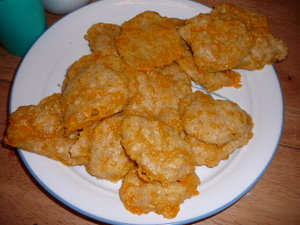
Cheddar Cheese Puffs

Description:
From the 25 March 2009 New York Times, which took it from "Party Appetizers," by Tori Ritchie (Chronicle Books, 2004)

I made these with medium cheddar rather than sharp and they could have used some salt and pepper.

Ingredients:
1 stick (8 tablespoons) unsalted butter, cut into pieces
1/2 teaspoon salt
1 cup all-purpose flour (i used freshly ground hard red wheat)
4 large eggs, at room temperature (who thinks that far ahead?!!)
1 1/2 teaspoons dry mustard
1/4 teaspoon cayenne pepper
1 1/2 cups (about 6 ounces) shredded sharp cheddar cheese

Directions:
1. preheat oven to 375 derees. line two baking sheets with parchment paper or nonstick baking mats. in a medium-size heavy saucepan, combine 1 cup water, the butter and salt, and bring to a boil. turn off heat adn add flour. mix with a wooden spoon until dough starts to pull away from sides of pan and form a lump. set aside, without stirring, 5 minutes. (lumps of this stuff taste so yummy!!! esp. if you used good flour.)

2. add eggs 1 at a time, mixing well after each addition. with each addition, dough will look glossy and slick at first; let it come together before adding next egg. mix in mustard, cayenne and cheese. dough will be quite loose and sticky.

3. scoop up a heaping teaspoon of dough and use another spoon to scrape it onto lined pan; it should form a mound about an inch in diamter. alternatively, use a pastry bag or thick plastic bag with one corner cut off, to pipe small mounds onto pan. repeat with remaining dough, leaving 1/2 inhc between puffs.

4. bake until pffy and golden, about 25 minutes, rotating pans halfway through. remove from oven adn serve immediately, or turn oven off and open door slightly to keep puffs warm up to 1 hour.

yield: about 36 puffs

March 12, 2009

Rob's Oat Cakes

Description:
When we first moved from San Francisco to Fort Collins, there were many foods that we missed -- freshly made tortillas, papusas, thai fish cakes (ok, so i was the only one that missed those), and oat cakes.

My search for tortillas and oat cakes particularly brought puzzled looks from people. Believe it or not, the only corn tortillas some of the supermarkets here had back in 2001, were the fried, taco shaped kinds. Now most supermarkets carry soft tortillas, but they're so full of preservatives that you're lucky if you can taste any corn. But at least when I asked for a tortilla, people in general seemed to know what I was getting at -- a flat thing made of corn.

When I'd ask about oat cakes on the other hand, people hadn't a clue. "You mean oatmeal cake?" they'd ask? "No, little round puck shaped things made with oats." "Oooooh." And that was that. They obviously thought I was a nutcase for even thinking such a thing existed and that anyone would want to eat one if they did.

So finally Rob, in exasperation, decided there's got to be a recipe out there somewhere so we could learn to make our own oatcakes. He did find a few online and modified them until he finally settled on the following recipe.

(In the meantime, I've finally seen oatcakes for sale in Fort Collins. They're over-packaged and marketed as heart-healthy food (instead of just being marketed as plain old yummy oat cakes). I haven't tried one yet, but that's largely because Rob's oat cakes are so good, I don't feel the need to even try the others now.)

Ingredients:
3 c. rolled oats (we used the thick rolled kind)
2 c. whole wheat flour
2 t. salt
1/2 t. baking powder
1 to 2 eggs
1/2 c. coconut oil (melted)
1/4 c. olive oil
3/4 c. cane syrup (we use steen's)
1/2 c. sucanut (wikipedia says i was spelling this wrong. it's sucanat.)
3 T. flax seeds (optional)
1 c. dried cherries (optional)

Directions:
Mix everything together and pack into muffin tins. (We don't use any cups of any kind and we don't grease the tins either.) Cook for 22 minutes at 325 degrees. Let cool before removing from tin. Eat within a week or store in the fridge to preserve freshness.

January 19, 2009

Pok-e-Kitty


This pic was not part of Naomi's email series of pics, but it was done on Photo Booth just like the other shots.

Behold, Poke-Kitty!

(Poor tibbies.)

December 27, 2008

Drink Ovaltine to Wake Up Gay


When I lived in Detroit, the attic of the house I lived in was full of old magazines. My mom took 3 of them, one of which was from the month that she was born. My brother-in-law's brother was over for Christmas and was thumbing through the magazine when he noticed an ad that promised to help him "Wake up Gay." Everyone got quite a kick out of it, so I scanned the page and thought I'd post the whole thing here.

December 4, 2008

Steve Jobs 2005 Stanford Commencement Address


Rogerio posted this, this morning (with Portuguese subtitles) and I thought it was excellent. (It's similar to "The Last Lecture".)

Ironically, it struck me that his 3 main points jived quite a bit with what we've been studying in our gals' Bible study. (We're reading through the book Peacemaking Women -- which isn't a traditional Bible study by any means, but it's still full of Scripture and is absolutely fantastic in terms of learning to love and forgive others.) I'm hoping, at some point, to tie Steve's thoughts to Tara and Judy's (perhaps on dandelion wine - now called Whispering Weeds) and if I do I'll post a link here.

November 24, 2008

My Martin Luther King Jr., Senior High School teacher days


I always got a kick out of the name of the school. Since MLK was a junior, but the school is a senior high school, they'd write out (and say) his whole entire name, but they'd add the senior bit in there lest anyone think we were a junior high school. ;-)

You can see the gold suit in all its glory, and more students pics, and another suit my grandmother sent (orange), in my Detroit photo album.

November 16, 2008

Easy No-Knead Whole Wheat Bread

Description:
This recipe is from the More-with-Less Cookbook (put out by the Mennonites). Rob has been using a Joy of Cooking recipe to make bread every once in awhile but he couldn't get it to rise properly. He tried this recipe yesterday and the bread rose wonderfully and tastes delicious!

Ingredients:
3 c. whole wheat flour
1/2 c. sugar
2 T. salt
3 pkg. dry yeast
2 c. milk
1/2 c. oil
2 eggs
5-6 c. more flour

Directions:
Combine the 3 cups of flour, sugar, salt and yeast. Heat 2 c. water along with milk and oil in a saucepan until warm. Combine dry ingredients, warmed liquids and 2 eggs. Beat at low speed until moistened. Beat for 3 minutes as medium speed. Stir in by hand 5 - 6 cups additional flour.

Use enough flour to form a stiff batter. Cover and let rise until double. Stir down and spoon into 2 greased 9x5" bread pans. Let rise 20-30 minutes. Bake at 375° F for 35 - 40 minutes.

Tastes great with butter and honey slathered on top.