July 12, 2007

Vichyssoise

Description:
A few weeks back we had some friends over and I served Vichyssoise, Wild Rice Salad with Dried Sour Cherries, Green Bean and Radish Salad, and an array of sausages (chicken and apple, Polish, spinach and feta, and Italian). For dessert we had biscuits with sweetened strawberries and cream.

The recipes for everything except the sausages and dessert were out of various Saveur magazines. The Vichyssoise is from the June/July 2006 issue.

Ingredients:
4 tbsp. butter
4 leeks, white and light green parts only, thinly sliced
1 medium onion, thinly sliced
5 medium white boiling potatoes (about 2 1/4 pounds), peeled and thinly sliced
salt
2 cups milk
2 cups light cream
1 cut heavy cream
2 tbsp. finely chopped chives

Directions:
1. Heat butter in a large pot over medium-low heat. Add leeks and onions and cook, stirring occasionally, until soft but not browned, about 20 minutes. Add potatoes, 4 cups water, and salt to taste and increase heat to high. Bring to a boil, reduce heat to medium-low, and simmer, stirring occasionally, until potatoes are soft, 50-60 minutes.

2. Strain soup through a mesh sieve into a bowl, pressing and scraping the solids with a spoon. Clean pot and return soup to it. Whisk in milk and light cream, bring to a boil over high heat, then remove from heat and let cool. Strain soup through a fine-mesh sieve (finer than the first), pressing and scraping it into a bowl with the spoon, leaving behind a thick paste of solids. Discard solids. Stir heavy cream into soup, cover with plastic wrap, and refrigerate until chilled. Season soup with salt to taste.

3. Divide soup between 8 soup bowls and garnish with chives. Serve cold.

Meg's Final Thoughts

Although this soup sounds very fancy, I found it not nearly as satisfying as a basic bowl of potato/leek soup. I think the outrageous amounts of cream were supposed to make this uber yummy, but I found that the cream also seemed to drown out the flavor of the potatoes and leeks. I also only sieved it once and I decided afterwards that that was one time too many. Soup should have substance, even if it's been bisqued. At some point I'll have to try making a Megyssoise version - no sieving, less cream, more flavor.

June 23, 2007

The Omnivore's Dilemma: A Natural History of Four Meals

Rating:★★★★★
Category:Books
Genre: Nonfiction
Author:Michael Pollan

One of the ironies of the era in which we live is that many Americans have pantries overflowing with food and yet are more detached from the origins of that food than ever before. We’re often quite ignorant of the many steps of production that our food endures as it travels from the fields to our kitchen. And as recent news stories involving pet food and toothpaste have shown, sometimes knowing where food has come from and what’s been done to it while it was there can be a matter of life and death: the ultimate dilemma.

Michael Pollan dives mouth first into issues of food in America in his book, The Omnivore’s Dilemma: A Natural History of Four Meals. He starts with a foray into the world of Industrial Agriculture, focusing specifically on a single crop: corn. He then moves on to the organic movement, exploring Big Organic as well as a sustainably run farm in Virginia, PolyFace Farm. The last third of the book explores the world of the present day hunter-gatherers and provides the author's favorite meal of the four he partakes in. Each third of the book ends with a meal, and each meal is representative of the type of food that Pollan has been discussing in that section. As faithfully as possible, Pollan has tried to trace the food from beginning to end, hitting upon relevant topics along the way, and ending with the meal itself -- his final thoughts on the process by which it came about, how it was eaten, and how it tasted.

(You may wonder, if there's three meals for three sections, why it's called a Natural History of Four Meals. Pollan does manage to fit an additional meal into the organic section of the book. But it doesn't get a chapter of it's own, nor complete a section of the book in the way that the other meals do. Still, it's a meal that helps to make a point, in this case a point about Big Organic.)

Industrial Agriculture: Corn

One of the hallmarks of Industrial Agriculture is monoculture, hence Pollan's decision to focus on only the one crop, corn. But through corn, he was able to delve into numerous related topics such as food subsidies, factory farmed animals, processed foods, food safety, obesity, and finally, how the meal (made predominantly with corn) tasted. Though I've read many articles about obesity in America and the problems of processed food, I've never understood farm subsidies very well. But Pollan not only explained how they worked, and why they were instituted, but he walks through the process step by step, describing the affects of subsidies upon the farmer, the purchasers (like Cargill or ADM), the food, and the consumers. It's an eye-opening read. In fact, even when Pollan hit upon topics that I was already familiar with, I found his his step-by-step, beginning-to-end descriptions of the how, what and why of things to be quite enlightening.

According to Pollan, the descendants of the Maya occasionally refer to themselves as "the corn people" or as "corn walking," not because they are trying to identify with the corn in some metaphysical way, but because they eat so much of the stuff that they're literally corn made flesh. Today, thanks to carbon 13, scientists can actually determine the percentage of corn that a person consumes. Pollan spoke with a Berkeley biologist, Todd Dawson, who said, “When you look at the isotope ratios, we North Americans look like corn chips with legs.” In fact, the average American eats more corn than the average Mexican. Granted, the standard Americano doesn’t wrap most of what he eats in corn tortillas, yet his food is still replete with corn. The meal that Pollan concludes the Industrial Agriculture section with includes McDonald’s chicken McNuggets. A chicken nugget, he says, "piles corn upon corn: what chicken it contains consists of corn, ... [since that is what the chicken was fed], but so do most of the nugget's other constituents, including the modified corn starch that glues the thing together, the corn flour in the batter that coats it, and the corn oil in which it gets fried. Much less obviously, the leavenings and lecithin, the mono-, di-, and triglycerides, the attractive golden coloring, even the citric acid that keeps the nugget 'fresh' can all be derived from corn."

Pastoral Agriculture: Grass

While corn provided an avenue through which to explore Industrial Agriculture, grass provides the means of exploring issues of sustainability, locality and the organic food movement. Factory farmed animals are stuffed full of corn (among other things that you really don't want to know about), but the movement in alternative farming circles is to allow animals to feed upon grass (which is actually the food stuff that works best in their system). So the central organizing theme of this section is grass - the pastoral.

This doesn't mean that meat with an organic label has been grass fed. And that, right there, is indicative of a widening crack that is growing along the veneer of the organic movement. Pollan takes a trip through Whole Foods exploring the world of organic food. As he does throughout the book, he then aims at getting to the heart of the matter by going to the farms where this food comes from. He meets "Rosie," the free-range chicken from Petaluma Poultry, and discovers that her world isn't that much different from her kosher and Asian cousins that reside on the same farm (except that she has a small grassy area that she can walk out onto (if she can find the doors, which might not be open), she gets cut up differently than her Asian cousin upon death, and there is no rabbi present when said death occurs. Other than that, Rosie's life is just as cramped and her food the same as all the other chickens.). He also visits Earthbound Farm (think packaged, pre-washed salads). He finds that large scale organic looks much different than the quaint, family-owned farm that often comes to mind when considering the organic movement. In the end, Big Organic leaves Pollan more than a little disappointed. Even the meal was a let down.

But in studying the world of organic agriculture, Pollan stumbles across Polyface Farm in Virginia. He visits Polyface for a week, helping out on the farm and seeing every part of this sustainable bit of agriculture. From grass to bugs to chicken and cows and pigs, Pollan records and explains the process of growth, of life, and of death. He describes a process that adds more to the earth than it takes away. And he describes animals that, though they're still eaten in the end, are allowed to live a happy, healthy life and are treated with respect from birth to death. And to wrap it all up, Pollan found that the meal he served from this world of local and sustainable farming was not only more nutritious than a comparable industrially raised meal, but it was far more flavorful as well.

Personal Agriculture: Forest

The last third of Pollan's book addresses the lifestyle and cuisine of modern day hunter gatherers. He went hunting for boar, picked morels that were shooting up after a forest fire, gathered wild yeast from the air and picked bing cherries from his sister's neighbor's cherry tree. He also harvested salt that turned out to be inedible due to it's toxic flavor. And he hunted for abilone, which he claimed was not only the hardest foraging he did, but the most dangerous as well. (And then he wasn't able to serve the abalone at his grand finale meal because he discovered that abalone had to be eaten fresh and the meal was still several weeks off at the time.)

This section of the book included a rather drawn out (in my opinion) meander through the morality of killing animals for their meat. If you look at the picture of Michael Pollan on the back cover, you'd think of him as the kind of guy that would swat at a fly and then feel guilty about it later. So before killing the boar, he spent a fair bit of time agonizing about it. Though this wasn't my favorite part of the book (get on with it already!), I have to admit that the guy did his best to be thorough by covering not only the hunt, but possible opposition to it as well.

In the end, Pollan admits that though hunting and gathering isn't the most practical way to put food on the table every day, it was definitely the means that he enjoyed most. He found that in hunting and foraging, there was quite a bit of fellowship, not only between humans and nature, but between people as well. In the end, not only did he find that his meal was excellent, but surrounding his table were also all of the people who helped to make that meal a reality. Of all the meals Pollan writes of in his book, this one seems the most to be a gift: a gift from nature and a gift from other people.

This is a well written book, and though the ethics of meat killing made me yawn a bit, the rest was definitely a real page turner. We've already made a few changes to where we get our food from, and we've absolutely forbidden my mother from taking the kids to Micky D's any more to partake of their chicken Mcnuggets (which we had previously assumed were one of their healthier kids meals. That's before we knew TBHQ (an antioxidant made from petroleum) was sprayed on them.).

I highly recommend reading The Omnivore's Dilemma. If you are interested in issues of nutrition, the environment, food politics, or food safety, then you'll appreciate this book. Heck, if you like eating, you might very well enjoy this book, since it is, after all, all about food.

June 10, 2007

Spinach and Ricotta Pasta


We've joined a CSA this year. It's Happy Heart Farm and it's just down the street from where my sister lives. She had joined last year and liked it, and the more we read of the Omnivore's Dilemma the more we felt we needed to go for it. We already eat mostly organic, whole-grain, less-processed foods. But ever since reading Gary Nabhan's book, Coming Home to Eat, I've felt like we should be focusing more on local foodstuffs. Though we'd done that a bit, Omnivore's Dilemma (review to come, I promise!) provided the kick in the butt that we needed.

When we lived in San Francisco we subscribed to "The Box" (now apparently called Organic Express). On a weekly basis we'd receive a box of veggies and fruits that were mostly local, all organic, and several items of which we'd never tried before (like chard). It was a wonderful chance to try out (and learn to cook) veggies that I'd never tried before. (Chard not only became one of my favorites, but Naomi has nicknamed it "Yummies in Tummies.")

I think that joining this CSA will be similarly gastronomically enlightening. I'm looking forward to trying new veggies, testing new recipes, and eating with the seasons.

After only two weeks of receiving shares from the farm, I found that I was already starting to drown in spinach. I had been adding it to the salads I was making with the radishes, beet leaves, and 2 kinds of lettuce I'd received from the farm, but I had only made a small dent in the spinach. So I decided not only to cook it all up tonight, but I also wanted to get rid of the ricotta that had been sitting in the fridge for too long (and which had a "sell by" date of today).

The following is what I came up with:

- - - - - - - - - - - - - - - - - - - -


butter
2 garlic chives
(This is a great example of something new I'm trying thanks to the CSA.)
fresh spinach (It was probably the equivalent of two boxes of frozen spinach. If I had tried to measure it before cooking, it probably would have been about 10 cups, but it cooked down to about 2 cups... maybe 3.)
15 oz. ricotta cheese
2 eggs (I buy these from a guy at church who has over 50 birds: chickens, ducks, geese, among other things. We're hoping to visit them sometimes this summer.)
1 teaspoon salt and pepper to taste
herbs (I used dried dill because I Love dill. But I also used some fresh oregano from the CSA.)
12 oz. pasta (I used fusilli, the kind that look like corkscrews, but shells would also work well.)
cheese (I used provolone but that's only because it's all I had. This dish would work well with mozzarella and a tad bit of parmesan.)
tomato sauce (I totally cheated and used Wild Oats parmesan pasta sauce

Put water on to boil. When boiling, add the pasta and cook until it's el dente.

Melt some butter in a large pan. (It should be big enough to hold the spinach.) Add chopped garlic chives. (Garlic chives look sorta like regular chives on steroids. They taste like green onions only magnified a few times and given a hint of a garlic punch.) Sautee garlic chives for about 2 minutes, then add cleaned spinach. (Remember, fresh spinach tends to be gritty. Wash it several times to be on the safe side.) Cook spinach until it is reduced to about half to a third of it's original size. Set aside.

In a medium sized bowl mix eggs, ricotta cheese, salt, pepper, and herbs. Add spinach and chives. Then add pasta and pour the entire mixture into a casserole dish.

Cook for about 10 - 15 minutes uncovered at 350 degrees. Add cheese to the top and cook until cheese is melted. While this is cooking, make pasta sauce (or heat up premade sauce, as I did).

Serve with a ladle (or two) of pasta sauce. Sprinkle some parmesan on top.

(Rob said several times, "I'm surprised at how good this is!")

May 12, 2007

Memories in the Making -- 2007


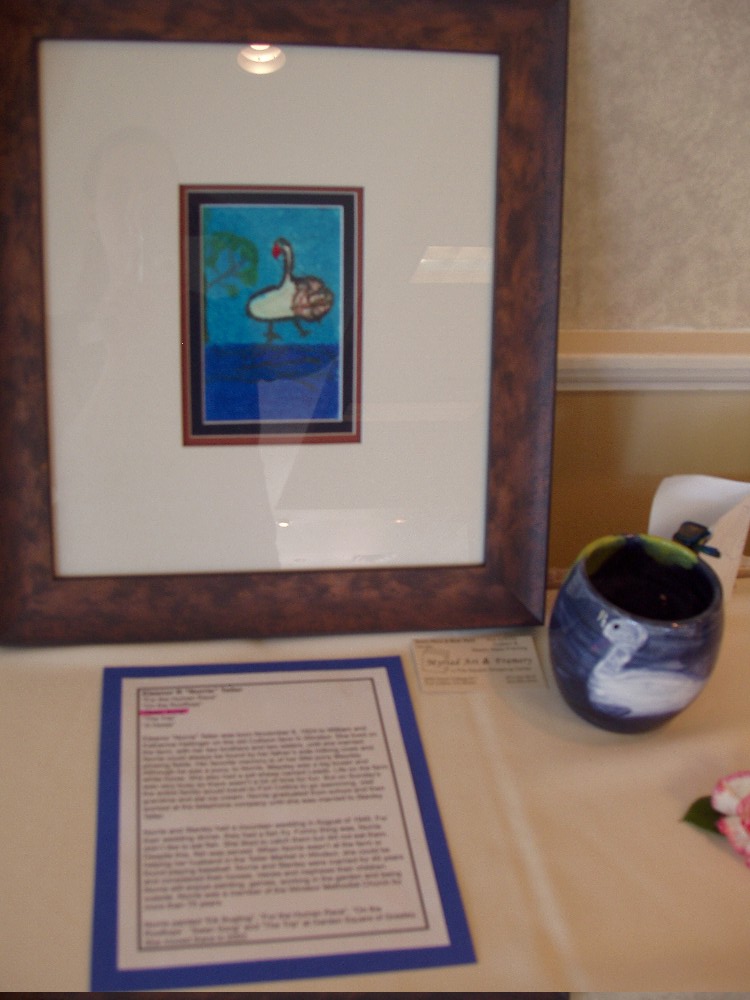
This is my dad's entry for this year.

For the fourth year in a row my dad's art entry has been accepted by the Northern Colorado Memories in the Making Auction. The auction is a fund-raising event by the local chapter of the Alzheimer Association.

Elder Care facilities from all over Northern Colorado have those in their care draw or paint pictures which are then submitted. The idea is that through art, these seniors can preserve some of the memories that are slipping away from them. (Since we live in an agricultural area, there are often farm scenes as well as farm animals.)

The auction is held in June, but as a thank you to all of the artist's whose works were accepted, there is a tea in early May. Artists and their families are welcomed and all of the art pieces are on display. This year there were also mugs pair with each piece. One of the sixth grades in the area was given color photocopies of each piece. The students were allowed to pick a piece that spoke to them and then make a mug to match. This gave the kids a chance to learn more about dementia and the mugs were then given to the artists as a thank you. They were very well done and it was a touching gift. Though the artists themselves, like my dad, may have no interest in or even recognition of the gift, it's a nice momento for the families.

To see pictures that my dad has done for previous auctions, click here.


May 9, 2007

Eyeball Pudding

Description:
This is essentially Large Pearl Tapioca pudding, but in our family it's affectionately known as "Eyeball Pudding."

I've taken the recipe from the back of the Island Large Pearl Tapioca box and modified it.

Ingredients:
1/2 cup Tapioca
4 1/2 cups Milk
2 Eggs well beaten
1/4 teaspoon Salt
1/2 cup Sucanut/Sugar

Directions:
I put the tapioca and a cup and a half of milk into a jar and put a lid on it. (I like to drink out of old Frontera Salsa jars -- the tall skinny ones. So we have lots and I just throw the tapioca and milk into one of those.) Let the tapioca sit over night (in the fridge, so the milk doesn't sour). I try to remember to shake it up once in awhile. As it expands it can get jammed into the bottom of the jar and won't soak up the milk like it should. If it doesn't get all jammed, just take a butter knife to it.

The next day pour the tapioca and milk, and another 3 cups milk, into a sauce pan and heat over a medium flame. Add 2 beaten eggs, the salt and sucanut.

Stir until you start to wonder if you're going to spend the rest of your life stirring that confounded mixture. Right when you wonder that (or within a few seconds of wondering it, at least) you'll start to notice that the mixture is thickening. Keep stirring for another few minutes. The pudding will thicken as it cools.

Pour pudding into bowls and tuck in. (Oh, and the Island recipe says to add 1/2 teaspoon of vanilla before pouring it into the bowls, but personally, I like it better without the vanilla.)

May 6, 2007

Meg and Les


This is me and my dad. He was driving my mom nuts last week when we were at my grandmother's place so I distracted him by snapping photos of the two of us. It worked for a few minutes, at least.

This was the best photo of the lot. It's hard to get a good self portrait when you're leaning in to take it with someone else in another chair. Oh well.

May 5, 2007

saving God's green earth

Rating:★★★★
Category:Books
Genre: Nonfiction
Author:tri robinson

Note to my non-Christian friends: Though this book probably won't interest you, the review might be worth the read. If there's a Christian in your life who is anti- or apathetic to environmental issues, this book might make an interesting (maybe even provocative) Christmas or birthday gift. ;-)


We cannot be excused when we have not at all considered God in His works. He does not at all leave Himself without witness here. ... Let us then only open our eyes and we will have enough arguments for the grandeur of God, so that we may learn to honor Him as He deserves.” -- John Calvin


John Calvin, Martin Luther, Francis of Assisi, even Saint Paul believed that the natural world is a reflection of God’s own nature. In the first chapter of the book of Romans, Paul writes that “God’s invisible qualities -- his eternal power and divine nature” can be “clearly seen, being understood from what has been made.” In fact, Paul even suggests that perhaps nature is the greatest evangelist, allowing people who may never meet a missionary to see in nature a reflection of God, just as a mirror shows a reflection of a face -- imperfect, but very close to the original none-the-less.

One might think, therefore, that Christians would be at the forefront of conserving and protecting God’s creation. In fact, the second chapter of the book of Genesis says that “God took the man and put him in the Garden of Eden to work it and take care of it.” One could make the argument that man was made with the purpose of caring for the rest of God’s creation. And certainly there are many Christians who have taken that call to heart. They ask questions such as “What Would Jesus Drive?” and they seek to “Reduce, Reuse, and Recycle.” But there are others who feel that environmentalism is either a distraction caused by Satan or a movement started by and for pantheistic earth worshipers (and therefore is something Christians should steer well clear of).

Tri Robinson hits the issue of Christianity and the environment head on. With quotes from many famous Christians (such as the one from John Calvin above) as well as large fistfuls of Scripture, Robinson walks the reader through five key reasons why a Christian should be an environmentalist:

1) God has provided the planet and all that is on it as a resource and provision for humanity. Proper management of this resource must be sustainable, keeping future generations in mind. The planet is a blessing. God made it to be a sanctuary for life and therefore it should be treated with consideration.

2) Nature is "a portrait of God's beauty." In fact, Robinson points out that "it's in nature that we oftentimes see not only the beauty but also experience the real presence of God." To damage this portrait that God has created of himself is to dishonor him and to endanger our own credibility in the eyes of humanity.

3) Caring for the environment can be a means of missions work. Many of those who are hardest hit by environmental degradation are "the least of these." Rather than receiving God's provision through his creation, they suffer without clean water and with ravaged soil -- the results of a misuse of the planet. By restoring the environment, Robinson says, we help to restore "the neglected assurance of God's abundant presence" as reflected in the provision of the earth.

4) Caring for the environment can be a means of evangelism. What environmentalist would take even a moment of their time to listen to the gospel from the lips of an SUV driving, pesticide spraying, disrespecter of God's creation? How much more readily might they be willing to listen when they see that a Christian's faith permeates every area of their life?

5) The renewal of God's creation is the last of a widening circle of renewal that God works in his creation, starting within the hearts of individuals and rippling out through our bodies, our homes, our communities, and the world.

Robinson intersperses each chapter of this book with examples of present day Christians who have felt called by God to take environmental concerns seriously. He understands that there are political and social pressures within the church that can be daunting, but he devotes an entire chapter to encourage the reader to heed God's call to care for the environment. (It's a powerful chapter, in fact, on having the courage to take the first step in obedience to any call which God has placed upon us, not just a call to care for the environment.) The final two chapters of the book provide practical guides for practical responses, first in terms of education and then in terms of taking action.

I have written several short essays on the topic of Christianity and the environment and therefore have given quite a bit of thought to the topic. I was pleased, however, as I read this book that though much of what Robinson wrote was old hat to me, there were also several points that he made and connections that he pieced together that were either new to me, or said in such a different way that they took on a beautiful new nuance. Robinson understands his audience well (He's a pastor of a church in Boise, Idaho.) and is gentle on his reader (who may feel a little panic-y when approaching this topic) and yet he doesn't hold back on his challenge to the reader to take seriously the care of God's creation.

In my opinion, however, this book, while a good place to orient yourself perhaps on *why* you should care for the environment, doesn't go very far into *how* you can care for the environment. Recycling is mentioned several times as well as reusing canvas grocery bags and getting involved in helping the National Forest service in projects. But there is little or no mention of sustainable farming practices, chemical pollutants or reducing our footprint. In terms of what one can *do* to change their lifestyle to make it more earth friendly, there simply isn't that much information. Then again, I don't believe that was the point of the book. As a springboard it's wonderful. As a guidebook from then on out, I'd recommend reading such books as Sidewalks in the Kingdom, Omnivore's Dilemma, or .... well, the list is enormous. (Feel free to add other good books in your reply.)

This book is an easy read and would be well suited to discussion groups. It is full of Scriptural references and may be appropriate therefore for a Sunday School class or Bible Study group.

I strongly recommend other Christians to read this book. If you're not a Christian, but know someone who is (and who isn't environmentally conscious) this might be a great book to hit them over the head with (or you could just get them a copy for Christmas).

April 28, 2007

Custard-Topped Spoon Bread

Description:
This recipe is from the 1997 edition of the Joy of Cooking.

Although it's called "custard-topped," when I make it the custard always ends up in the middle. In fact, when I made it just now, it seems that the whole wheat floated to the top (making a chocolate brown colored layer), the middle was a layer of custard, and the corn flour stayed at the bottom making a yellowish, light layer.

OK, from here on out is from the Joy of Cooking:

In the oven, this quick and easy batter is transformed, as if by magic, into moist corn bread topped with a layer of golden-crusted creamy custard that takes our breath away. Serve it with bacon or sausage for breakfast, or even all alone -- but try this luxurious dish at least once with pure maple syrup.

Position a rack in the lower third of the oven. Preheat the oven to 350 degrees (F). Place an ungreased 8 x 8 inch baking dish in the oven to heat.

Ingredients:
(see below)

Directions:
Whisk together thoroughly:
1 cup all-purpose flour [I used freshly ground hard red wheat.]
3/4 cup cornmeal [I used freshly ground corn -- It came out rather floury.]
1 teaspoon baking powder
1/2 teaspoon baking soda

Whisk together in a large bowl:
2 large eggs, lightly beaten
2 cups milk
2 tablespoons warm melted unsalted butter [Like it could be cold melted?!!]
2 tablespoons sugar [I used sucanut.]
1 1/2 tablespoons white vinegar
1/2 teaspoon salt

Add the dry ingredients to the wet ingredients and stir just until the batter is smooth and free of lumps. Add to the heated baking dish and tilt to coat the bottom:
2 teaspoons butter, softened or melted

Scrape the batter into the baking dish and spread evenly. Set the dish on the oven rack. Pour over the batter slowly, without stirring:
1 cup heavy cream

Bake until the custard layer on top is puffed and golden brown but still quivery and a knife inserted in the center comes out clean, 45 to 50 minutes. [My knife didn't come out clean but it was because the custard clung to it. So I just cooked it until it was set.] Remove from the oven and let stand for about 10 minutes before serving. Serve hot or warm.

February 28, 2007

Vermont Maple-Corn Drop Biscuits

Description:
I took this recipe to a bridal shower this past weekend to share. Somewhere between there and here it went missing. !!!! I was horrified when I realized that today and was utterly relieved when I found that I'd posted it previously on my old website. whew! But I thought I'd post it here now so that my recipes are all together.

source: Biscuits and Scones: 62 Recipes from Breakfast Biscuits to Homey Desserts, by Elizabeth Alston (Clarkson N. Potter, Inc./Publishers) page 15.

Ingredients:
1 cup coarse-ground yellow cornmeal
1 cup all-purpose flour --> [I use freshly ground wheat flour.]
1 tablespoon baking powder
1/4 teaspoon salt
1/4 cup maple or maple-flavor [gag!] syrup
milk
5 tablespoons cold unsalted butter, cut up

Directions:
Heat oven to 425 degrees. Put cornmeal, flour, baking powder, and salt into a large bowl. Stir to mix well.

Measure maple syrup in a glass cup measure. Add milk to the 2/3 cup mark.

Add butter to the flour mixture and cut in with a pastry blender or rub in with your fingers, until mixture looks like fine granules.

Add the milk mixture and stir with a fork until a very soft dough forms.

Drop 1/4 cupfuls of dough 2 inches apart onto an ungreased cookie sheet.

Bake 12 to 14 minutes, until pale golden brown. Cool, loosely covered with a dish towel, on a wire rack.

February 17, 2007

Tamale Pie

Description:
I love Amy's Tamale Pie. So for tomorrow's potluck at church I thought I'd try making my own version of the dish.

I've searched for recipes online and this is the one that I've used the most to base my own recipe off of. But I've made several modifications (mostly trying to draw it as close to the Amy's version as possible).

Ingredients:
2 cups dry pinto and/or black beans
Vegetable stock or water
1 tablespoon cumin
2 cups polenta
4 - 8 cups vegetable stock (to cook beans in)
1 teaspoon Bragg’s or tamari
1 teaspoon chili powder
2 cups chopped vegetables (corn, zucchini -whatever you like)
2 tablespoons tomato paste
1 cup grated cheese

Directions:
1. Cover beans with water and soak overnight. Drain and cover with vegetable stock or fresh water. Add 1 tablespoon cumin and 1 teaspoon chili powder and simmer 2 1/4 hours or until tender. (I covered with 4 cups of veggie stock but ended up adding at least another 4 if not 5 or 6 cups of water as the beans cook but didn't get soft enough. I also ended up cooking the beans for at least 4 hours. Why don't my beans ever get soft enough in the amount of time that the recipes say?!!)

2. Mix polenta and 2 to 3 times as much water. (I used 2 1/2 times as much.) Add 1 teaspoon Bragg’s and a pinch of salt in a saucepan over medium heat. Stir continuously until mixture thickens and all the liquid is absorbed (about 10-15 minutes). The polenta should still be smooth enough to stir fairly easily. Press mixture into sides and bottom of a buttered 9x13-inch baking dish at least 1 1/2 inches deep, saving one-fourth of the amount to drop of spread on top later. (The polenta will harden up as it sits in the pan.)

3. In a separate pan, saute onions until translucent. Add corn, zucchini and any other veggies (or tofu) that you might want to toss in. combine cooked beans (which can be mashed with a potato masher, leaving some whole) with other ingredients except cheese. Cook over medium heat until vegetables are almost cooked. Pour into baking pan and spread evenly. Sprinkle grated cheese on top and spoon on remaining cornmeal mixture.

4. Bake at 350F for 25 minutes.

Serves 6-8.

February 1, 2007

Speaking of Heroes


Bucky rocks.

January 22, 2007

January 21: Chicago


Honestly, why this little snow managed to bring such mayhem is beyond me.

Embassy Suites, Chicago: Monday

We ate breakfast, packed our stuff up and headed out Sunday morning. A taxi took us to the airport. (The taxi driver started out our conversation with, “Can I ask you a rather strange question?” It turns out that she wanted to know the names of any stores that might carry clothes for large women. Her son had gone to New York City for four days and hadn’t found anything, so she wanted to try online but she didn’t know what to look for. -- Speaking of being large. One of Roz’s friends, Bas, had a great line on size He’s originally from Hong Kong and though I wouldn’t call him fat, I’d say he was husky. He said that he goes to Hong Kong, looks around at everyone and says, “God I’m fat.” He goes to England, looks around and says, “God I’m fat.” He’s goes to America and looks around and says, “Yeah! I’m skinny!!!!!!!”) ;-)

The taxi only cost 35 quid. Apparently many taxi services have a fixed rate to the airport. The check in line was rather long and they only let us have one carry on item which ticked Rob off. He’s a regular traveler in the states where the rule is “one carry on and one personal item.” But the check-in gal was having none of that. (However, when we got on the plane later we saw several people with a large bag plus a suitcase as carry on. They obviously didn’t get the same check-in gal that we got.)

The security line was insane. There was a couple in front of us that probably missed their flight because of security.

Then when we got through security, we came out of the grumpy, drab, stressful security area into a world of light and color. It was the duty free shop and it looked like we had just been transported from some East German security checkpoint to some All American department store. It was very odd. And you had to get through the store to get to your flights. (So all those people who were running very late in getting to their flights had to fight their way past dreamy shoppers picking out cologne and bottles of Scotch.)

We got to our boarding gate where we had to go through a 3 point security check again (thankfully we weren’t pulled out for the last point which is where they go through all your carry on bags and check them for drugs, etc.)

Our flight to the States was fairly uneventful. We saw both Scotland and Ireland for the first time (just bitts of the coast as we flew over). And we landed on time at the Chicago airport.

As we were waiting to grab our bags to go through customs we saw one of the suitcases come down the center belt. Our luggage is distinctive not because it’s bright red (that seems to be a popular suitcase color these days) but because we had the kids draw pictures all over the suitcases before we left. We figured that that would not only be a pleasant reminder of them during our trip, but it would also help us to locate our luggage when picking it up. So we waited for that case to get off the center belt, then swing around till it reached us. But it never reached us. I started to get worried that someone else had taken it so I quickly buzzed about to the other side of the luggage carousel only to see a red suitcase heading down a long hallway past a security check point. As far as I could tell, our suitcase had just taken a trip without us.

Rob was pretty upset about it. But I figured that either the person would go to declare stuff and then realize that he had the wrong suitcase, or he’d take it through, not declare anything, and put it back on the luggage check-in belt and it would end up in Denver anyway, since that’s how it was tagged. Our only worry was if the guy was staying in Chicago. So we waited for the rest of our stuff (which took another 25 minutes) and right before we were getting ready to go fill out any paper work we might need to to say that our bag had been taken, there it was coming around the carousel. We’d been watching the center belt so we knew it hadn’t come down from there. So we’re guessing that the guy eventually got to the point where they tell you your gate change information. The people there would look at the tag on your bag and then tell you your gate based on that info. I can just picture the woman looking at the tag and saying, “You’re going to Denver?” and the guy’ slowly realizing that he’d screwed up. How he could grab a bag covered with pictures of kitties, doggies and lizards without noticing is beyond me, but there you go.

We took the train to our terminal and checked a television to make sure we were heading to the right gate.

What a shock. We found that our flight had been cancelled! We tried to find someone who could explain why (it certainly couldn’t be because there was a light snow in Chicago. Nothing was even sticking to the ground.)

After waiting in a couple of different lines, we finally calleda 1-800 number and found out that we’d already been rebooked on a Monday morning flight.

We were quite disappointed that we wouldn’t be getting back when planned. But I kept telling myself that the kids would have been asleep when we arrived and we’d only see them long enough in the morning to send them off to school. So we’re not missing kid time and the main bummers are the expense of the hotel (only $159 and we don’t have to worry about the wretched exchange rate!), the fact that Karen has to watch the kids one more day when she probably needs to catch up on work, and that my mom will have to wake my dad up to come get us. (My dad has been sleeping late in the mornings which is a blessing because it’s just that much less time that my mom has to cope with him.)

So we ended up at the Embassy Suites. We got a free drink in the evening and there’s supposed to be a continental breakfast this morning. And unlike Shendish, the television actually works, there’s a fridge in the room as well as a full length mirror and an iron and ironing board. We don’t need any of these things now, but it would have been nice to have them before the wedding and it’s comforting to be back in a land where these things are standard in a hotel room. It just helps to have a sense that you’ve got your bearings back. ;-)

January 20: Shendish Manor and the Wedding


Shendish Manor: Saturday -- link to Shendish

We slept in till 8, then we snitched some milk from the breakfast bar. (As with most hotels, they didn’t have a whole lot available for breakfast unless you ordered something from the kitchen. They did have some cornflakes, but I had my own cereal back in the room so we just grabbed milk for cereal and tea. Unfortunately they didn’t have enough milk out for anyone to have cereal, even though there were a few boxes of cornflakes out. I suppose cereal isn’t very British.)

We then took a walk down the hill and tried to find the magic round-a-bout so I could take a picture of the sign. Unfortunately we couldn’t find it and later when we passed it by car I realized we had gotten quite close. I don’t think we’ll have time tomorrow morning to catch it, though, since we have to leave by cab at 9.

We stopped in a coin and stamp shop to pick up a gift for a friend and while we were there the shop owner was thrilled to show us bank notes from the US. There were notes from the 1770’s that were Hand Written and had Three signatures on each one! They also had both pounds and dollars listed on them since the nation was switching over. There were some that were stamped from the confederacy, but they were signed and numbered by hand.

There were notes for as little as 3 cents and when we asked the guy about it he explained that all of the metal from the coins would have been needed to make cannons and bullets for the revolutionary war and later the civil war.

We got back to the manor in time to change into our wedding clothes and head down to the lobby to meet the couple that was going to drive us over to the church. After all of the beautiful old churches we’ve been in since we got here, it was a bit of a shock when I saw the church Roz and Alan were going to be married in. I’d say it was probably built in the 60s. Oh well.

During the wedding it was of course interesting to notice the difference between American and English weddings. The biggest difference, I think, was that Roz and Allen had to sign a church register During the ceremony. It’s apparently a big book that everyone that’s married in the church has to sign and it’s considered a legal document by the nation. I can only assume that it’s a result of the union of church and state. When I asked about it, it seems that this is done not only in Anglican churches (the state church) but in others as well. So in that way having a national church seems to also affect the other churches as well. (The whole church and state thing has been a regular topic of discussion between Rob and myself as we meet Christians in England and attend church services here. The Christian community here seems to have an over all rather different feel than the overall church community in America (and granted, that’s a huge chunk that covers many cultures within the church in each nation, but still I think there’s an underlying feeling or sense that is very different between the two).

We returned to Shendish at around 2 (the wedding started at 12) and there were appetizers and drinks available. Unfortunately there were no plates.... (Even one of the serving girls admitted that that was weird.)

There was a walnut and blue cheese paste wrapped in philo dough that Rocked! There was also asparagus, fresh veggies and chicken fingers. And though we saw other people drinking what looked like white wine, all we could locate was the mulled wine. It was good, but mulled wine has so much flavor that I really think it would have been better on it’s own, but I didn’t want to stop eating those lovely walnut pastries -- which presented quite a quandary. ;-)

At 3 we went through the receiving line and headed in for dinner. We started with watercress soup, which was fantastic. Apparently Hemel Hempstead area is known for their watercress (or at least it was back in the day). It apparently grew in a couple of the nearby rivers. (This according to the talk around the table as we ate our soup.)

I noticed, as we ate our soup, that as people neared the end of their bowl, they tipped it away from themselves and scooped out the last bits. Not wanting to be the crass American that tips my bowl toward myself (which is I think how we’d do it in the States, yes? I don’t think it’s just me.) I didn’t tip my bowl one way or the other.

When we finally got our food (turkey, gammon (ham), potatoes and veggies, though I got a puff pastry with mushroom sauce and asparagus since I don’t eat meat) I also noticed that all of the Brits (and the Bermudans) ate with their fork in their left hand and their knife in their right I’d seen that before and even eat that way on occasion when it suits the food (as in, I’ll be cutting it alot). But when I tried eating that way tonight I had a very hard time getting the puff pastry onto my fork. So I finally gave up. June, the vegetarian on my right, managed it just fine. I was quite impressed. She and her husband commented on the fact that we were using our right hands for our forks and said that when they were at a business dinner in the states once, they noticed that the Americans from the east coast ate like they did, but the Americans from the west coast ate like I did. Hmmm, perhaps I should do a poll on this at some point, eh?

I should add, at this point, that there was no clinking of glasses. Not only do I think it’s not a custom here, but since we were in an oddly shaped room, we wouldn’t have seen the bride and groom kiss even if there was that custom here. Oh well. It’s never been my favorite part of a reception anyway.
Pudding (dessert) was either chocolate covered pear, strawberries and pineapple, banana cream pie, or fruit crumble (what I’d call a cobbler). I chose fruit crumble (as did most people, it seems). There was also custard (I think we’d call it vanilla pudding) to pour over it. Again, this was really delicious. (All the food was quite wonderful. I wish they’d publish a recipe booklet for us at the end of the event.)

For the dessert, I noticed that again everyone had their forks in their left hand and this time they had a large spoon in their right which they used to scoop their food onto their forks. Rob just ate his with a spoon and I just ate mine with a fork. We both seemed to do fine with only using one utensil. ;-)

Then they passed out the wedding cake as well as served tea, coffee and champagne. (They scrunched this part all together because serving the meal had taken a bit longer than they had intended.) There was a toast by the father of the bride, Peter. Then Alan (the groom) got up and thanked people while Roz and her nephew handed out gifts to those who had helped out with the wedding. Then James, the best man got up to speak. A friend of his had gone around to all of the tables earlier and taken bets on how long James would speak. I went for 6.5 minutes, knowing from last night that he liked to talk. But when I heard him say that he wasn’t going to talk long because he hadn’t gotten a moment to prepare, I knew my guess had just been tossed out the window. Sure enough, he talked for 8 minutes and Alan (the groom) won the pot. (We had each put in 50p - the “p” stands for pence but people just say the “p”.)

After all that Roz told us that we were free to get a bit of fresh air or do whatever we wanted until 7:30 when there would be dancing. So Rob and I came up to our room (it IS nice to be staying in the same building as the reception) and called the kids. Then I typed most of this up knowing that I wanted to catch those little details like the soup bowls being tilted forward and I’m afraid that all that is going to run right out of my head as I experience all the other things coming up that are going to be utterly different than weddings in the States. ;-)

Shendish Manor: Sunday 2:45 am

(Rob woke me up when he got up to go to the bathroom, so here I am finishing off today’s entry. The wind seems to have come back. I hope it’s not like this when our plane is getting ready to leave later today.)

We went back downstairs in time for Rob to try yet another English beer. This was named after a person (John Smith?) and was labeled “extra smooth” which we decided might mean it’s not quite as hoppy as most of the other beers we’d tried. It turned out to be rather like a lighter version of Guinness.

Alan looked like he only made it through the first dance because Roz was with him, but he looked like he was hoping desperately to escape by the time he was dancing with his mum. Roz, of course, was having the time of her life. Once others joined the dance floor she took some time out to pass out glowing necklaces to any kids that were still around, which turned out to be only two young ones who were coaxed out to the dance floor. (OK, so it didn’t really take much coaxing.)

There was a cash bar and later another room was opened with snacks and tables to sit around and gab. The snacks were all very greasy, which fit with what we’d been told earlier by one of Roz’s friends. After drinking a lot people like to stop off at KFC or something like that for something a bit greasy. It seemed like a recipe for disaster too me, but what do I know?

After chatting with some more folks, Rob and I snuck off to pack up and get ready to go. (I’m an introvert, remember. So hanging out with that many people that I don’t know for that long gets a bit draining. Everyone was very nice to us, though.)

Instead of packing, however, I ended up reading the newspaper. ;-) The “Big Brother” show seems to be a hot topic this week. Also there was a horrid article about a serial killer in Vancouver.

I’m rather bummed that Shendish doesn’t have wifi. Being up in the middle of the night is a perfect time to catch up on multiply surfing. But considering that tomorrow is going to be a long day (we get to live 7 hours twice), I probably should try getting some sleep.

January 19: Histon and Shendish Manor


I mentioned earlier that there's moss on everything. There's moss in the yards. Moss on the roofs. Moss on the walls. Moss on the sidewalk. There's also lichen everywhere. It's a very wet country. Especially in January. ;-)

(Rob and I loved it though. We like that misty, autumny feel.)

Last day in Cambridge/Histon

Vanessa went to work this morning and Rob and I slowly gathered up all of our stuff from throughout the house and gathered it together in the lounge (aka the living room). We ran a couple of loads of laundry (though the dryer works about as well as the dial-up). And we took a walk (where we actually saw many street signs. !!!) I took a shot of the moss that was growing on someone’s brick wall in their front yard. And we went by the house that Rob’s brother Ryan lived in when he was out here for a year. (At least, I think we got the right house. Did we, Ryan?)

I wrestled with slow upload times the rest of the morning and then Vanessa came home from work at 2 so we could pray for her.

The kids all got home from school (well, except Becca who, rumor had it, was stopping by the store to get some chocolate) so we could say good buy to them yet once again (we said goodbye last night thinking that we might not see them this afternoont -- but we hadn’t booked our bus tickets yet so we didn’t really know when we were leaving). Then Vanessa trundled us and all our stuff (lots and lots of tea as well as some hand-me-down clothes and goodies for presents along with all the stuff we hauled here in the first place) down to the Trumpington Park & Ride.

The bus was almost 15 minutes late, but he managed to make up the time along the way and we only ended up at our destination a few minutes late. Other than that, the ride was rather un-eventful.

Once at the Hemel Hempstead bus station we called Roz’s cell phone hoping she could find someone to come give us a lift, but she didn’t pick up. So then we considered walking, but we weren’t sure which direction to head out. So we finally hailed a cab and for 6 quid we were very glad we did. All it took was hitting the magic round-a-bout and we knew immediately that we would have been completely lost if we had tried to go it alone. And then it turned out that the bus station was rather far from Shendish afterall. Our cabbie was Indian, we think (as in, a person from India), had a very thick accent, and drove slightly more insanely than the typical Brit (which means I spent most of the ride praying).

Once at Shendish we signed in and were taken to our room which was on the second floor (which is the same as the third floor in the States). There was no lift (elevator) so we had to haul all of our lugguge up one flight up stairs, through a door and down a hall, up a second set of stairs, around a corner and down another hall, down some stairs and then back up some more stairs at the end. The manor director (or whatever she is) apologized several times (basically every time we hit another flight of stairs) but we ended up with a double room for the price of a single (which I think is 120 quid) because they had run out of rooms. (This also explains why our room was one of the furthest from the entrance.)

We got settled in, then headed downstairs to get something to eat. Shendish doesn’t have a lunch or dinner restaurant (though they apparently do take orders at breakfast and though they do serve catered food later in the day). So we started to walk back down towards town to grab a bite to eat. (The driveway is probably about 1/2 mile long.) About a third of the way down we ran across Roz and Alan (the soon to be newlyweds) driving up. They picked us up, took us back up to Shendish, rattled on about James (the best man) for a bit, and then drove us back down the hill. ;-) They eventually took us to Roz’s mom’s house and from there we walked over to an Indian restaurant where we met up with 16 or so other friends of Roz and Alan’s. (None of whom we’d ever met before since we knew Roz from San Francisco and they all knew her from England (or maybe Germany).)

To be perfectly honest, we found the food to be rather bland. I’ve definitely had better saag paneer, the service was rather slow (although having 20 odd folks arrive all at once could have something to do with that, I’m sure) and my prawn curry was just OK. (They used little shrimps, the kind I’m used to only seeing in salads.) The rice pilaf had colored rices in it. And nothing else, just rice. (We’re used to our pilaf being entirely rice colored except for the bits of peas and other odds and ends that are thrown in.) All in all, I’d probably recommend the restaurant for the ambiance, but not the food. (And, as in all other cafes and dining areas, the room was filled with smoke.Apparently Britain (and the UK?) will be banning smoking in public places in July, so it looks like we just came a bit early in that regard.)

We ended up sitting with two friends of Roz and Alan’s, Sarah and Martin. The rest of the crew was at one long table, but they hadn’t made enough room for all of us so we were seated on the other side of the room. We had a lovely discussion with them. Once we were done eating we headed out with the rest of the crew on a theoretical pub crawl. I say theoretical because every time we came across a pub, we’d stand around out front and talk about going in, but then someone would mention a pub further up and we’d end up walking toward that one instead. I think they eventually did end up at a pub, but by that time we were by the Manor so Rob and I just pealed off from there.

We met a few more of Roz and Alan’s friends along the walk and I quickly came to realize that the reception today may be much more of a camcorder event than a camera event. As Sarah said at one point during the walk, “I’m sure you’re beginning to see the Thesbian theme here.” There were several flamboyant personalities and putting them all together was like gathering several comedians on stage and having a laugh-off contest.

Before turning in we thought we’d test out the Bush iD flat screen television in our room. We received a note that if it were too windy out, the digital tv might not work, in which case we were told to switch it over to regular tv. Well, despite the fact that I didn’t see much wind outside, our digital definitely didn’t work, so we tried to watch the beginning of Stigmata but the picture was so fuzzy that I could barely make out the subtitles. And the rest of the channel options were no better. There were two stations with comedians. One made horrible jokes and the other was the guy from the Office and then the clip of him talking ended and it turned out to be a critical review (with 5 or 6 speakers) of his comedy routine. (I am not making this up.)

Rob and I decided we had better things to do than watch horrible tv.

January 18: Cambridge and Histon


i thought this was hilarious. ;-)

Written from Histon

This morning Vanessa had to get to work right on time (for a meeting that ended up not happening, as it happens) so we could either get a ride to the park & ride and take a bus from there, or we could take a bus from Histon. Rob doesn’t like buses, though. So we walked in to Cambridge. (1 hour, 30 minutes. intermittant rain. wind. attacking thorn bushes.)

While walking we passed by some subway signs that we’d seen before. We thought it was odd that we saw signs for a subway, but Vanessa had never mentioned using the subway to get into Cambridge. (Plus we’d never seen these subway signs at any other place in the city besides this intersection.) Then we realized that the “subway” was really just a way for pedestrians to go under the round-a-bout and come back out on the other side. !!!

We decided to go to the cafe first so I could post three days worth of photos. (I only managed to get two posted. It takes awhile to check email, upload photos, add descriptions, etc.)

Then we headed off to the Fitzgerald Museum. Unfortunately, in an attempt to take a short cut, we went through one of the colleges only to find that all the gates on the far end were locked. :-P So we had to go all the way back out and around.

The museum was free (bonus!) but we had to check in our backpacks (which freaked Rob out because he had his computer in there). (I should add that for all of these places that we went in for free, we always gave a bit of a donation any way. So a 6 pound donation is $12 of free museum. ;-) ) We were a little disappointed that several galleries were either closed or under renovation. But there were several great pieces of artwork and by the end we were entirely overwhelmed all the same.

(Vanessa just mentioned that even Tony Blair doesn’t vacation in England because it’s so expensive. They go to Italy instead.)

After the museum we were pretty much wiped out. So we started to head back home. We stopped and got a microphone for Vanessa so she can Skype with her friends and family back in the states. And we picked up some t-shirts for the kids. (We also stopped in a less windy spot (I kid you not, the wind was CRAAAAAZY) and called the kids to say good morning.) Then we started back towards Histon.

We stopped at the Castle mound on the way, mostly because we just hadn’t seen it yet. Talk about windy. Rob actually got blown over while he was trying to take pictures of the wind whipping my hair arouind. It was insane on the mound and over the highway and it was just at an incredible level when we were walking along the streets. We saw a wooden fence and two brick walls that looked like the wind had torn chunks out of them. (We’ve walked up this road once or twice before and didn’t see the fences/walls messed up so we’re assuming it was from the wind.)

We stopped by several bars hoping to grab a pint but we’ve learned that many bars that aren’t in the center of Cambridge don’t open until 5. (They’re essentially open for lunch and dinner and not in between.) So we trudged on home and had a beer and cider at Vanessa’s (and some leftoever lentils).

Then Vanessa dropped us off at Patrick’s on her way to class. The kids were all at his house and I snapped a picture of Nathaniel with his famed (and favorite) chocolate spread sandwich. ;-) I helped Rebecca a little with her math homework while Rob and Patrick talked start-ups and Patrick served us some wonderful tea. (I had a gunpowder green. I think Rob had something black.)

Then the kids and Patrick ate a quick dinner and the girls started watching Legally Blond (gag!) while Nathaniel and I cruised around neopets>http://www.neopets.com%E2%80%9D">neopets.

After Vanessa’s class she came and picked Rob, Katie and I up but the other two stayed over at Patrick’s for the night.

January 18, 2007

January 17: Cambridge


Vanessa’s Dining Room: Histon and the mid-level of CB2: Cambridge: Wednesday 10:45 pm and Thursday 11 am GMT

Vanessa didn’t have to work today so she drove us in to Cambridge and we visited the round church. (I’ve posted pictures of the outside of it already.) The people that own the church use it to focus on the story of Christianity in England in general and Cambridge in particular, highlighting notable religious figures throughout the ages that have had interactions with Cambridge UIniversity.

Inside there are several (12 or so) large displays that start during the Roman period(and St. Alban) and tell the story of Christianity in England. Every time a famous person is mentioned, if they had attended Cambridge University, then their college name was included in parentheses just after their name.

After reading through these we went on a tour that the Round Church people put on which takes you through several of the Cambridge churches and chapels telling you the history of Christianity in Cambridge.

We started with the round church, of course. The church had been built after Crusaders had gone to Jersusalem and seen the Church of the Holy Sepulchre (which had been built by Constantine as a memorial that is supposedly over the location that Jesus was buried. We have a friend that used to work at the Garden Tomb which is another place Jesus might have been buried. So there are two locations that I suppose people believe may be The place.) which is a round church. In order to remind themselves of this great event in their lives (going and sacking Jerusalem seeing this great monument) they came back and built several little versions of the round church throughout England and this one in Cambridge is one of those.

Then another section was added on to the round church and that's where the stained glass window is that I took a photo of. The stained glass was put in just after WWII, I believe that each part had special significance. (Like the pelicans just over the cross. People used to think that they tore off their own flesh and fed it to their babies. So the birds came to represent Christ who gave of his own flesh, so to speak. The guide pointed out that you'll see pelicans carvings all over the city. Of course, now people realize that the pelicans are just pulling out bits of stored up fish to feed their babies. So there you go.)

We left the round church and headed over to the divinity school (where the grumpy old men picture was.) Just so you get a sense of how close together this all is, the round church is kitty corner from St. John's College (which was started by Henry VII's mother, Margaret Beaufort (who gave birth to him when she was 13). Across from St. John's College (and it would be just across the street from the round church except there was a shop in between) was the divinity school. So these buildings are all within spitting distance of each other.

The guide explained that the dude on the left of the entranceway (in that grumpy old men picture) was a famous Catholic named Fisher who invited Erasmus to Cambridge as Lady Margaret Professor. (Henry's mother not only started the Divinity school and St. John's but she provided endowments that would pay for a professorship and a divinity head (or something like that). Erasmus then made a parallel Greek and Latin New Testament (meaning that you could read the familiar Latin down one side and then compare it to the original Greek that was on the other side of the page). This was a beginning ingredient for the reformation as those who studied Scripture began to see the little changes that had taken place from the original text to the then present-day Latin translation. Fisher was later killed after Henry VIII led England out from under Rome.

The grumpy old man on the right was Cranmer, Henry VIII's archbishop (I believe he's the one that helped Henry secure his first divorce). He helped lead the reformation in England and I believe he was killed by Henry VIII's daughter, Queen Mary I (who was later renamed by her sister Elizabeth, Bloody Mary).

We did a quick stop into St. John's College Chapel which had a statue of Margaret B. out front stamping out ignorance and another of Fisher, I think it was, stamping out ignorance and something else. (I think I only took a pic of Fisher.) Inside there was a statue of Wilberforce who was instrumental in ending slavery in England. (And the anniversary of that date is coming up this summer so there are going to be several celebrations. I hope abolitionists of today's slavery make the most of that. I'll probably try to post something on it in the slave group at some point.)

From the divinity school we headed over to Trinity College which Isaac Newton attended. (There's an apple tree planted by the college entrance in his honor.) Trinity was also *cough* started by Henry VIII (hence the picture of him as a stubby little man holding an orb and a chair leg).

Near the end of Henry VIIIs life his wife (#6, I believe) said something to him along the lines of, "You really think you're going to get into heaven after splitting the church from Rome and beheading two wives?" Back in those days, one way to assure your entrance into heaven was to build a church or college. I'm sure that had been part of Margaret Beaufort's desire back when she started the divinity school and St. John's. And she was quite free with her money. Her grandson, Henry VIII, however, decided to take two old colleges, combine them, rip out a building or two and call it Trinity College. (Actually, it had a much more laborious name to say, but Trinity was in there and that's what it got shortened to.)

We went into the courtyard of Trinity and I think I snapped a shot of their dining hall. Far cry from the cafeterias most of us chowed at in our University days. And we visited the chapel where there were several statues of famous men.

We then went to see the Senate House where David Livingstone made a call to Englishmen to become missionaries to Africa.

Though the site of the White Horse Inn as well as many other churches were a part of the tour, we'd already covered our allotted hour and a half by this point so the guide took us quickly to one last church before leaving us. That was St. Edward's Church. This church is famous for being the heart of the Reformation in England. Because it was hosted by two University colleges and was not under the governance of the Anglican church, reformation preachers could preach freely here. (You'll notice that this is the church that now holds Goth Eucharists.)

Once the guide left us, Vanessa decided that we really should see the King's College Chapel. Rob decided to his a cafe rather than pay the 4.50 ($9) to get in. It wasn't worth it to him. But I enjoyed the Tudor history involved.

It was basically built by the Henrys and it was decorated during the time of Henry VIIIs short lived marriage to Anne Bolin (after 3 years he had her beheaded because he thought she was conspiring against him) so there are H's and A's all over the place. It reminded me of teenagers carving their initials everywhere only these were in stone and worked into all of the church decorations.

The ceiling was breathtaking. I wish there was something on the floor that I could lie on and take in the ceiling without getting a crink in my neck. The screen and wall decorations were wonderful (and matched the shot I took of the outside with the dragon and dog). But I have to admit that I really felt like they were grumpy at the door about making us pay (like they wish they could have charged more) and I felt a sense of the "Let's make the tourists pay to keep up England's national treasures." I really prefer the suggested donation thing. At least then you feel like you're helping as opposed to feeling used.)

After King's College we went and got some pasties for lunch. Rob Loves pasties. Have I mentioned that before? We found a really cute little shop right on the market where the workers all seemed to be from France, which Vanessa enjoyed since she was a French major.

After Cambridge we went to Tesco's again. This time Rob and I picked up a suitcase and goodies for the kids to fill it with. ;-) We also got more tea and biscuits for home.

Rob made lentils for dinner and since Nathaniel and Rebecca were at Patrick's it was just Ness, Rob, me and Katie for dinner. I don't know if Katie has ever had lentils before the way Rob makes them but she enjoyed them and she and I practically devoured and entire wheel of yummy, creamy cheese. :-)

January 16: Nottingham


Nessa’s dining room, Histon: Wednesday 9:30 GMT

On Tuesday we said goodbye to Nathaniel since he’ll be with his dad till we see him one last time right before we leave on Friday. Then Vanessa dropped us off at the Cambridge train station.

Before when she’d take us down to Cambridge, she’d go the long way about and when I asked her why she said it was because the traffic going straight into town was horrible. But this morning she went straight into town (the way that we walk back) and it was Craaaaazy!!! It took us forever just to leave Histon and another forever to get to the station. So we ended up setting off later than I had hoped.

We got our tickets without any problem, but then we had no idea which platform to go to. We couldn’t find any signs that told us (though I think if we’d been brave and just walked out to a platform, we would have found a tv out there that listed it... maybe. If we’d known what we were looking for. Which we didn’t.) The problem was that we knew we had to switch trains but the ticket agent hadn’t told us where. So we weren’t even sure which train to get onto. So Rob got back in line and asked and that got us to the right platform. Then we weren’t sure where to get off so we had to ask the conductor to help us out. Whew!

We managed to make our way to Nottingham and then got lost again trying to find out way out to the train station from the platforms. ivy basically guided us in via cell phone.

From the train station we promptly set out for the castle (and grabbed some food that we ate on the way).

The original castle was built in 1067 by William the Conquerer (apparently also called William the Bastard). When he realized that the Saxons up north (I think they were Saxons *shrug*) were not going to simply bow the knee to him, he decided to set up a fortress from which he’d gently and mercifully bend them to his will. It was a wooden structure built on top of a hill with sheer cliffs on three sides.

Later, one of the Henrys, I think it was, came up and tore down the wood structure and replaced it with stone. This was expanded several times by various Plantagenet kings (think Richards, Henrys and Edwards) who liked to come up to Nottingham to kick back and kill things (mostly animals out in the forest. “Forest” by the way, didn’t necessarily mean wooded areas like we Americans tend to assume, but any land that was covered under the king’s “Forest Laws” which could include not only woods but fields and heath as well.)

Edward II's wife, Isobel, took a lover at one point, Roger Mortimer. (They used to have secret meetings at the bar that we went to after visiting the castle.) Mortimer killed the king but forgot about doing away with this son, who became Edward III. The king knew of a back passage into the Nottingham castle so Mortimer and the queen thought they were safe but Edward snuck in and killed him.

Once Henry VII took the throne, the Nottingham castle fell into disrepair. (Mostly because all the Plantagenet fighting was, for the most part, done, and Henry had other things to do with his time than chase about game in the forest.)

Somewhere in the 1600 or 1700s the castle was passed on to some duke or earl or some such and eventually razed. Then some dude in the 1700s built his own little hideaway there and that’s the building we saw.

The building has been turned into a museum. One part holds the history of the castles that have been there. One part holds art (the kind that goes on walls, mostly). There’s a large display of Wedgwood Pottery. (Rob was majorly impressed by that.) And there was a room dedicated to the Sherwood Rangers including information on several rangers who had earned Victoria Crosses as well as equipment that they used or commandeered during various battles. (There was a really neat compass that some POW’s made during WWII that enabled them to escape. They used a razor blade, a button, a shoe polish container and a pin.)

After looking around inside the museum we wandered around the outside, noting where Ivy goes to school, where the English equivalent of the IRS is located, and getting queasy as we looked over the sides of the cliff.

We then decided to grab a pint and headed down to the oldest pub in England. Started in 1189, Ye Olde Trip to Jerusalem Inn may very well have been a stop along the way for the Crusaders as they left England for Jerusalem. The back of the pub was carved out of the same rock that the castle was atop of, and it is said that Mortimer and the Queen had secret trysts there.

After leaving the pub we hit a thrift shop or two (Rob is trying to find a cheap (lol!!!!) long coat made of wool here. So far the cheapest he’s found is about $200 or made of synthetics.) and then went and had crepes. I had a tomato, basil, mozzarella crepe. Rob had a ham and cheddar cheese crepe. And Ivy had a chocolate and banana crepe with some sort of shake. I think it had a cookie in it or something, right Ives?

We had to go soon after that so Ivy led us back to the train station. I should stop here and say that Nottingham has a very cute downtown with many marvelous old buildings in it. I didn’t snap any pictures of them, but they were certainly cool.

We got to the train station (we would have been sincerely lost without a guide) and headed back to Cambridge on the train.

On the first leg of the trip (we had to switch trains in Ely, pronounced either ee-lee or eh-lee) we ended up sitting across from a Scotsman who saw that I was reading How the Scots Invented the Modern World: The True Story of How Western Europe’s Poorest nation Created Our World & Everything in It. We ended up chatting with him for awhile. He had a wonderful sense of humor.

We got back to the Cambridge train station at 20:00 and Vanessa drove up just as we were walking out of the station. Perfect timing. We got home, had some dinner, chatted for awhile (and discussed what personality types Vanessa, Katie and Rebecca were) then went to bed.

January 17, 2007

January 15: Cambridge


The ducks were ducking themselves into the water then splashing all around. I thought the kids would enjoy this picture.

Vanessa’s Dining Room, Histon: Monday 7:45 pm GMT

Vanessa dropped us off by the William Fitzgerald Museum today. Unfortunately, it turns out that they’re open from Tuesday to Saturday. :-P So we ended up wandering around parts of Cambridge that we hadn’t seen yet (and some parts that we had).

We came across Little St. Mary’s Church and though we didn’t go in, we did walk around to the garden in the back and enjoy listening to the birds and looking at the back of Peterhouse College. (Peterhouse is the oldest college at Cambridge. It was started in 1284.)

As I sat looking at the greenery and the paving stones that were used to shore up the areas of the garden that where higher than other areas, it suddenly dawned on me that the rocks had writing on them. Then I realized that they were gravestones. Someone had rearranged the gravestones to make them into borders that held back the dirt behind them!!! I became convinced of this when I found a stone that had been set in place with the text sideways.

We then wandered over to St. Botolph’s Church, which was built in 1320. Believe it or not, the city of Boston (first the one on this side of the pond, then the one over in Massachusetts) got it’s name from St. Botolph.

After Botolph’s we found ourselves in an area that we’d seen already. But we knew where the internet cafe was from there, so we buzzed over there and uploaded pictures. On the way Rob grabbed a cornish pasty. I believe that’s his new favorite (or shoudl I say favouritie?) food. (See Mary. It’s not all complaining. Rob keeps throwing his hands in the air every time we pass a pasty shop. (He was pronouncing it as “paste-ey” then he changed it to “pahsty”))

From the cafe we tried to find St. Tibbs Row to take a picture of the sign, but it turns out they’re doing construction there. So the street sign (if there ever was one. Have I mentioned that the English don’t seem to like street signs?) was gone or hidden behind construction supplies. That was a pretty severe dissapointment because I knew the kids would have loved to see that. (Speaking of the kids. Nathan was diagnosed with strep. yesterday and now my mom tells me that she thinks Anna has it as well. :-P )

While we were wandering looking for St. Tibbs Row, though, we managed to find a funky rocky church. Again, it’s only about 100 years old, but it was still cool.

We passed by the Museum of Archeology and Anthropology and hoped to go in, but they’re not open on Mondays either. We did find a sign for another school of Economics, though. That’s always important. So we took a picture.

We made our way to the touristy part of town to find a place to exchange the rest of our dough. Then we hit the pub. This time I got cider. It was nothing to write home about.

We walked back to Histon and made it in record time. We tried to find the place that Rob’s brother Ryan had stayed when he was here (we only just today found out that he had lived in Histon when he attended Cambridge) but we couldn’t find it. (He later sent a map in an email so we’ll go hunt it down later.)

We grabbed some groceries at the mini-Tesco and headed home. For dinner we had leftovers over baked potatoes. Yum! And Rob, Nathaniel and Rebecca are now making brownies.

January 15, 2007

Mediterranean Chicken

Description:
This is the dish that Vanessa made for us the other night. We finished up the leftovers by pouring them over baked potatoes tonight. It was DELICIOUS! (or "Off the Richter scale" as Rob just said.) (I didn't eat any of the chicken, but Rob said that was also excellent. I just used the sauce and extras and they were wonderful.)

Ingredients:
150 ml (2/3 cup) Red Wine Vinegar
2 cloves garlic, crushed
30 ml (2 tbsp) freshly chopped oregano
salt and black pepper
150 ml (2/3 cup) olive oil
150g (6 oz) ready to eat dried prunes, quartered
150g (6 oz) ready to eat dried apricots, quartered
100g (4 oz) green olives
50g (2oz) capers
1 bayleaf
4 large boneless, skinless chicken breasts
40g (1 1/2 oz) brown sugar
175 ml (6 fl oz) white wine

Directions:
Mix together the vinegar, garlic, oregano, seasoning, oil; prunes, apricots olives, capers and bay leaves in a large bowl. Place the chicken in the marinade, cover, refrigerate and leave to marinate for 4 hours or overnight if possible.

Preheat the oven to 325 F (180 C, Gas Mark 4).

Arrange the chicken in a shallow baking dish in a single layer and pour over the marinade. Sprinkle the chicken with brown sugar and pour the wine around. Bake for 30 - 40 minutes until the chicken is well browned.

Serve over rice or cous cous.