August 17, 2007

Zucchini Chocolate Cake

Description:
I've gotten to the point where the zucchini is starting to take over the kitchen. When you find wayward zucchini hidden inside your box of raisin bran, in the dog's food dish, and piled in mounds on every counter top, you know it's time to take action.

OK, so it hasn't really gotten that bad yet, but I could see where things were headed and I decided to take matters into my own hands. After zucchini bread, stuffed zucchini, ratatouille with zucchini and zucchini in my stir fry, I was completely sick of zucchini. I finally decided it was time for the ultimate in food disguise mechanisms. Sure, cheese covers over a multitude of wrongs, but even that was starting to wear on me. It was time for the big guns. It was time... for chocolate.

The following recipe was taken from Garden and Hearth and it's fantastic. I took some to the pool yesterday and offered it to a friend's kid. I said, "B, would you like some zucchini chocolate cake?" She looked at me funny, but nodded. I gave her a piece and she scarfed it right up. Her mom asked her later, "So did you notice the zucchini in the cake?" She turned and looked at me in awe and said, "I thought you were kidding!" Honestly, you don't notice the zucchini except that the cake is moister and there's an occasional green sliver of zuc. skin popping out.

Ingredients:
* 1 cup butter
* 2 1/2 cups sugar (I used sucanut.)
* 4 eggs
* 2 tsp. vanilla
* 2 tsp. baking powder
* 1 tsp. baking soda
* 3/4 tsp. salt
* 3 cups plain flour (I used ground hard red wheat.)
* 1/2 cup baking cocoa
* 1 cup milk
* 3 cups zucchini grated (any summer squash is fine)

Directions:
Mix the butter and sugar until creamed. Add the eggs and vanilla until blended. Add in the dry ingredients and milk. (You're supposed to alternate but I just toss it all in at once.)

I'm making my second cake already because the one I made two days ago is long gone.

August 12, 2007

Peanut Dipping Sauce

Description:
I got a hankering for some peanut dipping sauce, and thanks to the CSA I have a fridge full of veggies just waiting to be munched, so I thought I'd make some sauce and dip the veggies.

I took this to the pool where we met some friends. The sauce was definitely a hit. (I caught my friend dipping her finger in. As she then confessed to me, this is the kind of sauce that you just want to eat straight.) ;-)

I found the original recipe here but modified the ingredients to fit what I had on hand. (I'll post the original recipe here and explain my substitutions at the end.)

Ingredients:
1/3 cup smooth peanut butter
1 garlic clove
2 tablespoon fresh lime juice
2 tablespoon soy sauce
1 teaspoon sugar
1/8 teaspoon cayenne -- or to taste
1/3 cup water

Directions:
Blend the snot out of the above ingredients. [OK, so this part has been paraphrased a bit.]

The sauce may be made 2 days in advance and kept covered and chilled. Makes about 1 cup.

I didn't have lime juice, so I dumped in 1/3 cup limeade and 3 T lemon juice instead of the lime juice and water.

I recently threw my cayenne pepper out. (I had gotten a huge thing of the stuff at the warehouse where Rob used to live in SF. It was outdated then and had been nabbed by a dumpster along with several other cases of stuff. I figured that if it was outdated then, and that was 12 years ago, that it was probably time to toss the stuff.) So I substituted some ground black pepper. My friend said some sweet cayenne would have been good so I'm gonna check the co-op out and see if they have any. (I didn't know cayenne could be sweet!)

I don't like soy sauce because it's full of sugar and preservatives and non-soy crap. So I 2 T of Bragg's Liquid Aminos. We affectionately call it "The Spray" because we originally got it in a spray bottle, though now I buy the mega-sized version. The kids LOVE it.

July 21, 2007

Stuffed Zucchini

Description:
For those days when your garden runneth over....

Ingredients:
2 medium zucchini (6 to 7 inches each) - halved lengthwise
2 teaspoons olive oil or butter
2 jumbo garlic cloves - chopped fine, or grated teeny
1/3 cup dry bread crumbs or one slice whole wheat bread
2 tablespoons chopped fresh marjoram, tarragon, basil or thyme
salt and pepper to taste
1/2 grated or sliced mozzarella cheese

Directions:
Scoop out the insides of the zucchini leaving a 3/8 inch thick shell. Steam the shells, cut side down, for about 5 minutes. Coarsely chop the pulp.

Sauté onions and garlic in butter/olive oil until translucent to slightly browned. Add chopped zucchini pulp and sauté for another 5 minutes or so. Add bread crumbs, chopped herbs, salt and pepper. Scoop this mixture into the zucchini shells and place on a baking pan. Cover with shredded (or sliced) cheese and put under the broiler until the cheese is melted. (about 2 minutes)

Zucchini Cheddar Bread

Description:
I'm not a big fan of the usual, rather-too-sweet, form of zucchini bread. But I have too much zucchini lying around and decided to make some anyway (hoping that the friends we were meeting with today would eat most of it so I wouldn't have to).

So I pulled out the Joy of Cooking this morning only to find a lovely, savory recipe for zucchini bread. I didn't have any scallions so I used two enormous cloves of garlic (all mushed up) instead. It came out quite lovely.

Ingredients:
3 cups freshly ground whole grain flour (I used hard red wheat.)
4 teaspoons baking powder
1 teaspoon salt
1/2 teaspoon baking soda
-- -- -- -- --
1 cup coarsely shredded zucchini
3/4 cup shredded sharp Cheddar cheese
1/4 cup chopped scallions
3 tablespoons chopped fresh parsley
1 tablespoon snipped fresh dill, or, 2 teaspoon dried
-- -- -- -- --
2 large eggs
1 cup buttermilk (i used plain yogurt since i had no buttermilk in the house)
4 tablespoons (1/2 stick) warm melted butter

Directions:
Whisk the flour, bakking powder, salt and soda together. Add and toss to separate and coat with flour the zucchini, cheese, scallions, parsley and dill. Whisk the eggs, buttermilk and butter together in another bowl, then add to the flour mixture. Mix with a few light strokes just until the dry ingredients are moistened. Do not over mix; the batter should not be smooth. Bake until a toothpick inserted in the center comes out clean, 55 to 60 minutes. Let cool in the pan on a rack for 5 to 10 minutes before unmolding to cool completely ont he rack.

July 19, 2007

The Banana Lady: and other stories of curious behaviour and speech

Rating:★★★★★
Category:Books
Genre: Health, Mind & Body
Author:Andrew Kertesz


"To live with someone with FTD is a test of personal strength and character.... Spouses of FTD/Pick patients are often treated for clinical depression, and one I heard about committed suicide.”-- Andrew Kertesz


My dad has Picks disease. He was diagnosed about 7 years ago, but he’s had it for even longer. His personality started to slowly change. He would sing and dance at inappropriate times in inappropriate places. He would speak to people only in Ukrainian, even after they told him that they didn’t understand him. And it was difficult to have a conversation with him because he generally came back to one refrain (Ukraine) no matter what the actual topic of conversation was. And to top it all off, no one but my mom, my sister, and myself seemed to realize that anything was wrong. Everyone else apparently just assumed that he'd always had an eccentric personality.

Even after we'd finally gotten a diagnosis, people would still shrug their shoulders and say, "He looks fine to me," as if what they could see with their eyes was sufficient to deny what both an MRI and a doctor had confirmed. So when he would do something that was embarrassing (like insisting on greeting every Asian person with a Japanese greeting), or rude (like saying loudly that a woman nearby was fat) or unsettling (like looking through parking lots for coins--something many people took as an excuse to glance through cars looking for something to steal) we could explain that he had Pick’s disease, but because he didn’t look sick and because most people have no clue what Pick's disease is, they still got upset, uncomfortable, or called the police on him. Though my father didn’t mind--one of the symptoms of PIck’s disease is an apathetic response--it was withering to my mom, who day in and day out had to excuse his behavior and whisk him away home.

So it was utterly refreshing to read The Banana Lady: and other stories of curious behavior and speech, by Andrew Kertesz. Here was someone who deeply understood what we were going through. And he tells stories of many others who have stood in our place, who have walked the lonely and misunderstood path that we walk--who “get it.” It’s such a relief to know that you're not alone. And if The Banana Lady book were to accomplish nothing else, this would be enough, bringing some comfort to the caregivers who often suffer alone in silence and validating what we have been trying to explain to friends and family since the time the disease first started to take over.

But Kertesz goes beyond just the story telling. Along with giving depressing, scary, and sometimes even amusing portrayals of patients he has worked with, he also describes distinguishing features of the disease, variations of it (and how they’re related to each other), clinical features, and distinctives that help to distinguish Pick complex diagnoses from others such as bipolar disease, depression, Alzheimer's, obsessive-compulsive disorder, and several others with which Pick's could be confused. At times the descriptions and delineations become a bit clinical (They are obviously included in the book to help those in the medical profession better be able to recognize this disease.), but these sections are short and surrounded by stories and descriptions that are very accessible to the average reader.

Andrew Kertesz uses 19 case studies to describe the variations within a disease that he prefers to refer to as Pick Complex. (A list of the names attributed to various forms of this disease are given at the end of this review. One of the reasons that this disease is so little known, Kertesz suggests, is that rather than titling it with one umbrella term, doctors and researchers have given it many names to describe specific facets of the disease--often doing so without even realizing that one facet is related to another.) Though many of the symptoms described in the case studies overlap with those highlighted in other chapters, each chapter is intended to specifically highlight one characterization of the disease, how it might be manifested, and how it will differ from other diseases that have a few similar symptoms. Symptoms that are highlighted include: food fads (craving sweets and bananas, for example), gluttony (eating whatever is in front of them just because it’s there... even if it’s on a nearby stranger’s plate), compulsive behaviors, aphasia (loss of language), semantic memory loss (forgetting what a familiar word means), roaming and restlessness, having an “alien hand”, supranuclear palsy (motor difficulties), hypersexuality, senile squalor (failing to bathe, change clothes, wash dishes), social problems (like being in trouble with the law), inappropriate jocularity, punning and singing, constantly repeating words or phrases, stereotypic routines, inability to organize or finish tasks, lack of concern and insight, childishness, and change in personality.

This book also covers the history of the disease (first described in 1892 in a paper by Arnold Pick), its biology (Pick bodies, spongiform change in brain tissue, etc.), genetic counseling (Kertesz believes that "FTD/Pick's disease is more often dominantly inherited than AD [Alzheimer's Disease]."), and prevalence of the disease (which he believes is far higher than most estimates state). The author also addresses treatment options (There really isn't anything you can do but treat the symptoms.) and the directions that research is currently taking. And he gives 25 tips for caregivers to help them navigate the hellaciousness that Pick's will force upon them. (See the quote I included at the top if you have any doubt about the ridiculous amount of stress this disease can cause caregivers.)

If you have a friend or family member who has been diagnosed with Pick's disease (or any of the diseases listed at the bottom of this review), or if they have any of the symptoms listed above and you suspect Pick's, I highly recommend that you read this book. I also recommend this book to medical professionals, not just those who work in the field of geriatrics since Pick's disease can strike those in their 20's and 30's, but anyone who works with adults on a regular basis. Diagnosing the disease early may not make a difference to the patient (since there is no Aricept or similar drug that helps forestall the disease), but it can make all the difference in the world to the caregivers who can start to take financial and legal steps that will help them to prepare for what is to come.

You can find out more about this book on the publisher's website. It is also available for purchase through Amazon, Barnes & Noble, Booksamillion.com and other retailers.

- - - - - - - - - - -


Pick Complex
Though there is some argument over whether some of these diseases should be grouped with Picks, the author posits that "Pick complex" should cover them all (due to similarities in both symptoms and brain studies done upon autopsy).

Frontotemporal dementia (FTD)
Frontotemporal Degeneration (FTD)
Frontotemporal obar Degeneration (FTLD)
Pick's Disease (PiD)
Pick Complex (FTD/Pick)
Primary progressive aphasia (PPA)
Semantic dementia (SD)
Corticobasal Degeneration Syndrome (CBDS)
Corticobasal Degeneration (CBD)
Progressive Supranuclear Palsy (PSP)
FTD with Motor Neuron Disease (FTD/MND)
FTD-Motor Neuron Disease Inclusion type (FTD-MND)
FTLD-U
FTDP-17
Dementia Lacking Distinctive Histology
Argyrophillic Grain Disease
ALS-Parkinsonism-Dementia complex
"Lytico-Bodig" of Guam
Mesial Temporal Sclerosis
Neuronal Intermediate Neurofilament Disease (NIFID)
Progressive Subcortical Gliosis
Tangle only Dementia

July 12, 2007

Green Bean and Radish Salad

Description:
A few weeks back we had some friends over and I served Vichyssoise, Wild Rice Salad with Dried Sour Cherries, Green Bean and Radish Salad, and an array of sausages (chicken and apple, Polish, spinach and feta, and Italian). For dessert we had biscuits with sweetened strawberries and cream.

The recipes for everything except the sausages and dessert were out of various Saveur magazines. The Green Bean and Radish Salad is from the May 2006 issue.

Ingredients:
salt
1 lb. green beans, trimmed
1/4 cup extra-virgin olive oil
1/2 lb. radishes, trimmed and quartered
2 cloves garlic, chopped
1 tbsp. honey, preferably chilli (chile) honey
Freshly ground black pepper

Directions:
1. Bring a large pot of salted water to a boil over high heat. Blanch green beans until crisp-tender, 3-4 minutes. Drain and quickly plunge green beans into a bowl of ice water, to cool them. Drain.

2. Heat oil in a large skillet over medium heat. Add green beans, radishes, and garlic and cook until vegetables are soft, about 5 minutes. Add honey, season with salt and pepper to taste, and cook until vegetables are just beginning to caramelize, about 2-3 minutes more. Transfer salad to a large bowl; set aside to let cool slightly.

3. Season salad with salt and pepper to taste and divide between 4 small plates. Serve at room temperature.

Meg's Final Thoughts

This was pretty yummy. I think next time I'll add about 3 times as much garlic, though. I've never seen a cooked radish salad before, making this a great unique salad to bring out to "surprise and amaze your guests!"

Wild Rice Salad with Dried Sour Cherries

Description:
A few weeks back we had some friends over and I served Vichyssoise, Wild Rice Salad with Dried Sour Cherries, Green Bean and Radish Salad, and an array of sausages (chicken and apple, Polish, spinach and feta, and Italian). For dessert we had biscuits with sweetened strawberries and cream.

The recipes for everything except the sausages and dessert were out of various Saveur magazines. The Wild Rice Salad with Dried Sour Cherries is from the June/July 2004 issue.

Ingredients:
1/2 cup wild rice
5 cups chicken stock
4 sliced bacon, coarsely chopped
3/4 cup dried sour cherries
1 rib celery, diced
1 scallion, trimmed and chopped
leaves from 5 sprigs parsley, chopped
2 tbsp. red wine vinegar
salt and freshly ground black pepper

Directions:
1. Put rice into a medium pot, cover with water, and swish around with your hand. Drain; repeat process until water remains clear, 3-4 more times. Drain rice and return to pot. Add stock and bring to a boil over high heat. Stir rice once or twice and reduce heat to medium-low. Partially cover pot and cook rice until grains are swollen and tender but not blossomed, 50-60 minutes. Drain rice in a colander and let rest, undisturbed, for 10 minutes. (Disturbed rice can become very... disturbing!) Transfer rice to a large bowl to let cool.

2. Cook bacon in a medium skillet over medium heat until crisp, about 5 minutes. Transfer bacon and 2 tbsp. of the rendered bacon fat to bowl with rice. Add dried cherries, celery, scallions, parsley, and vinegar and toss well. Season to taste with salt and pepper. Garnish salad with a sprig of parsley, if you like, and serve at room temperature.

Meg's Final Thoughts

This was pretty darn yummy. I used dried cherried that I'd gotten last summer in Traverse City, MI. I'm not even sure they were sour, exactly, but they worked just fine. The only thing that went wrong while making this recipe is that I tried using a rice cooker and put the lid all the way on. The rice boiled an hour longer than it should have (and "blossomed") and much of the liquid was still there. I had to pour it off. *shrug* It was a waste of broth, but I don't think the salad suffered. I'll definitely be making this again.

Vichyssoise

Description:
A few weeks back we had some friends over and I served Vichyssoise, Wild Rice Salad with Dried Sour Cherries, Green Bean and Radish Salad, and an array of sausages (chicken and apple, Polish, spinach and feta, and Italian). For dessert we had biscuits with sweetened strawberries and cream.

The recipes for everything except the sausages and dessert were out of various Saveur magazines. The Vichyssoise is from the June/July 2006 issue.

Ingredients:
4 tbsp. butter
4 leeks, white and light green parts only, thinly sliced
1 medium onion, thinly sliced
5 medium white boiling potatoes (about 2 1/4 pounds), peeled and thinly sliced
salt
2 cups milk
2 cups light cream
1 cut heavy cream
2 tbsp. finely chopped chives

Directions:
1. Heat butter in a large pot over medium-low heat. Add leeks and onions and cook, stirring occasionally, until soft but not browned, about 20 minutes. Add potatoes, 4 cups water, and salt to taste and increase heat to high. Bring to a boil, reduce heat to medium-low, and simmer, stirring occasionally, until potatoes are soft, 50-60 minutes.

2. Strain soup through a mesh sieve into a bowl, pressing and scraping the solids with a spoon. Clean pot and return soup to it. Whisk in milk and light cream, bring to a boil over high heat, then remove from heat and let cool. Strain soup through a fine-mesh sieve (finer than the first), pressing and scraping it into a bowl with the spoon, leaving behind a thick paste of solids. Discard solids. Stir heavy cream into soup, cover with plastic wrap, and refrigerate until chilled. Season soup with salt to taste.

3. Divide soup between 8 soup bowls and garnish with chives. Serve cold.

Meg's Final Thoughts

Although this soup sounds very fancy, I found it not nearly as satisfying as a basic bowl of potato/leek soup. I think the outrageous amounts of cream were supposed to make this uber yummy, but I found that the cream also seemed to drown out the flavor of the potatoes and leeks. I also only sieved it once and I decided afterwards that that was one time too many. Soup should have substance, even if it's been bisqued. At some point I'll have to try making a Megyssoise version - no sieving, less cream, more flavor.

June 23, 2007

The Omnivore's Dilemma: A Natural History of Four Meals

Rating:★★★★★
Category:Books
Genre: Nonfiction
Author:Michael Pollan

One of the ironies of the era in which we live is that many Americans have pantries overflowing with food and yet are more detached from the origins of that food than ever before. We’re often quite ignorant of the many steps of production that our food endures as it travels from the fields to our kitchen. And as recent news stories involving pet food and toothpaste have shown, sometimes knowing where food has come from and what’s been done to it while it was there can be a matter of life and death: the ultimate dilemma.

Michael Pollan dives mouth first into issues of food in America in his book, The Omnivore’s Dilemma: A Natural History of Four Meals. He starts with a foray into the world of Industrial Agriculture, focusing specifically on a single crop: corn. He then moves on to the organic movement, exploring Big Organic as well as a sustainably run farm in Virginia, PolyFace Farm. The last third of the book explores the world of the present day hunter-gatherers and provides the author's favorite meal of the four he partakes in. Each third of the book ends with a meal, and each meal is representative of the type of food that Pollan has been discussing in that section. As faithfully as possible, Pollan has tried to trace the food from beginning to end, hitting upon relevant topics along the way, and ending with the meal itself -- his final thoughts on the process by which it came about, how it was eaten, and how it tasted.

(You may wonder, if there's three meals for three sections, why it's called a Natural History of Four Meals. Pollan does manage to fit an additional meal into the organic section of the book. But it doesn't get a chapter of it's own, nor complete a section of the book in the way that the other meals do. Still, it's a meal that helps to make a point, in this case a point about Big Organic.)

Industrial Agriculture: Corn

One of the hallmarks of Industrial Agriculture is monoculture, hence Pollan's decision to focus on only the one crop, corn. But through corn, he was able to delve into numerous related topics such as food subsidies, factory farmed animals, processed foods, food safety, obesity, and finally, how the meal (made predominantly with corn) tasted. Though I've read many articles about obesity in America and the problems of processed food, I've never understood farm subsidies very well. But Pollan not only explained how they worked, and why they were instituted, but he walks through the process step by step, describing the affects of subsidies upon the farmer, the purchasers (like Cargill or ADM), the food, and the consumers. It's an eye-opening read. In fact, even when Pollan hit upon topics that I was already familiar with, I found his his step-by-step, beginning-to-end descriptions of the how, what and why of things to be quite enlightening.

According to Pollan, the descendants of the Maya occasionally refer to themselves as "the corn people" or as "corn walking," not because they are trying to identify with the corn in some metaphysical way, but because they eat so much of the stuff that they're literally corn made flesh. Today, thanks to carbon 13, scientists can actually determine the percentage of corn that a person consumes. Pollan spoke with a Berkeley biologist, Todd Dawson, who said, “When you look at the isotope ratios, we North Americans look like corn chips with legs.” In fact, the average American eats more corn than the average Mexican. Granted, the standard Americano doesn’t wrap most of what he eats in corn tortillas, yet his food is still replete with corn. The meal that Pollan concludes the Industrial Agriculture section with includes McDonald’s chicken McNuggets. A chicken nugget, he says, "piles corn upon corn: what chicken it contains consists of corn, ... [since that is what the chicken was fed], but so do most of the nugget's other constituents, including the modified corn starch that glues the thing together, the corn flour in the batter that coats it, and the corn oil in which it gets fried. Much less obviously, the leavenings and lecithin, the mono-, di-, and triglycerides, the attractive golden coloring, even the citric acid that keeps the nugget 'fresh' can all be derived from corn."

Pastoral Agriculture: Grass

While corn provided an avenue through which to explore Industrial Agriculture, grass provides the means of exploring issues of sustainability, locality and the organic food movement. Factory farmed animals are stuffed full of corn (among other things that you really don't want to know about), but the movement in alternative farming circles is to allow animals to feed upon grass (which is actually the food stuff that works best in their system). So the central organizing theme of this section is grass - the pastoral.

This doesn't mean that meat with an organic label has been grass fed. And that, right there, is indicative of a widening crack that is growing along the veneer of the organic movement. Pollan takes a trip through Whole Foods exploring the world of organic food. As he does throughout the book, he then aims at getting to the heart of the matter by going to the farms where this food comes from. He meets "Rosie," the free-range chicken from Petaluma Poultry, and discovers that her world isn't that much different from her kosher and Asian cousins that reside on the same farm (except that she has a small grassy area that she can walk out onto (if she can find the doors, which might not be open), she gets cut up differently than her Asian cousin upon death, and there is no rabbi present when said death occurs. Other than that, Rosie's life is just as cramped and her food the same as all the other chickens.). He also visits Earthbound Farm (think packaged, pre-washed salads). He finds that large scale organic looks much different than the quaint, family-owned farm that often comes to mind when considering the organic movement. In the end, Big Organic leaves Pollan more than a little disappointed. Even the meal was a let down.

But in studying the world of organic agriculture, Pollan stumbles across Polyface Farm in Virginia. He visits Polyface for a week, helping out on the farm and seeing every part of this sustainable bit of agriculture. From grass to bugs to chicken and cows and pigs, Pollan records and explains the process of growth, of life, and of death. He describes a process that adds more to the earth than it takes away. And he describes animals that, though they're still eaten in the end, are allowed to live a happy, healthy life and are treated with respect from birth to death. And to wrap it all up, Pollan found that the meal he served from this world of local and sustainable farming was not only more nutritious than a comparable industrially raised meal, but it was far more flavorful as well.

Personal Agriculture: Forest

The last third of Pollan's book addresses the lifestyle and cuisine of modern day hunter gatherers. He went hunting for boar, picked morels that were shooting up after a forest fire, gathered wild yeast from the air and picked bing cherries from his sister's neighbor's cherry tree. He also harvested salt that turned out to be inedible due to it's toxic flavor. And he hunted for abilone, which he claimed was not only the hardest foraging he did, but the most dangerous as well. (And then he wasn't able to serve the abalone at his grand finale meal because he discovered that abalone had to be eaten fresh and the meal was still several weeks off at the time.)

This section of the book included a rather drawn out (in my opinion) meander through the morality of killing animals for their meat. If you look at the picture of Michael Pollan on the back cover, you'd think of him as the kind of guy that would swat at a fly and then feel guilty about it later. So before killing the boar, he spent a fair bit of time agonizing about it. Though this wasn't my favorite part of the book (get on with it already!), I have to admit that the guy did his best to be thorough by covering not only the hunt, but possible opposition to it as well.

In the end, Pollan admits that though hunting and gathering isn't the most practical way to put food on the table every day, it was definitely the means that he enjoyed most. He found that in hunting and foraging, there was quite a bit of fellowship, not only between humans and nature, but between people as well. In the end, not only did he find that his meal was excellent, but surrounding his table were also all of the people who helped to make that meal a reality. Of all the meals Pollan writes of in his book, this one seems the most to be a gift: a gift from nature and a gift from other people.

This is a well written book, and though the ethics of meat killing made me yawn a bit, the rest was definitely a real page turner. We've already made a few changes to where we get our food from, and we've absolutely forbidden my mother from taking the kids to Micky D's any more to partake of their chicken Mcnuggets (which we had previously assumed were one of their healthier kids meals. That's before we knew TBHQ (an antioxidant made from petroleum) was sprayed on them.).

I highly recommend reading The Omnivore's Dilemma. If you are interested in issues of nutrition, the environment, food politics, or food safety, then you'll appreciate this book. Heck, if you like eating, you might very well enjoy this book, since it is, after all, all about food.

June 10, 2007

Spinach and Ricotta Pasta


We've joined a CSA this year. It's Happy Heart Farm and it's just down the street from where my sister lives. She had joined last year and liked it, and the more we read of the Omnivore's Dilemma the more we felt we needed to go for it. We already eat mostly organic, whole-grain, less-processed foods. But ever since reading Gary Nabhan's book, Coming Home to Eat, I've felt like we should be focusing more on local foodstuffs. Though we'd done that a bit, Omnivore's Dilemma (review to come, I promise!) provided the kick in the butt that we needed.

When we lived in San Francisco we subscribed to "The Box" (now apparently called Organic Express). On a weekly basis we'd receive a box of veggies and fruits that were mostly local, all organic, and several items of which we'd never tried before (like chard). It was a wonderful chance to try out (and learn to cook) veggies that I'd never tried before. (Chard not only became one of my favorites, but Naomi has nicknamed it "Yummies in Tummies.")

I think that joining this CSA will be similarly gastronomically enlightening. I'm looking forward to trying new veggies, testing new recipes, and eating with the seasons.

After only two weeks of receiving shares from the farm, I found that I was already starting to drown in spinach. I had been adding it to the salads I was making with the radishes, beet leaves, and 2 kinds of lettuce I'd received from the farm, but I had only made a small dent in the spinach. So I decided not only to cook it all up tonight, but I also wanted to get rid of the ricotta that had been sitting in the fridge for too long (and which had a "sell by" date of today).

The following is what I came up with:

- - - - - - - - - - - - - - - - - - - -


butter
2 garlic chives
(This is a great example of something new I'm trying thanks to the CSA.)
fresh spinach (It was probably the equivalent of two boxes of frozen spinach. If I had tried to measure it before cooking, it probably would have been about 10 cups, but it cooked down to about 2 cups... maybe 3.)
15 oz. ricotta cheese
2 eggs (I buy these from a guy at church who has over 50 birds: chickens, ducks, geese, among other things. We're hoping to visit them sometimes this summer.)
1 teaspoon salt and pepper to taste
herbs (I used dried dill because I Love dill. But I also used some fresh oregano from the CSA.)
12 oz. pasta (I used fusilli, the kind that look like corkscrews, but shells would also work well.)
cheese (I used provolone but that's only because it's all I had. This dish would work well with mozzarella and a tad bit of parmesan.)
tomato sauce (I totally cheated and used Wild Oats parmesan pasta sauce

Put water on to boil. When boiling, add the pasta and cook until it's el dente.

Melt some butter in a large pan. (It should be big enough to hold the spinach.) Add chopped garlic chives. (Garlic chives look sorta like regular chives on steroids. They taste like green onions only magnified a few times and given a hint of a garlic punch.) Sautee garlic chives for about 2 minutes, then add cleaned spinach. (Remember, fresh spinach tends to be gritty. Wash it several times to be on the safe side.) Cook spinach until it is reduced to about half to a third of it's original size. Set aside.

In a medium sized bowl mix eggs, ricotta cheese, salt, pepper, and herbs. Add spinach and chives. Then add pasta and pour the entire mixture into a casserole dish.

Cook for about 10 - 15 minutes uncovered at 350 degrees. Add cheese to the top and cook until cheese is melted. While this is cooking, make pasta sauce (or heat up premade sauce, as I did).

Serve with a ladle (or two) of pasta sauce. Sprinkle some parmesan on top.

(Rob said several times, "I'm surprised at how good this is!")

May 12, 2007

Memories in the Making -- 2007


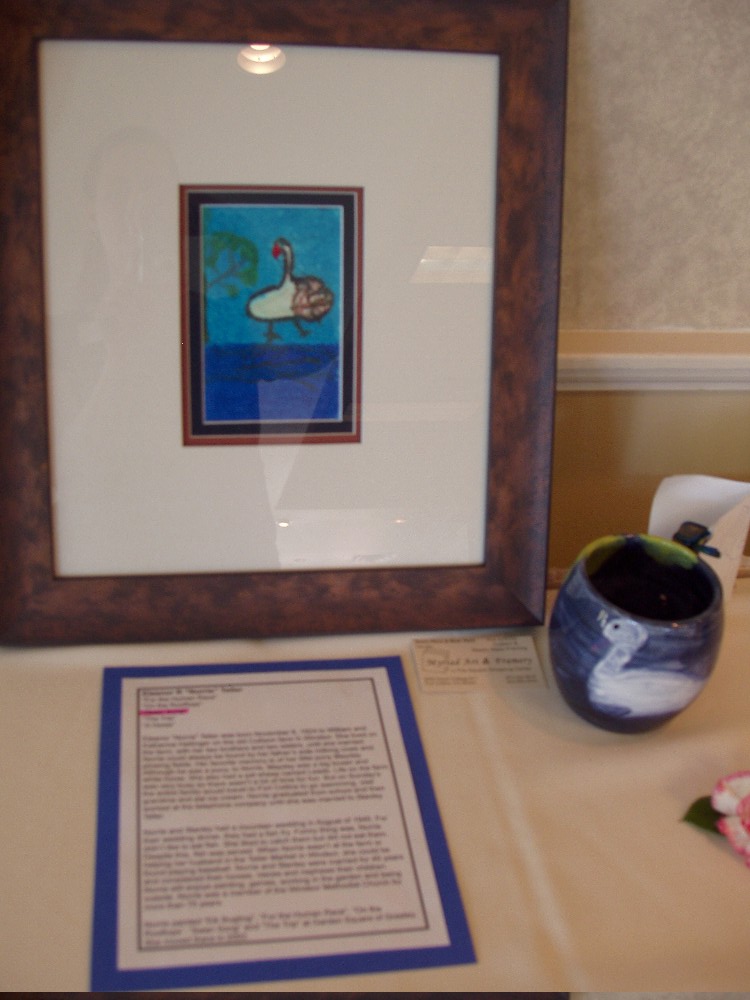
This is my dad's entry for this year.

For the fourth year in a row my dad's art entry has been accepted by the Northern Colorado Memories in the Making Auction. The auction is a fund-raising event by the local chapter of the Alzheimer Association.

Elder Care facilities from all over Northern Colorado have those in their care draw or paint pictures which are then submitted. The idea is that through art, these seniors can preserve some of the memories that are slipping away from them. (Since we live in an agricultural area, there are often farm scenes as well as farm animals.)

The auction is held in June, but as a thank you to all of the artist's whose works were accepted, there is a tea in early May. Artists and their families are welcomed and all of the art pieces are on display. This year there were also mugs pair with each piece. One of the sixth grades in the area was given color photocopies of each piece. The students were allowed to pick a piece that spoke to them and then make a mug to match. This gave the kids a chance to learn more about dementia and the mugs were then given to the artists as a thank you. They were very well done and it was a touching gift. Though the artists themselves, like my dad, may have no interest in or even recognition of the gift, it's a nice momento for the families.

To see pictures that my dad has done for previous auctions, click here.


May 9, 2007

Eyeball Pudding

Description:
This is essentially Large Pearl Tapioca pudding, but in our family it's affectionately known as "Eyeball Pudding."

I've taken the recipe from the back of the Island Large Pearl Tapioca box and modified it.

Ingredients:
1/2 cup Tapioca
4 1/2 cups Milk
2 Eggs well beaten
1/4 teaspoon Salt
1/2 cup Sucanut/Sugar

Directions:
I put the tapioca and a cup and a half of milk into a jar and put a lid on it. (I like to drink out of old Frontera Salsa jars -- the tall skinny ones. So we have lots and I just throw the tapioca and milk into one of those.) Let the tapioca sit over night (in the fridge, so the milk doesn't sour). I try to remember to shake it up once in awhile. As it expands it can get jammed into the bottom of the jar and won't soak up the milk like it should. If it doesn't get all jammed, just take a butter knife to it.

The next day pour the tapioca and milk, and another 3 cups milk, into a sauce pan and heat over a medium flame. Add 2 beaten eggs, the salt and sucanut.

Stir until you start to wonder if you're going to spend the rest of your life stirring that confounded mixture. Right when you wonder that (or within a few seconds of wondering it, at least) you'll start to notice that the mixture is thickening. Keep stirring for another few minutes. The pudding will thicken as it cools.

Pour pudding into bowls and tuck in. (Oh, and the Island recipe says to add 1/2 teaspoon of vanilla before pouring it into the bowls, but personally, I like it better without the vanilla.)

May 6, 2007

Meg and Les


This is me and my dad. He was driving my mom nuts last week when we were at my grandmother's place so I distracted him by snapping photos of the two of us. It worked for a few minutes, at least.

This was the best photo of the lot. It's hard to get a good self portrait when you're leaning in to take it with someone else in another chair. Oh well.

May 5, 2007

saving God's green earth

Rating:★★★★
Category:Books
Genre: Nonfiction
Author:tri robinson

Note to my non-Christian friends: Though this book probably won't interest you, the review might be worth the read. If there's a Christian in your life who is anti- or apathetic to environmental issues, this book might make an interesting (maybe even provocative) Christmas or birthday gift. ;-)


“We cannot be excused when we have not at all considered God in His works. He does not at all leave Himself without witness here. ... Let us then only open our eyes and we will have enough arguments for the grandeur of God, so that we may learn to honor Him as He deserves.” -- John Calvin


John Calvin, Martin Luther, Francis of Assisi, even Saint Paul believed that the natural world is a reflection of God’s own nature. In the first chapter of the book of Romans, Paul writes that “God’s invisible qualities -- his eternal power and divine nature” can be “clearly seen, being understood from what has been made.” In fact, Paul even suggests that perhaps nature is the greatest evangelist, allowing people who may never meet a missionary to see in nature a reflection of God, just as a mirror shows a reflection of a face -- imperfect, but very close to the original none-the-less.

One might think, therefore, that Christians would be at the forefront of conserving and protecting God’s creation. In fact, the second chapter of the book of Genesis says that “God took the man and put him in the Garden of Eden to work it and take care of it.” One could make the argument that man was made with the purpose of caring for the rest of God’s creation. And certainly there are many Christians who have taken that call to heart. They ask questions such as “What Would Jesus Drive?” and they seek to “Reduce, Reuse, and Recycle.” But there are others who feel that environmentalism is either a distraction caused by Satan or a movement started by and for pantheistic earth worshipers (and therefore is something Christians should steer well clear of).

Tri Robinson hits the issue of Christianity and the environment head on. With quotes from many famous Christians (such as the one from John Calvin above) as well as large fistfuls of Scripture, Robinson walks the reader through five key reasons why a Christian should be an environmentalist:

1) God has provided the planet and all that is on it as a resource and provision for humanity. Proper management of this resource must be sustainable, keeping future generations in mind. The planet is a blessing. God made it to be a sanctuary for life and therefore it should be treated with consideration.

2) Nature is "a portrait of God's beauty." In fact, Robinson points out that "it's in nature that we oftentimes see not only the beauty but also experience the real presence of God." To damage this portrait that God has created of himself is to dishonor him and to endanger our own credibility in the eyes of humanity.

3) Caring for the environment can be a means of missions work. Many of those who are hardest hit by environmental degradation are "the least of these." Rather than receiving God's provision through his creation, they suffer without clean water and with ravaged soil -- the results of a misuse of the planet. By restoring the environment, Robinson says, we help to restore "the neglected assurance of God's abundant presence" as reflected in the provision of the earth.

4) Caring for the environment can be a means of evangelism. What environmentalist would take even a moment of their time to listen to the gospel from the lips of an SUV driving, pesticide spraying, disrespecter of God's creation? How much more readily might they be willing to listen when they see that a Christian's faith permeates every area of their life?

5) The renewal of God's creation is the last of a widening circle of renewal that God works in his creation, starting within the hearts of individuals and rippling out through our bodies, our homes, our communities, and the world.

Robinson intersperses each chapter of this book with examples of present day Christians who have felt called by God to take environmental concerns seriously. He understands that there are political and social pressures within the church that can be daunting, but he devotes an entire chapter to encourage the reader to heed God's call to care for the environment. (It's a powerful chapter, in fact, on having the courage to take the first step in obedience to any call which God has placed upon us, not just a call to care for the environment.) The final two chapters of the book provide practical guides for practical responses, first in terms of education and then in terms of taking action.

I have written several short essays on the topic of Christianity and the environment and therefore have given quite a bit of thought to the topic. I was pleased, however, as I read this book that though much of what Robinson wrote was old hat to me, there were also several points that he made and connections that he pieced together that were either new to me, or said in such a different way that they took on a beautiful new nuance. Robinson understands his audience well (He's a pastor of a church in Boise, Idaho.) and is gentle on his reader (who may feel a little panic-y when approaching this topic) and yet he doesn't hold back on his challenge to the reader to take seriously the care of God's creation.

In my opinion, however, this book, while a good place to orient yourself perhaps on *why* you should care for the environment, doesn't go very far into *how* you can care for the environment. Recycling is mentioned several times as well as reusing canvas grocery bags and getting involved in helping the National Forest service in projects. But there is little or no mention of sustainable farming practices, chemical pollutants or reducing our footprint. In terms of what one can *do* to change their lifestyle to make it more earth friendly, there simply isn't that much information. Then again, I don't believe that was the point of the book. As a springboard it's wonderful. As a guidebook from then on out, I'd recommend reading such books as Sidewalks in the Kingdom, Omnivore's Dilemma, or .... well, the list is enormous. (Feel free to add other good books in your reply.)

This book is an easy read and would be well suited to discussion groups. It is full of Scriptural references and may be appropriate therefore for a Sunday School class or Bible Study group.

I strongly recommend other Christians to read this book. If you're not a Christian, but know someone who is (and who isn't environmentally conscious) this might be a great book to hit them over the head with (or you could just get them a copy for Christmas).

April 28, 2007

Custard-Topped Spoon Bread

Description:
This recipe is from the 1997 edition of the Joy of Cooking.

Although it's called "custard-topped," when I make it the custard always ends up in the middle. In fact, when I made it just now, it seems that the whole wheat floated to the top (making a chocolate brown colored layer), the middle was a layer of custard, and the corn flour stayed at the bottom making a yellowish, light layer.

OK, from here on out is from the Joy of Cooking:

In the oven, this quick and easy batter is transformed, as if by magic, into moist corn bread topped with a layer of golden-crusted creamy custard that takes our breath away. Serve it with bacon or sausage for breakfast, or even all alone -- but try this luxurious dish at least once with pure maple syrup.

Position a rack in the lower third of the oven. Preheat the oven to 350 degrees (F). Place an ungreased 8 x 8 inch baking dish in the oven to heat.

Ingredients:
(see below)

Directions:
Whisk together thoroughly:
1 cup all-purpose flour [I used freshly ground hard red wheat.]
3/4 cup cornmeal [I used freshly ground corn -- It came out rather floury.]
1 teaspoon baking powder
1/2 teaspoon baking soda

Whisk together in a large bowl:
2 large eggs, lightly beaten
2 cups milk
2 tablespoons warm melted unsalted butter [Like it could be cold melted?!!]
2 tablespoons sugar [I used sucanut.]
1 1/2 tablespoons white vinegar
1/2 teaspoon salt

Add the dry ingredients to the wet ingredients and stir just until the batter is smooth and free of lumps. Add to the heated baking dish and tilt to coat the bottom:
2 teaspoons butter, softened or melted

Scrape the batter into the baking dish and spread evenly. Set the dish on the oven rack. Pour over the batter slowly, without stirring:
1 cup heavy cream

Bake until the custard layer on top is puffed and golden brown but still quivery and a knife inserted in the center comes out clean, 45 to 50 minutes. [My knife didn't come out clean but it was because the custard clung to it. So I just cooked it until it was set.] Remove from the oven and let stand for about 10 minutes before serving. Serve hot or warm.

February 28, 2007

Vermont Maple-Corn Drop Biscuits

Description:
I took this recipe to a bridal shower this past weekend to share. Somewhere between there and here it went missing. !!!! I was horrified when I realized that today and was utterly relieved when I found that I'd posted it previously on my old website. whew! But I thought I'd post it here now so that my recipes are all together.

source: Biscuits and Scones: 62 Recipes from Breakfast Biscuits to Homey Desserts, by Elizabeth Alston (Clarkson N. Potter, Inc./Publishers) page 15.

Ingredients:
1 cup coarse-ground yellow cornmeal
1 cup all-purpose flour --> [I use freshly ground wheat flour.]
1 tablespoon baking powder
1/4 teaspoon salt
1/4 cup maple or maple-flavor [gag!] syrup
milk
5 tablespoons cold unsalted butter, cut up

Directions:
Heat oven to 425 degrees. Put cornmeal, flour, baking powder, and salt into a large bowl. Stir to mix well.

Measure maple syrup in a glass cup measure. Add milk to the 2/3 cup mark.

Add butter to the flour mixture and cut in with a pastry blender or rub in with your fingers, until mixture looks like fine granules.

Add the milk mixture and stir with a fork until a very soft dough forms.

Drop 1/4 cupfuls of dough 2 inches apart onto an ungreased cookie sheet.

Bake 12 to 14 minutes, until pale golden brown. Cool, loosely covered with a dish towel, on a wire rack.

February 17, 2007

Tamale Pie

Description:
I love Amy's Tamale Pie. So for tomorrow's potluck at church I thought I'd try making my own version of the dish.

I've searched for recipes online and this is the one that I've used the most to base my own recipe off of. But I've made several modifications (mostly trying to draw it as close to the Amy's version as possible).

Ingredients:
2 cups dry pinto and/or black beans
Vegetable stock or water
1 tablespoon cumin
2 cups polenta
4 - 8 cups vegetable stock (to cook beans in)
1 teaspoon Bragg’s or tamari
1 teaspoon chili powder
2 cups chopped vegetables (corn, zucchini -whatever you like)
2 tablespoons tomato paste
1 cup grated cheese

Directions:
1. Cover beans with water and soak overnight. Drain and cover with vegetable stock or fresh water. Add 1 tablespoon cumin and 1 teaspoon chili powder and simmer 2 1/4 hours or until tender. (I covered with 4 cups of veggie stock but ended up adding at least another 4 if not 5 or 6 cups of water as the beans cook but didn't get soft enough. I also ended up cooking the beans for at least 4 hours. Why don't my beans ever get soft enough in the amount of time that the recipes say?!!)

2. Mix polenta and 2 to 3 times as much water. (I used 2 1/2 times as much.) Add 1 teaspoon Bragg’s and a pinch of salt in a saucepan over medium heat. Stir continuously until mixture thickens and all the liquid is absorbed (about 10-15 minutes). The polenta should still be smooth enough to stir fairly easily. Press mixture into sides and bottom of a buttered 9x13-inch baking dish at least 1 1/2 inches deep, saving one-fourth of the amount to drop of spread on top later. (The polenta will harden up as it sits in the pan.)

3. In a separate pan, saute onions until translucent. Add corn, zucchini and any other veggies (or tofu) that you might want to toss in. combine cooked beans (which can be mashed with a potato masher, leaving some whole) with other ingredients except cheese. Cook over medium heat until vegetables are almost cooked. Pour into baking pan and spread evenly. Sprinkle grated cheese on top and spoon on remaining cornmeal mixture.

4. Bake at 350F for 25 minutes.

Serves 6-8.

February 1, 2007

Speaking of Heroes


Bucky rocks.

January 22, 2007

January 21: Chicago


Honestly, why this little snow managed to bring such mayhem is beyond me.

Embassy Suites, Chicago: Monday

We ate breakfast, packed our stuff up and headed out Sunday morning. A taxi took us to the airport. (The taxi driver started out our conversation with, “Can I ask you a rather strange question?” It turns out that she wanted to know the names of any stores that might carry clothes for large women. Her son had gone to New York City for four days and hadn’t found anything, so she wanted to try online but she didn’t know what to look for. -- Speaking of being large. One of Roz’s friends, Bas, had a great line on size He’s originally from Hong Kong and though I wouldn’t call him fat, I’d say he was husky. He said that he goes to Hong Kong, looks around at everyone and says, “God I’m fat.” He goes to England, looks around and says, “God I’m fat.” He’s goes to America and looks around and says, “Yeah! I’m skinny!!!!!!!”) ;-)

The taxi only cost 35 quid. Apparently many taxi services have a fixed rate to the airport. The check in line was rather long and they only let us have one carry on item which ticked Rob off. He’s a regular traveler in the states where the rule is “one carry on and one personal item.” But the check-in gal was having none of that. (However, when we got on the plane later we saw several people with a large bag plus a suitcase as carry on. They obviously didn’t get the same check-in gal that we got.)

The security line was insane. There was a couple in front of us that probably missed their flight because of security.

Then when we got through security, we came out of the grumpy, drab, stressful security area into a world of light and color. It was the duty free shop and it looked like we had just been transported from some East German security checkpoint to some All American department store. It was very odd. And you had to get through the store to get to your flights. (So all those people who were running very late in getting to their flights had to fight their way past dreamy shoppers picking out cologne and bottles of Scotch.)

We got to our boarding gate where we had to go through a 3 point security check again (thankfully we weren’t pulled out for the last point which is where they go through all your carry on bags and check them for drugs, etc.)

Our flight to the States was fairly uneventful. We saw both Scotland and Ireland for the first time (just bitts of the coast as we flew over). And we landed on time at the Chicago airport.

As we were waiting to grab our bags to go through customs we saw one of the suitcases come down the center belt. Our luggage is distinctive not because it’s bright red (that seems to be a popular suitcase color these days) but because we had the kids draw pictures all over the suitcases before we left. We figured that that would not only be a pleasant reminder of them during our trip, but it would also help us to locate our luggage when picking it up. So we waited for that case to get off the center belt, then swing around till it reached us. But it never reached us. I started to get worried that someone else had taken it so I quickly buzzed about to the other side of the luggage carousel only to see a red suitcase heading down a long hallway past a security check point. As far as I could tell, our suitcase had just taken a trip without us.

Rob was pretty upset about it. But I figured that either the person would go to declare stuff and then realize that he had the wrong suitcase, or he’d take it through, not declare anything, and put it back on the luggage check-in belt and it would end up in Denver anyway, since that’s how it was tagged. Our only worry was if the guy was staying in Chicago. So we waited for the rest of our stuff (which took another 25 minutes) and right before we were getting ready to go fill out any paper work we might need to to say that our bag had been taken, there it was coming around the carousel. We’d been watching the center belt so we knew it hadn’t come down from there. So we’re guessing that the guy eventually got to the point where they tell you your gate change information. The people there would look at the tag on your bag and then tell you your gate based on that info. I can just picture the woman looking at the tag and saying, “You’re going to Denver?” and the guy’ slowly realizing that he’d screwed up. How he could grab a bag covered with pictures of kitties, doggies and lizards without noticing is beyond me, but there you go.

We took the train to our terminal and checked a television to make sure we were heading to the right gate.

What a shock. We found that our flight had been cancelled! We tried to find someone who could explain why (it certainly couldn’t be because there was a light snow in Chicago. Nothing was even sticking to the ground.)

After waiting in a couple of different lines, we finally calleda 1-800 number and found out that we’d already been rebooked on a Monday morning flight.

We were quite disappointed that we wouldn’t be getting back when planned. But I kept telling myself that the kids would have been asleep when we arrived and we’d only see them long enough in the morning to send them off to school. So we’re not missing kid time and the main bummers are the expense of the hotel (only $159 and we don’t have to worry about the wretched exchange rate!), the fact that Karen has to watch the kids one more day when she probably needs to catch up on work, and that my mom will have to wake my dad up to come get us. (My dad has been sleeping late in the mornings which is a blessing because it’s just that much less time that my mom has to cope with him.)

So we ended up at the Embassy Suites. We got a free drink in the evening and there’s supposed to be a continental breakfast this morning. And unlike Shendish, the television actually works, there’s a fridge in the room as well as a full length mirror and an iron and ironing board. We don’t need any of these things now, but it would have been nice to have them before the wedding and it’s comforting to be back in a land where these things are standard in a hotel room. It just helps to have a sense that you’ve got your bearings back. ;-)

January 20: Shendish Manor and the Wedding


Shendish Manor: Saturday -- link to Shendish

We slept in till 8, then we snitched some milk from the breakfast bar. (As with most hotels, they didn’t have a whole lot available for breakfast unless you ordered something from the kitchen. They did have some cornflakes, but I had my own cereal back in the room so we just grabbed milk for cereal and tea. Unfortunately they didn’t have enough milk out for anyone to have cereal, even though there were a few boxes of cornflakes out. I suppose cereal isn’t very British.)

We then took a walk down the hill and tried to find the magic round-a-bout so I could take a picture of the sign. Unfortunately we couldn’t find it and later when we passed it by car I realized we had gotten quite close. I don’t think we’ll have time tomorrow morning to catch it, though, since we have to leave by cab at 9.

We stopped in a coin and stamp shop to pick up a gift for a friend and while we were there the shop owner was thrilled to show us bank notes from the US. There were notes from the 1770’s that were Hand Written and had Three signatures on each one! They also had both pounds and dollars listed on them since the nation was switching over. There were some that were stamped from the confederacy, but they were signed and numbered by hand.

There were notes for as little as 3 cents and when we asked the guy about it he explained that all of the metal from the coins would have been needed to make cannons and bullets for the revolutionary war and later the civil war.

We got back to the manor in time to change into our wedding clothes and head down to the lobby to meet the couple that was going to drive us over to the church. After all of the beautiful old churches we’ve been in since we got here, it was a bit of a shock when I saw the church Roz and Alan were going to be married in. I’d say it was probably built in the 60s. Oh well.

During the wedding it was of course interesting to notice the difference between American and English weddings. The biggest difference, I think, was that Roz and Allen had to sign a church register During the ceremony. It’s apparently a big book that everyone that’s married in the church has to sign and it’s considered a legal document by the nation. I can only assume that it’s a result of the union of church and state. When I asked about it, it seems that this is done not only in Anglican churches (the state church) but in others as well. So in that way having a national church seems to also affect the other churches as well. (The whole church and state thing has been a regular topic of discussion between Rob and myself as we meet Christians in England and attend church services here. The Christian community here seems to have an over all rather different feel than the overall church community in America (and granted, that’s a huge chunk that covers many cultures within the church in each nation, but still I think there’s an underlying feeling or sense that is very different between the two).

We returned to Shendish at around 2 (the wedding started at 12) and there were appetizers and drinks available. Unfortunately there were no plates.... (Even one of the serving girls admitted that that was weird.)

There was a walnut and blue cheese paste wrapped in philo dough that Rocked! There was also asparagus, fresh veggies and chicken fingers. And though we saw other people drinking what looked like white wine, all we could locate was the mulled wine. It was good, but mulled wine has so much flavor that I really think it would have been better on it’s own, but I didn’t want to stop eating those lovely walnut pastries -- which presented quite a quandary. ;-)

At 3 we went through the receiving line and headed in for dinner. We started with watercress soup, which was fantastic. Apparently Hemel Hempstead area is known for their watercress (or at least it was back in the day). It apparently grew in a couple of the nearby rivers. (This according to the talk around the table as we ate our soup.)

I noticed, as we ate our soup, that as people neared the end of their bowl, they tipped it away from themselves and scooped out the last bits. Not wanting to be the crass American that tips my bowl toward myself (which is I think how we’d do it in the States, yes? I don’t think it’s just me.) I didn’t tip my bowl one way or the other.

When we finally got our food (turkey, gammon (ham), potatoes and veggies, though I got a puff pastry with mushroom sauce and asparagus since I don’t eat meat) I also noticed that all of the Brits (and the Bermudans) ate with their fork in their left hand and their knife in their right I’d seen that before and even eat that way on occasion when it suits the food (as in, I’ll be cutting it alot). But when I tried eating that way tonight I had a very hard time getting the puff pastry onto my fork. So I finally gave up. June, the vegetarian on my right, managed it just fine. I was quite impressed. She and her husband commented on the fact that we were using our right hands for our forks and said that when they were at a business dinner in the states once, they noticed that the Americans from the east coast ate like they did, but the Americans from the west coast ate like I did. Hmmm, perhaps I should do a poll on this at some point, eh?

I should add, at this point, that there was no clinking of glasses. Not only do I think it’s not a custom here, but since we were in an oddly shaped room, we wouldn’t have seen the bride and groom kiss even if there was that custom here. Oh well. It’s never been my favorite part of a reception anyway.
Pudding (dessert) was either chocolate covered pear, strawberries and pineapple, banana cream pie, or fruit crumble (what I’d call a cobbler). I chose fruit crumble (as did most people, it seems). There was also custard (I think we’d call it vanilla pudding) to pour over it. Again, this was really delicious. (All the food was quite wonderful. I wish they’d publish a recipe booklet for us at the end of the event.)

For the dessert, I noticed that again everyone had their forks in their left hand and this time they had a large spoon in their right which they used to scoop their food onto their forks. Rob just ate his with a spoon and I just ate mine with a fork. We both seemed to do fine with only using one utensil. ;-)

Then they passed out the wedding cake as well as served tea, coffee and champagne. (They scrunched this part all together because serving the meal had taken a bit longer than they had intended.) There was a toast by the father of the bride, Peter. Then Alan (the groom) got up and thanked people while Roz and her nephew handed out gifts to those who had helped out with the wedding. Then James, the best man got up to speak. A friend of his had gone around to all of the tables earlier and taken bets on how long James would speak. I went for 6.5 minutes, knowing from last night that he liked to talk. But when I heard him say that he wasn’t going to talk long because he hadn’t gotten a moment to prepare, I knew my guess had just been tossed out the window. Sure enough, he talked for 8 minutes and Alan (the groom) won the pot. (We had each put in 50p - the “p” stands for pence but people just say the “p”.)

After all that Roz told us that we were free to get a bit of fresh air or do whatever we wanted until 7:30 when there would be dancing. So Rob and I came up to our room (it IS nice to be staying in the same building as the reception) and called the kids. Then I typed most of this up knowing that I wanted to catch those little details like the soup bowls being tilted forward and I’m afraid that all that is going to run right out of my head as I experience all the other things coming up that are going to be utterly different than weddings in the States. ;-)

Shendish Manor: Sunday 2:45 am

(Rob woke me up when he got up to go to the bathroom, so here I am finishing off today’s entry. The wind seems to have come back. I hope it’s not like this when our plane is getting ready to leave later today.)

We went back downstairs in time for Rob to try yet another English beer. This was named after a person (John Smith?) and was labeled “extra smooth” which we decided might mean it’s not quite as hoppy as most of the other beers we’d tried. It turned out to be rather like a lighter version of Guinness.

Alan looked like he only made it through the first dance because Roz was with him, but he looked like he was hoping desperately to escape by the time he was dancing with his mum. Roz, of course, was having the time of her life. Once others joined the dance floor she took some time out to pass out glowing necklaces to any kids that were still around, which turned out to be only two young ones who were coaxed out to the dance floor. (OK, so it didn’t really take much coaxing.)

There was a cash bar and later another room was opened with snacks and tables to sit around and gab. The snacks were all very greasy, which fit with what we’d been told earlier by one of Roz’s friends. After drinking a lot people like to stop off at KFC or something like that for something a bit greasy. It seemed like a recipe for disaster too me, but what do I know?

After chatting with some more folks, Rob and I snuck off to pack up and get ready to go. (I’m an introvert, remember. So hanging out with that many people that I don’t know for that long gets a bit draining. Everyone was very nice to us, though.)

Instead of packing, however, I ended up reading the newspaper. ;-) The “Big Brother” show seems to be a hot topic this week. Also there was a horrid article about a serial killer in Vancouver.

I’m rather bummed that Shendish doesn’t have wifi. Being up in the middle of the night is a perfect time to catch up on multiply surfing. But considering that tomorrow is going to be a long day (we get to live 7 hours twice), I probably should try getting some sleep.